

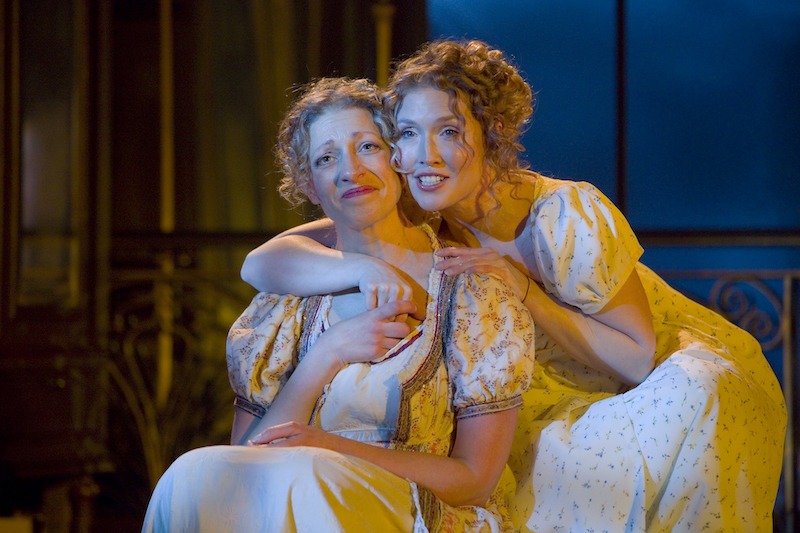
Writer: Jane Austen
Adaptation: Abigail Pickard Price, with Sarah Gobran and Matt Pinches
Director: Abigail Pickard Price
It is a truth universally acknowledged that a good book, in possession of a large readership, must be in want of an adaptation.
Jane Austen’s Pride and Prejudice has been adapted for the stage several times before, whether as a “straight” adaptation (e.g., Simon Reade’s for Regent’s Park Open Air Theatre in 2016) or as a comedic reinterpretation from the servants’ perspective (Pride and Prejudice* (*sort of), currently touring).
Abigail Pickard Price’s adaptation for Guildford Shakespeare Company falls somewhere between these two stools. Primarily, it relies upon the sly wit and loving satire of Austen’s 19th-century prose for its humour, delivering a largely faithful run through the tale of the Bennet sisters’ romances and marriages. But it also finds time to exploit that this world is populated by a large array of Regency characters. It is portrayed by just three people and they mine the humour to be had therein.
Initially, the Austen style of humour takes centre stage. GSC cofounder Sarah Gobran’s Mrs Bennet captures the essence of the demanding matriarch, which Luke Barton ripostes with a bone-dry performance as her husband. Their interplay sets the foundation for a script that knows how warm and rich Austen’s dialogue is when left well alone.
Beside them, April Hughes as the headstrong Elizabeth must often play the straight woman to other shenanigans. That said, she does get to play several other roles, most notably the Bennets’ neighbour Mr Bingley, who turns the head of Lizzie’s sister Jane (Gobran, who also plays Bingley’s sister Caroline).
That dual role, in which Hughes must shift frequently between Lizzie and Bingley in the same scene, is the first occasion where the small cast size is mined for humour. However, the adaptation remains faithful in the first act. This involves substantial transformations from Barton, creating distinctly vivid characters from the stoically aloof Mr Darcy to the unctuousness of the Bennetts’ distant cousin, Mr Collins. That sense of transformation is heightened when Barton is also called upon to play Darcy’s aunt, the ostentatious and haughty Lady Catherine de Bourgh, in Act II.
The second act is more determined to mine the actors’ need to play multiple roles. Whereas dance scenes are populated by the actors holding hats to portray other attendees, other scenes require multiple switches between roles. In introducing Darcy’s Derbyshire home of Pemberley, Barton plays the estate’s housekeeper and every portrait of a Darcy family member. Similarly, a dinner party scene involves all three actors switching between multiple characters in quick succession, with the aid of hastily donned and removed costume additions to help clarify who is who.
But even with such silliness, it is never to the detriment of the play’s determination to deliver Pride and Prejudice with the utmost fidelity. There is no wet shirt swimming, as in the renowned BBC adaptation; and the most significant turnaround in Elizabeth and Darcy’s occasionally volatile relationship comes, as is so often the case with Austen, as the result of Lizzie reading a letter rather than from a re-enactment of its contents.
And that is all to its credit. While Guildford Shakespeare Company has created a chance to revel in quick-change comedy, it remains a joyously faithful adaptation of one of literature’s best-loved novels. It achieves its goals so well that one is tempted to wonder why anyone would attempt a stage adaptation with a larger cast ever again.
Reviewed on 11 March 2025
