

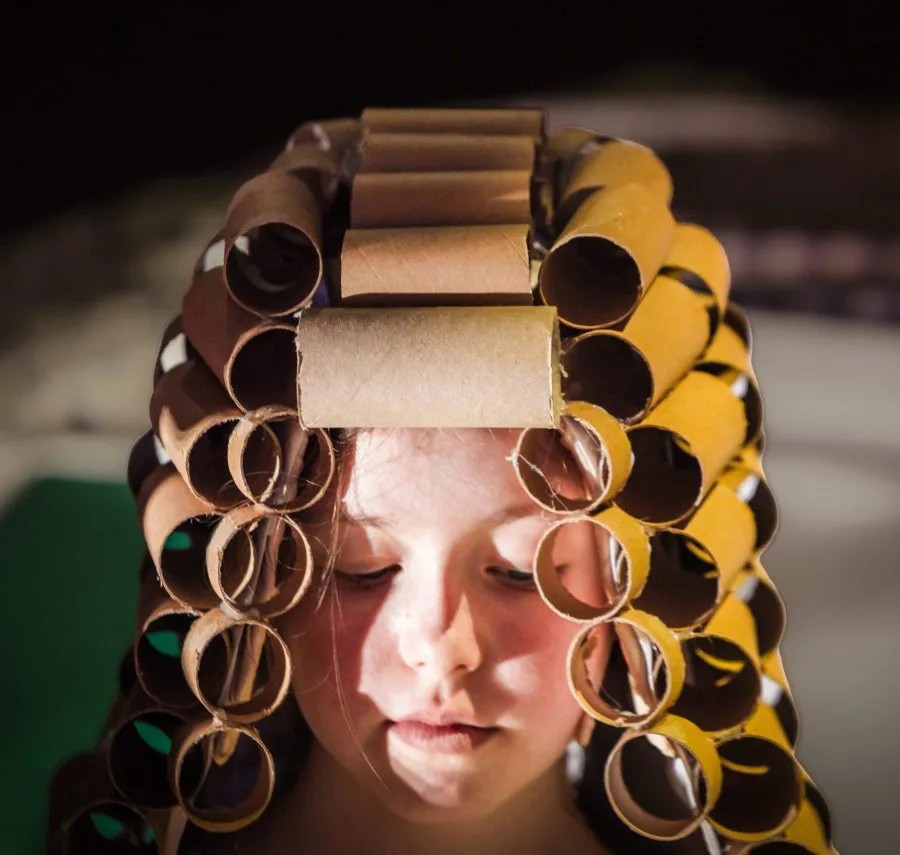
Concept and Direction by: Samara Hersch
What was your favourite childhood story? If you could rule the world for 18 minutes what would you demand? What did you dream about last night?
PowerPlay is a mesmerizing, unique and precocious Polish piece of intermedial theatre, that elevates children’s theatre and pushes the limits of our wild imagination.
The ensemble consists of 8 members; four adults and four children, but in this context it feels wrong to define them as adults or children due to the youth the adults portrayed and maturity the children radiated. So from here on in they’ll be referred to as senior actors and junior actors respectively.
The performance is split into three parts each exploring different levels of jurisdiction. The first sequence is a retelling of the children’s story “King Matt the First” where a 10-year old prince becomes King and attempts to put in place his childlike desires for the kingdom. The design is playful and thematically accurate as costumes are too big and props are made from everyday utensils like a crown out of cutlery. But it doesn’t seem right as the young prince is played by a senior actor…This takes us into the second sequence when the kids abruptly stop the children’s story, strip the set and take over with 15 minutes of pure improvisation where they can tell the senior actors to do whatever they want. In this particular performance that involved the senior actors doing jumping jacks, a member of the audience leaving the auditorium to buy the junior actor snacks and the senior actors playing hide and seek in the audience. Praise to the live transcriber of the subtitles trying to keep up with translating these bizarre demands. The final sequence was a complete transformation as we’re taken to this serene sand dune, where the ensemble tell us what they’re dreaming about.
For the first and third sequence there is an innovative use of live camera and video onstage. The use of digital theatre in projection and screening throughout the performance can have multiple interpretations. While it may be used as another medium to aid the engagement of a younger audience’s attention span, creatively, it could be seen as a way to express the power of the imagination and inner workings of the mind. In the first sequence we see the workings of the fairytale “King Matt the First” onstage within this patchwork blanket fort, we see an operator controlling the camera which displays onscreen this playful and absurdist mini play. When the junior actors take over there is a glitch in the screen and a countdown appears displaying the remaining time of the improvisation. This flip in authority changes the trajectory of the play as in the third and final sequence both actors operate the camera, with the footage being projected on a sheer sheet. This portrays the similarities of the mind between children and adults and how we all have the power of dreaming for the same thing, love, family and safety.
PowerPlay explored the dynamics of the inner child within adults, what happens when we let children control adults and how rushed maturity can treat children. Seeing this generational bond occur onstage both fictionally and not was extremely refreshing to the eye and added an extra layer dissecting childhood education and how we raise children to adults. It expresses that all in all, we co-exist and influence each other on a much deeper level. Director Samara Hersch’s divisive structure of the three sequences makes this matter easily accessible and entertaining with moments of immersiveness and interaction alleviating this environment of community and harmony. The scenic design transitions from vibrant and colourful fairytale, to barren space to ethereal landscape kept the audience engaged throughout.
PowerPlay bends the definition of children’s theatre, creating theatre appropriate for all age groups and exploring the power dynamics we experience everyday. It’s riveting to see Dublin Theatre Festival giving international theatre productions the opportunity to perform in Dublin and thus the chance for Irish audiences to experience such a high standard of diverse theatre.
Reviewed: 3rd Oct 2026.
