

Writer and Director: Nelicia Low
One might have hoped my bronze medal in fencing would give me some insight regarding Pierce from Nelicia Low, a professional fencer turned writer/ director. However, it turns out the film is more about deception than sport.
As a child Zi-Jie (Liu Hsiu-fu) is rescued from drowning by his older brother Zi-Han (Tsao Yu-ning) to whom he, naturally, becomes devoted. The sentiment is not shared by their mother Ai Ling (Ding Ning), a glamorous widow and nightclub singer, who maintains Zi-Han was calmly watching events unfold and only took action when she raised the alarm.
Zi-Han kills an opponent during a fencing completion and his claim it was accidental is not accepted in view of his championship expertise at the sport. Ai Ling constructs an elaborate fiction to explain her son’s absence to her amiable beau Zhuang (Lin Tsu-Heng) and, when his release date from gaol nears, arranges for Zi-Han to reside in the country arguing city living is expensive. Zi-Han does not cooperate and watches his brother, who is struggling with fencing, from the side-lines. Zi-Han begins to coach Zi-Jie and not only in sport. He is the only person to ascertain his brother is gay, although deeply in the closet, and offers advice on how to sweet talk fellow pupil, Hui (Rosen Tsai). Zi-Jie’s confidence in both fencing and his sexuality grows but events begin to spiral out of control pushing towards a climax.
In fencing the faces of participants are concealed behind protective masks making it impossible to determine emotions and identity. In Pierce the characters constantly hide the reasons for their actions. Zi-Han torments his mother by gate-crashing her fiancé’s family dinner and elaborating and expanding on the fabrication his absence is due to studying medicine at the prestigious Johns Hopkins University so as to cause discomfort to Ai Ling who is terrified the truth might come out. Yet Zi-Han is sincere in trying to help his brother, being the only person who takes seriously the conflict Zi-Jie is experiencing about his sexuality and offering support in an understated manner.
By comparison Zi-Jie’s deceptions stem from the innocent desire to help, or avoid humiliating, other people. He conceals his sexuality to avoid embarrassing his mother and safeguards Zi-Han by keeping his presence in town secret and stealing to provide him with funds. Significantly, it is only when Zi-Jie ignores Zi-Han’s advice to flatter and begins to tell the truth- admitting to his potential boyfriend he does not share his musical taste- his conflicted emotions begin to resolve.
Zi-Han is an enigmatic character. There is considerable evidence – a number of accidents occur when he is fencing- to suggest he is sociopathic. But then there is also evidence to the contrary proving accidents do happen: Zi-Jie is injured during a match and one of the opponents wounded by Zi-Han admits he was not wearing protective gear. To the closing moments of the film Zi-Jie is looking for opportunities to give his brother the benefit of the doubt. Perhaps the most damning sequence in the film is when a young child sees through the emperor’s new clothes and, upon meeting Zi-Han, declares him ‘’scary’’ and bursts into tears.
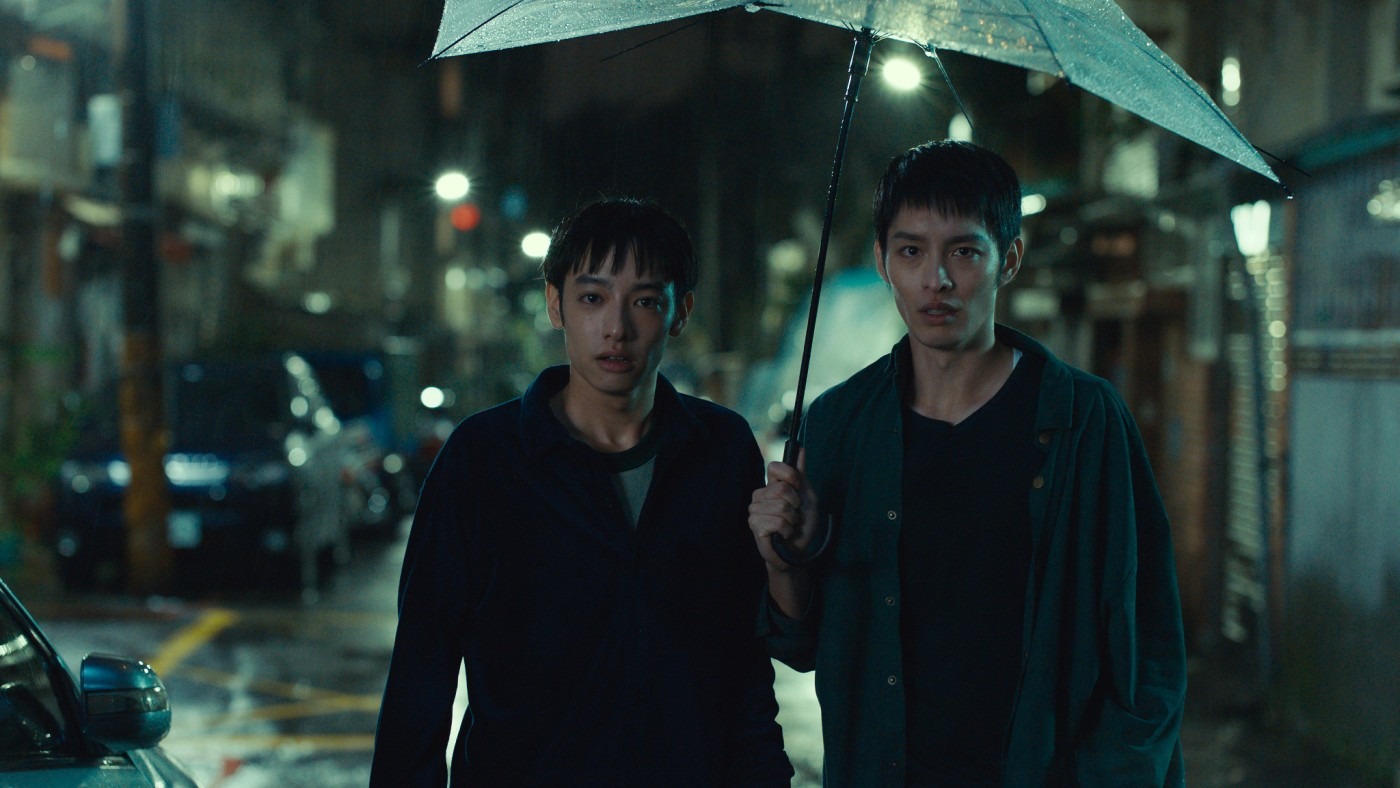
The meetings between the brothers are clandestine – taking place in dark corners with whispered conversations. They resemble lovers in a shameful relationship which accords with Zi-Jie’s reluctance to be honest about his sexuality. Significantly when Zi-Han proposes a celebration he takes his brother to a gay bar as if to encourage him to be more forthcoming.
Tsao Yu-ning is classically handsome with high cheekbones but is a closed book -his eyes give nothing away-whereas Zi-Jie’s sexuality is apparent to the viewer Zi-Han is remote, asexual. . By contrast, Liu Hsiu-fu wears his heart on his sleeve or, more accurately, his expressive face which is constantly tear-stained and anguished.
Pierce is a film in which tension develops gradually yet in the final sequence all restraint is lost. There is a sudden shift to extreme violence and an act of self-sacrifice by a character which is hard to understand or justify unless regarded as paying off a Karmic debt.
Pierce uses the thriller format as an unusual way of telling a coming-of-age/coming out story. Aided by excellent performances the approach is largely successful although the sudden shift towards the end is puzzling.
Pierce screens at the Barbican on 14 May for Queer East Festival 2025
