

Music: Goi Ywei Chern
Director and Librettist: Mayra Stergiou
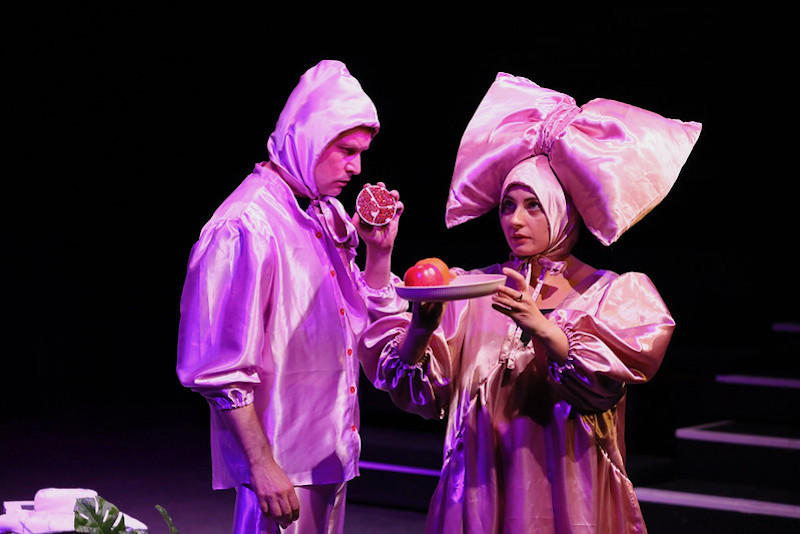
A woman in a white, almost Pierrot costume walks down from a seat at the side of the theatre carrying a Swiss Cheese plant and starts to sing in a Slavic-sounding language that isn’t English. It later transpires that she is Orpheus, but not as we know him. The programme notes – not that this is obvious from anything said, sung, or happening on stage – that he and Eurydice have spent the last 20 years in the underworld. In this version, Orpheus has forgotten why he is there, and lives with Eurydice ‘in their grave as if it were a small apartment’.
Then a film at the back of the stage commences, which includes a close-up of an egg being boiled in slow motion, followed by a caption about promoting economic growth. A succession of unconnected images continues for the rest of the piece, including someone washing their hands, some teazels in black and white being blown by the wind, pictures of the moon – along with mystifying references to a second moon – and a model of an eyeball, as well as passengers on the tube, and a group of houses in the middle of the countryside.
This piece calls itself a dark comedy but is distinctly short of laughs. The performers (including Alexandra Achillea, Benjamin Press, and Claire Monique Martin) are well drilled and utterly committed, and their earnestness seeps into an audience, which is baffled by the sheer and resolute unintelligibility of what is going on. There is also something of an overwhelm, as the stage action and what the singers sing and declaim have to compete for the audience’s attention with the film and a soundtrack, in which electronic music is interrupted by vaguely totalitarian slogans, along with references to things like the Ministry of Perpetual Administration. It’s meant to be surreal but ends up as incomprehensible rather than fun. It wisely stops after about 50 minutes.
It’s all rather a shame and something of a wasted opportunity, as there is some talent and a lot of dedication on show here. Goi Ywei Chern’s music – featuring piano ostinato against vocal melisma – can be moderately beguiling, but on this evidence is not remotely operatic. The piece, playing at The Cockpit’s Tête à Tête Opera Festival, might be trying to say something about a world in which we are saturated by disconnected images, but its point remains elusive.
Reviewed on 10 September 2026
