

Book, Music and Lyrics: David Cumming, Felix Hagan, Natasha Hodgson, Zoë Roberts
Director: Robert Hastie
Operation Mincemeat began life as a scratch performance in a studio at The Lowry, Salford, in 2017. A co-production with the New Diorama Theatre followed, and from that 77-seat fringe beginning the show has travelled to the West End, to Broadway — collecting an Olivier Award for Best New Musical, three Tony nominations for Best Musical, Best Score and Best Book along the way — and has now embarked on an international tour. No mean feat for a debut musical. Currently running simultaneously in London and New York while the tour plays out, it arrives at Wolverhampton Grand with 100 five-star reviews to its name and what the company bills as the status of best-reviewed show in West End history.
The story is drawn from one of the Second World War’s most audacious deception operations: British intelligence’s plan to fool the Nazis into believing the Allied invasion would target Greece and Sardinia rather than Sicily, by planting false documents on a dead body floated ashore in Spain. The identity of that body — eventually confirmed as Glyndwr Michael, a Welsh vagrant who died in London — sits at the heart of the show’s emotional theme. Operation Mincemeat is very funny, often absurdly and incongruously so, but it never loses sight of the people whose names history forgot: the scientists, the secretaries, the intelligence officers working in the shadows, and the man who had no say in the matter at all, yet all delivered with comic flair.
SpitLip — the collective of David Cumming, Felix Hagan, Natasha Hodgson and Zoë Roberts, who share the book, music and lyrics — has written a show that is cleverly put together and extremely witty. The script is sharp, with a gift for the perfectly-timed absurdity: a pause held a beat too long, a look exchanged across the stage, a line that arrives from an unexpected angle. Robert Hastie’s direction draws maximum comic effect from these moments without overplaying them. The writing has been tightened since the show’s early incarnations — some plot elements refined, some numbers reshaped — and the result is a production that moves with real precision.
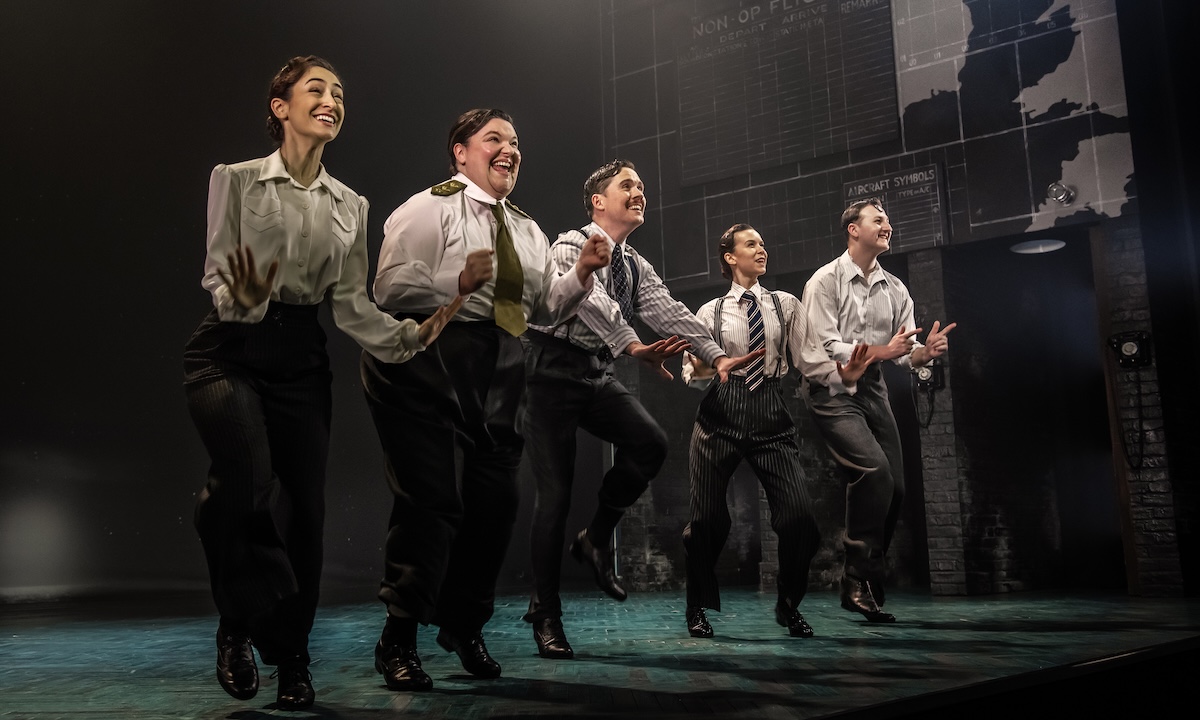
Ben Stones’ set is deliberately simple: a collection of pieces shifted in full view by the cast, each element doing multiple duty as office furniture, a naval vessel, a Spanish shoreline. A roll-down image transforms a panel; a hand-lettered sign reframes a scene. The costume changes are equally economical and generate comedy of their own — a moustache whisked away behind a newspaper becomes a new character entirely; a raincoat dropped mid-number signals a scene change before the audience quite registers it.
The five-strong cast carries the show’s multiple-roling with ease. Men play women, women play men, and the cross-gender casting is handled not as a statement but as a comic device that the show deploys with cheerful self-awareness. Holly Sumpton’s Ewen Montagu is all clipped English superiority, the kind of man who assumes competence is a birthright; it’s a beautifully judged comic performance that somehow remains likeable throughout. Christian Andrews’ Hester Leggatt — the secretary whose quiet efficiency underpins the entire operation — carries the show’s most affecting moment, the song Dear Bill, which cuts through the comedy with a sudden, genuine tenderness. Seán Carey’s Charles Cholmondeley is the introverted scientist whose genius is inversely proportional to his social confidence, and Carey finds the humanity beneath the awkwardness without sentimentalising it. Jamie-Rose Monk and Charlotte Hanna-Williams complete the company, both handling the show’s demands with considerable skill and comic timing.
The score is consistently entertaining — catchy, witty in its lyrics, and cleverly varied in tone. Sail On Boys delivers the stirring ensemble number the genre almost requires, and the finale arrives with glitz. sparkle and its own bit of visual humour. But the show’s musical intelligence lies in knowing when to step back from the comedy: Dear Bill, for example, carries its emotional weight precisely because the surrounding material has been so relentlessly funny.
As well as the comedy, what stays with you, though, is the more serious argument behind the jokes. Operation Mincemeat is ultimately a show about the invisibility of contribution — the idea that history records the outcomes but rarely the people who made them possible. Glyndwr Michael did his bit without ever being asked. So did the secretaries and the tea-makers and the minor functionaries whose names never made the files. SpitLip’s achievement is to make that point land not through solemnity but through laughter, and then through the quiet that follows it.
It’s had a lot of hype on its journey, and it’s worth every bit of it.
Runs until 21 March 2026 and on tour
The Reviews Hub Star Rating
-
10
