

Writer: Malory Blackman
Adapter: Sabrina Mahfouz
Director: Esther Richardson
Noughts and Crosses is one of those books that defines a generation. First published 25 years ago, it would be hard to find a millennial adult today who hasn’t read it. It was adapted by the RSC in 2007, and again in 2019 by Pilot Theatre. The 2007 show is a straight adaptation. The 2019 show is a little more abstract. The 2026 tour unfortunately uses the latter script.
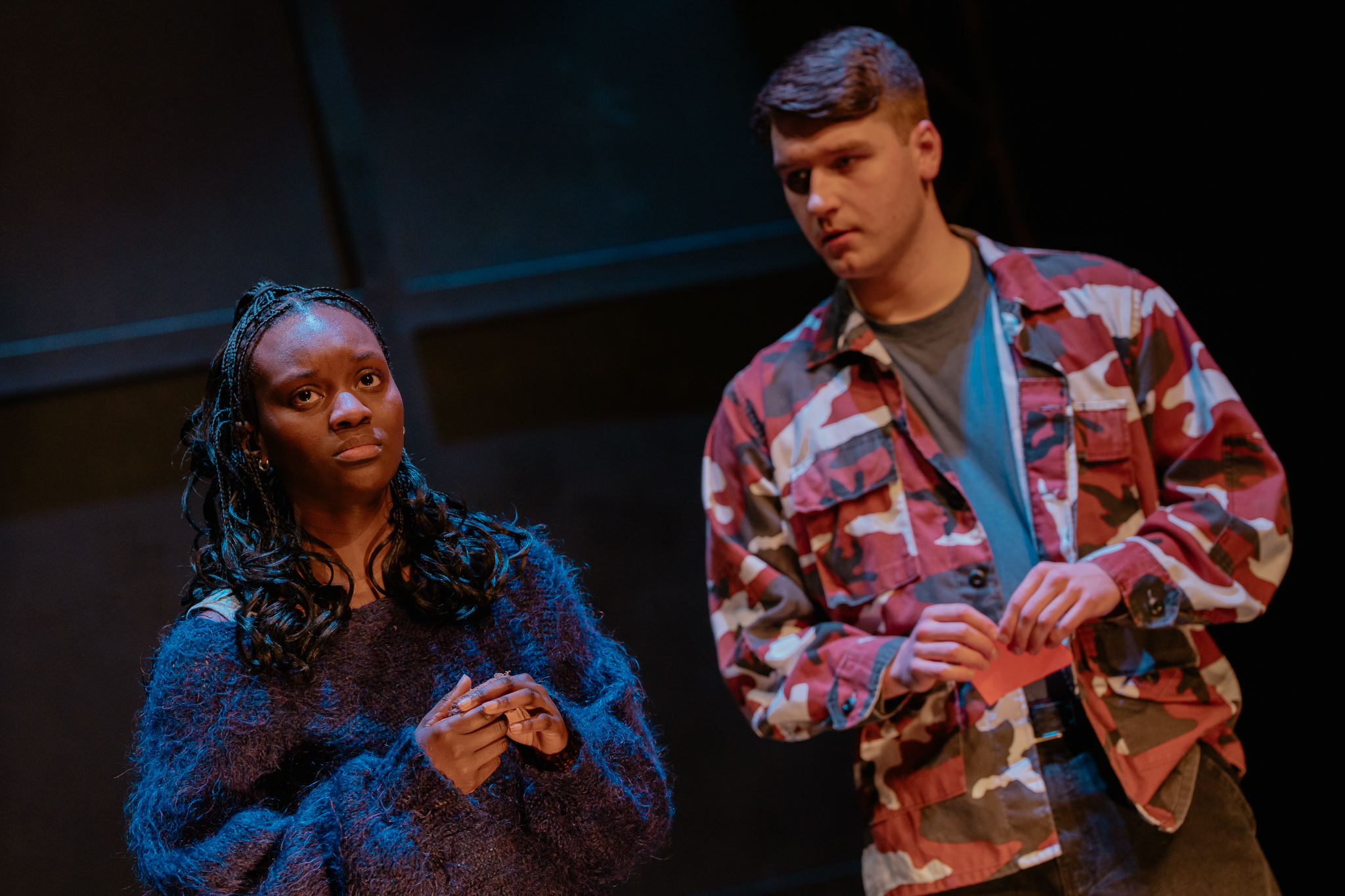
Sephy Hadley (Brianna Douglas) is a Cross, the black skinned leaders of society and the upper class. Her best friend Callum McGregor (Lewis Tidy) is a Nought, the Caucasian underclass, with no rights and no hope. Themes of segregation, terrorism and prejudice are at the forefront of the plot as we cover four years of their young lives. It’s a race flipped view of societal expectations around power, a ‘what if’ with a harsh outcome, full of pain and heartache. It’s a story with so much to say about how we view and treat the people we see as Other, and one that is sadly still all too relevant today when politics seems set of dragging us back to the dark ages, and with a wider range of people who might be seen as our Noughts.
The show is trying very hard to take all these big topics, and to make them accessible to its younger audience members. This means a lot of the story is told via emotional, slam poetry inspired monologues. Your mileage will vary on how effective that is. It breaks down to a lot of telling not showing. Sephy and Callum talk a lot about things they have done or events that occurred, but it’s few and far between that the audience actually gets to experience anything with them, especially in act one. Six other cast members multirole through a variety of supporting characters, so the world is being built up around the pair, but it does seem like a few extra bodies might have been a good idea to fully flesh it out. When they do it’s great – a bombing scene told through physical theatre is excellently effective even if the use of this is awkward in other scenes; the moments of stage combat are wonderfully slick; and the actors are talented when they’re allowed to verbally interact. But there’s also an issue with commitment to the emotion – while Tidy is shouting all his lines, a lot of the time the emotions of other characters are flat and restrained. Arrests, hangings, discoveries of family secrets – everything just feels slightly dulled. Douglas does well at making Sephy feel engaged, but in the first act has a high squeaky voice which does little to endear her to the audience despite her obvious acting ability. Fintan Heyeck who plays Jude is bristling with anger, but so quietly spoken that his intensity is easy to dismiss as inexperience. It smacks of either insufficient direction, a bad script, or a show that the actors are tired of performing.
Visually however, Noughts and Crosses is a treat. The set (Simon Kenny) is a dominating wall of boxes and screens and illuminated tables which all move around to create locations. Projected news updates are used effectively, although it would be nice to be able to see those on a bigger scale. The lighting (Ben Cowens) is atmospheric, creating divides between the sides and intensifying scenes with the use of shadows and up-lighting. The two hanging scenes feel large in both scale and significance. The costumes (Kenny) are dominated by the colour red, presumably the Cross colour, although it would have been good to see a competing Nought colour as the show progressed.
It’s not that Noughts and Crosses is a bad show. The cast are talented, the look is cultivated, and the plot is pacey. But it is let down by a muddled script which too often falls back on monologues, and direction which favours overly dramatic standing around and whiffs the action scenes. Turn everything up by 10% and even that could be overcome. It is obvious that the creatives are trying to appeal to the teenagers in the audience, and so they should, but they should also trust that those young people don’t need everything spelling out, as it ends up feeling a little amateur and GCSE. This is an important story, and maybe this version of it is more suited to schools and colleges where the style might be more forgiven.
Runs until Saturday 23 May 2026
The Reviews Hub Star Rating
-
5
