

Writer: Martin Crimp
Director: Christian Lapointe
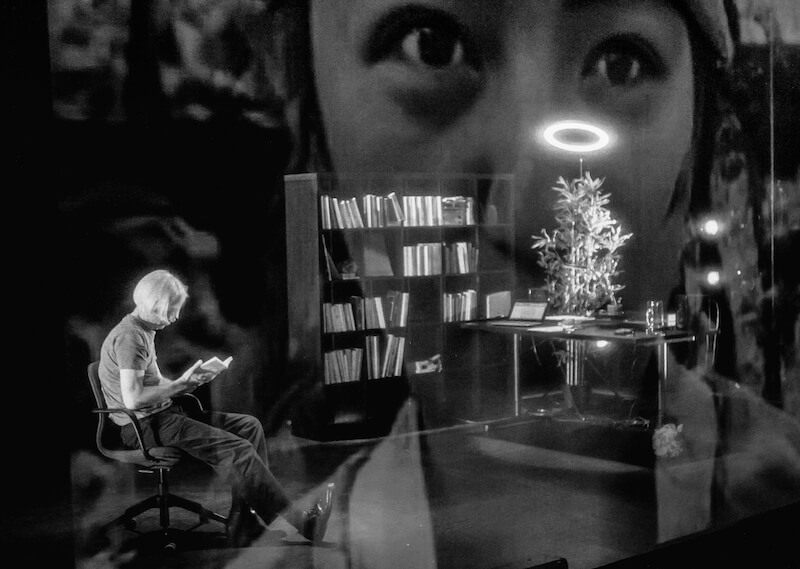
On the right side of a bare stage stands a high-tech lectern, with mysterious illuminated rings and everyday ordinary iPad. There is a screen across the stage. A voice comes from the theatre’s speakers and a still photograph of a face appears on the screen. An explanatory caption informs us that the faces have been generated by Artificial Intelligence and none of them are of real people, which may well be true, but the faces are bland and neutral, and taken from a folder labelled ‘diverse’ – all ages, ethnicities, genders, are represented. The voice is Martin Crimp’s, and he is reading, it transpires, 299 statements.
The statements could come from vox pop interviews or from books or from Martin Crimp’s imagination. After about 20 minutes, the pictures are slightly animated, with shifting gazes and lifting eyebrows. Martin Crimp appears at the lectern and starts reading in person, he turns on the lectern-tech, the animation becomes more active and is modelled on his facial movements. After a while he leaves the stage, and appears behind the gauze screen. The animation of the faces continues. He puts on his shoes, he puts on a record, he gets up, the screen flies out, and he reads statement 299 off a sheet of paper. The show ends.
It’s all a bit mysterious, and quite a lot Uncanny Valley; some of the statements recapitulate points made previously in front of a different image. Some of the statements could have come from Brief Interviews With Hideous Men, the short-story collection by David Foster Wallace in which a series of men confess to appalling behaviour without recognising any personal responsibility. Some of the statements could have come from Caryl Churchill’s Love and Information, which employed a similar mosaic technique to talk about alienation and technology.
Both the Wallace and the Churchill works have a cumulatively eloquent effect, but Crimp seems to want to avoid having his statements add up to a Statement. The changes, from unanimated to animated, from a recorded voice-over to live speech, from standing stage-right to sitting behind a gauze in a set that resembles a study, don’t seem to impact on the statements’ meaning or emotional resonance; they’re just a different way of illustrating Martin Crimp reading a lot of statements. It’s all a bit puzzling.
There are some funny moments – statements about high-concept physics associated with the picture of a small child gets a laugh. There are some statements of bad behaviour – dropping slates off a high building onto a crowded pavement, a driver saying he likes to shut his eyes while driving on the motorway – and a number of statements involving sexual politics and racial prejudice, that elicit reactions from the audience. There are a number of unexceptionable statements, about blue skies, about pretending to be Russian for fun, that elicit a generally benevolent response, but the sum total is bemusing. Bemusing and not terribly illuminating. And while Martin Crimp may have a reputation as a great theatre-maker, he probably won’t be mistaken for a great actor.
The technology (which goes uncredited) to superimpose a live actor’s expressions on a projected image is striking, though on film the glitches can be edited out, and on stage they can’t. The statements are quite varied in content, though the single voice makes that less telling. The cumulative effect is disorientating, which is probably the intention. Martin Crimp has dramatised 90 minutes of mildly intriguing, mildly disturbing snippets of conversation, that may or may not be real, staged in an unusual but not wildly dynamic fashion. The snippets may add up to a statement of significance. Or they may not.
Runs until 5 November 2022
