

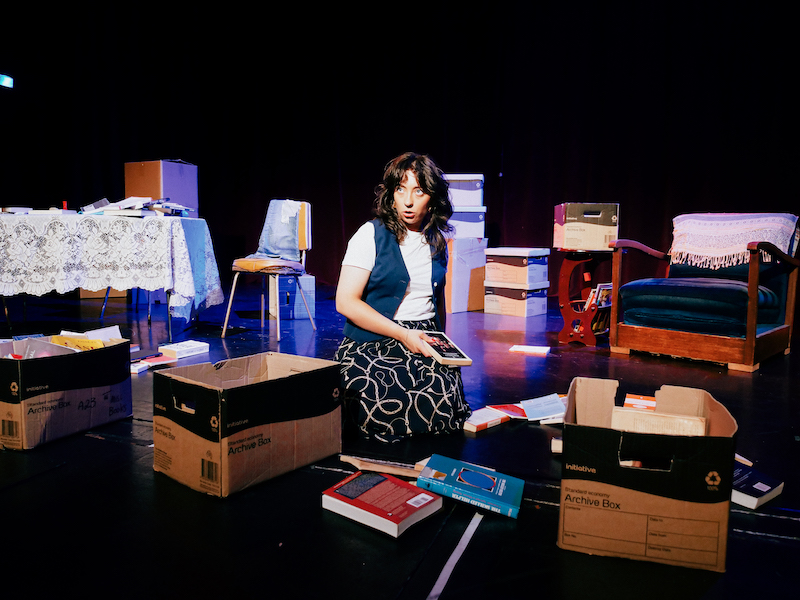
Writer: Beth Paterson
Director: Kat Yates
Shadowy family histories can be difficult to confront, and none more so than those leading back to humanity’s darkest hours. It’s with bravery then that Beth Paterson (writer and performer) digs deep into the life story of her grandmother Niusia, her struggle to survive Auschwitz and the horrors of the Holocaust, in a solo show that reaches for great heights but often fails to reach them.
Core aspects of the show have plenty going for it; Paterson is a charming performer who easily pulls us into her own life story and how her views on Niusia have gradually shifted from the unpleasant old woman she knew as a child to a hero who went through Hell and lived to tell (or more pointedly not tell) the tale. Lighting (by Sidney Younger) is also used to great effect, keeping the audience well on track with a narrative that jumps across years and voices at a second’s notice.
Beyond this core, though, the show stumbles, often seeming to change its mind about what its themes are as it flicks between Paterson’s story, her rediscovery of her heritage, Nisuia herself and the larger world of Judaism. It all feels like a rich tapestry that might really come together in one big moment, but this moment never comes, many punches feel pulled, and the story strands remain separate.
This may be due to fairly consistent fourth wall breaks, where Paterson informs the audience at multiple junctures that they can leave at any time if the play is too distressing for them, or that it’s ok to laugh at her jokes even if they do touch on sensitive topics. These add little, and the show could do with spending less time anticipating its own impact and more time actually delivering it, as often there’s a failure to inspire the same emotions that we’re being told it’s ok to feel.
The other notable stumble is that a large portion of the show relies on Paterson interacting with her own mother through voice-overs, where snippets of Niusia’s past are shared, and her own view on life is offered. It’s an inventive inclusion that allows the play to become a kind of multi-generational dialogue, so it’s a shame then that the audio quality of these voice-overs is so poor, featuring a lot of distracting background noise that can shatter the delicate atmosphere Paterson skillfully builds on-stage.
Come the end, the show again breaks the fourth wall to become strangely self-congratulatory as Paterson lists off the many people the play has impacted. Once more, this does a disservice to the narrative told and feels like a recent addition to the play that adds nothing and only takes away. Too much of the show is like this, with important subject matter fumbled and the core narrative side-lined. Fingers crossed, then, that future iterations of the show can lose these weaknesses and double down on its strengths.
Runs until 23 May 2026
