

Writer and Director: Brian Foster
Brian Foster’s Myra’s Story began life as Maire: A Woman of Derry in 2002, drawn from street people Foster knew in his home city. Rewritten and renamed in 2009, it has since become something of a theatrical phenomenon — four Edinburgh Fringe runs, a West End transfer, and a touring production that has now reached over 150,000 theatregoers across Ireland, the UK and North America. Its return to Birmingham Rep, this time stepping up from The Door to the main House stage, feels like a natural progression for a show that has quietly grown into one of the most significant pieces of Irish theatre currently on tour.
The premise is deceptively simple. Myra McLaughlin sits at her pitch by Dublin’s Ha’penny Bridge, begging. What follows is the story of how she got there — a childhood marked by trauma, an early marriage to Tommy, a baby son Daniel, the slow unravelling that drink accelerates and circumstance compounds. Foster’s writing is clear-eyed about causality: this is not a story of weakness or fecklessness, but of ordinary life tipping, incrementally, into crisis. He is equally clear-eyed about how society responds — or fails to. The instinct to look away, to avoid catching someone’s eye, is woven into the fabric of the piece, and it gives the play a moral argument that extends well beyond its Dublin setting.
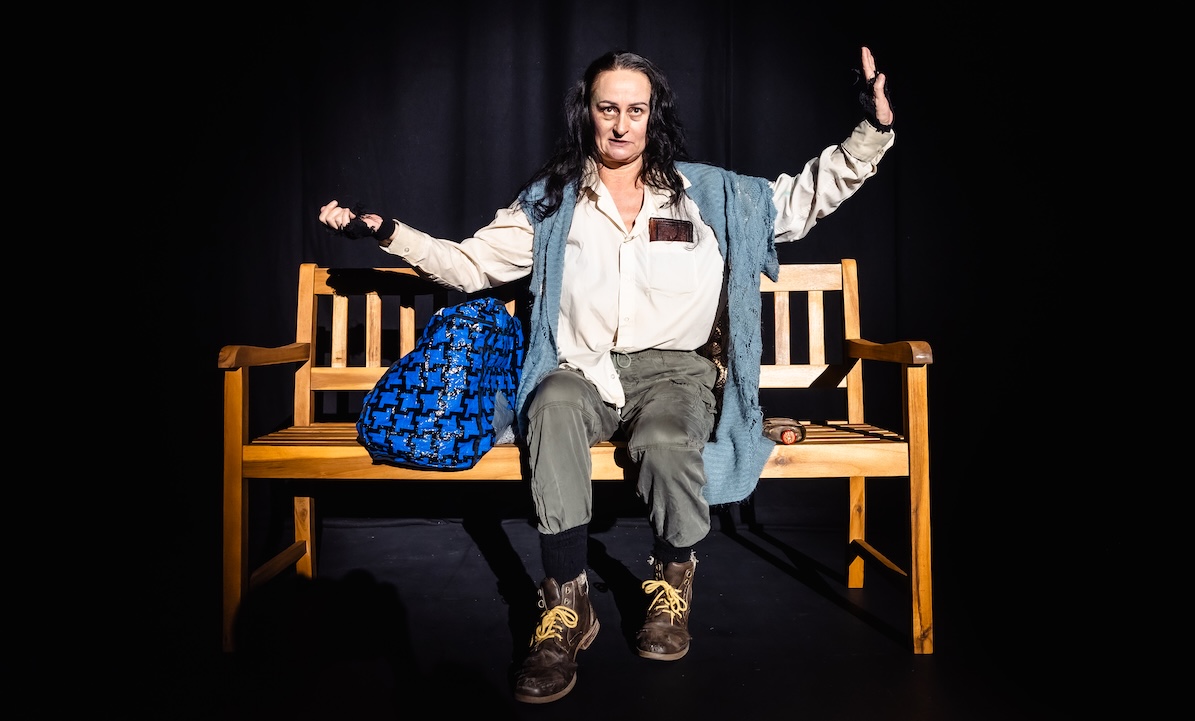
None of it would work without Fíonna Hewitt-Twamley, and her performance here is exceptional. She carries the piece entirely alone across ninety minutes, on a bare stage with nothing but a bench, playing Myra and more than fifteen supporting characters — family, neighbours, strangers — each individually rendered through shifts in voice, posture and rhythm that are precise enough to be instantly recognisable and sustained long enough to feel fully inhabited. Tommy and Daniel, the priest, Bridie: all emerge as distinct presences. There is no blurring between them, no reliance on the audience’s goodwill to paper over under-differentiated characterisation. That Hewitt-Twamley remains entirely believable as Myra throughout — dishevelled, restless, quietly desperate — while simultaneously inhabiting a dozen other lives, is a considerable achievement. It is, in the truest sense, a tour de force.
The structural conceit tracks a single day, and the interval arrives at a moment that earns it: Myra sings, collects her coins and heads for the off-licence. Whether the faint echo of Danny Boy in Daniel’s name is intentional or coincidental, it gives the break an understated resonance. The second half is darker, the accumulation of losses heavier, and Hewitt-Twamley carries that shift without ever tipping into melodrama.
At the close, Hewitt-Twamley steps briefly out of the play to address the audience directly. “It’s not just a play, not just entertainment,” she says — and the observation lands not as a rebuke but as an extension of what the preceding ninety minutes have already established. With nearly 300,000 households in England experiencing acute homelessness in 2024 — a 45% increase since 2012 — the play’s quiet argument that what separates the audience from Myra is less than they might assume feels all the more pointed.
Myra’s Story is a mature, humane and thoroughly compelling piece of theatre, delivered by a performer at the height of her powers.
Reviewed on 15 March 2026 and on tour
The Reviews Hub Star Rating
-
10
