

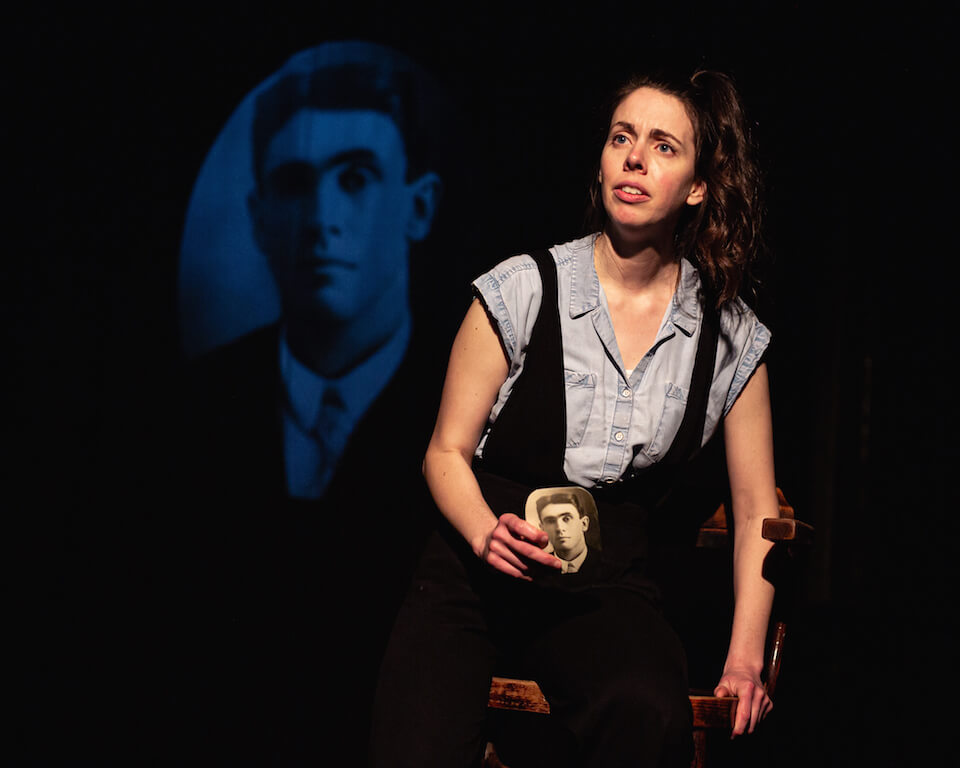
Writer and Director: Carolyn Hartvigsen
Do you know you dead? This is the provocative question around which Carolyn Hartvigsen has built her new one hour monologue exploring ancestry and the ways in which family history tends to repeat itself. Working across several generations over 200 years, My Dead is part Who Do You Think You Are?, part rom com as the writer explores how her own romantic present and desire for family has been informed by the ancestors who experienced similar burdens of love and grief.
My Dead began as a student project, part of LAMDA’s LiveLab initiative to connect with theatre via Zoom during the pandemic, and Hartvigsen’s 25-minute play was the result. Now expanded into a piece of more than double the length, the writer-director performs the original production in full, before noting where it concluded as part of this longer performance, breaking the fourth wall to connect with the audience.
Structured around a series of letters and memoirs written by members of Hartvigsen’s family tree, these are incorporated into the overall story as a way to understand the writer’s present, a process triggered by the death of the grandmother she felt distant from, cutting between time periods in both her own life and those of her antecedents. Hartvigsen plays all of these people herself, from Ann alone in 1904 Norway writing to her daughter in celebration of a wedding to a son-in-law she will never meet, Ella in 1940s Mexico who prioritises education over marriage until she meets a widower with eight children who she weds aged 40 and two men called James Jardine, a father and son who bury their wives before they are ready and live with the grief.
And it is death that connects them all, along with questions about second marriages, polygamy and what happens on the other side when husbands and wives are reunited. In fact, Hartvigsen could make some of these connections far stronger and more explicit, drawing more direct links between these similar experiences across time as well as with her own romantic troubles. The themes here of losing a partner too soon, living with the grief and contemplating taking or being a second spouse are areas not well explored by theatre and there is room to grow this piece into a more structured conversation about the universality of that.
Hartvigsen is a warm and engaging performer, making the show seem like a chat over a cup of tea. But these feel like separate stories used to inform Hartvigsen’s own romantic encounter with a bereaved Frenchman that ended after three months. But, in spite of her pain, it is not easy for the audience to equate this with the scale of her relative Elena’s grief, losing her husband to an accident after 26 years of marriage and 12 children and why the writer makes this comparison.
Love is all very well but it would be more interesting to reflect on what all of these relations felt about each other and how their own choices were reconciled within the wider family story. What do we tell ourselves about those who came before us and how have family histories been shaped by the eccentric and unusual as much as the ordinary and sensible choices that individuals made. My Dead is filled with lots of incredible people who struggled and suffered and somehow made it through their lives with or without the ones they love. So in the midst of all this history, what does it mean to be a Hartvigsen now and what kind of person does that inspire the writer to be?
Reviewed on 4 March 2023
