

Writer: William Shakespeare
Director: Kay Brattan
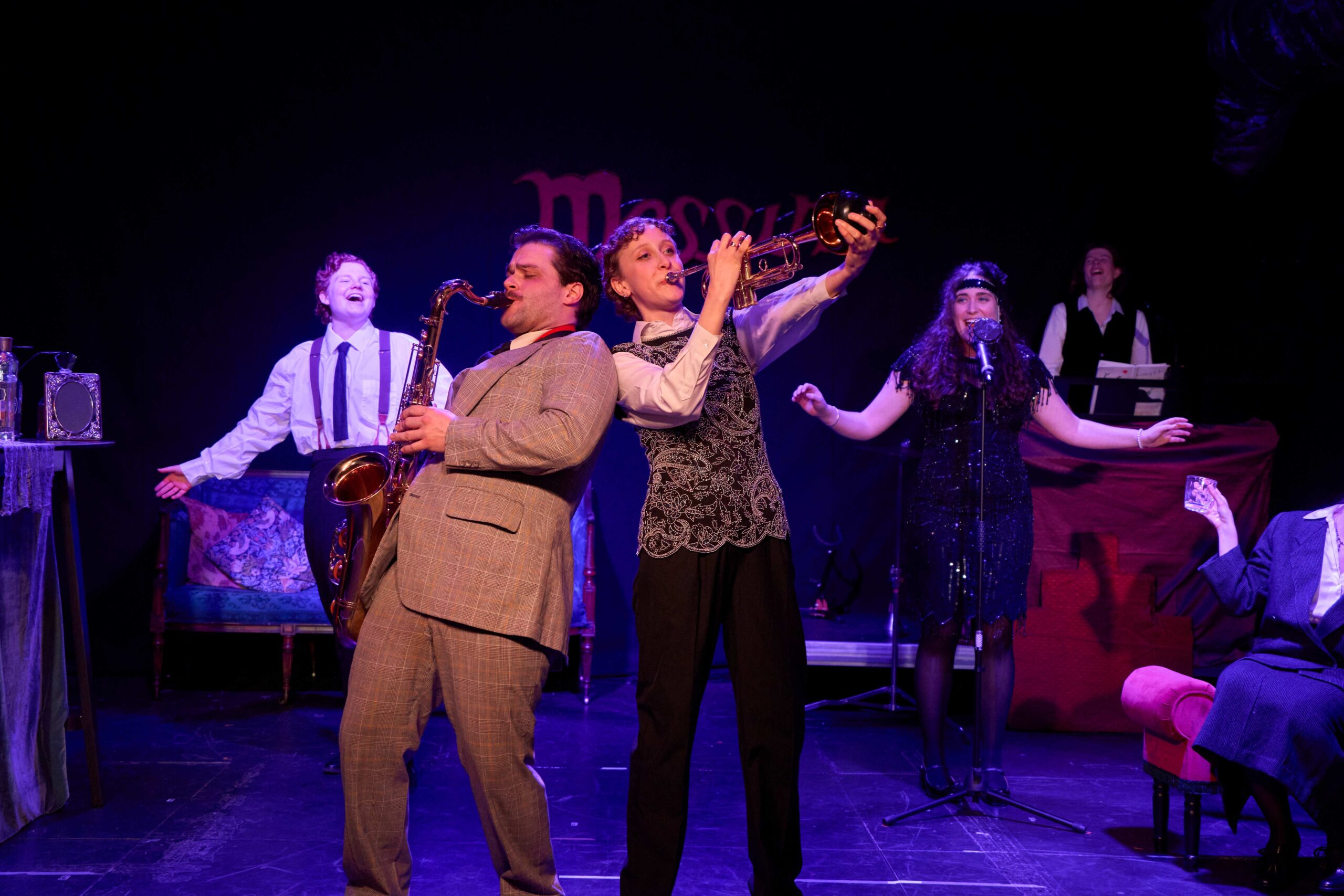
A bartender greets audience members as they arrive. There are crystal decanters, flapper dresses, a stylish bar, a silk-upholstered sofa, live music… The relocation of Much Ado about Nothing from sixteenth-century Sicily to 1920s Brooklyn fits both the Arches Lane theatre’s own subterranean vibe and the number of Americans among this young cast. Messina is no longer a city, but an underground speakeasy, the alcohol-soaked setting for playful, subversive entertainment after the horrors of war. The story begins as a group of soldiers return from battle, looking for laughter and love.
Leonato, local governor and father of eligible bachelorette Hero, becomes Señora Leonata, Hero’s mother and owner of the Messina nightclub. Oihane Rodrígue plays Leonata with passion and dignity, while Jaelon Love is her sweet, warm-hearted daughter. The gender switch makes Messina a matriarchy, but also messes up a few lines of poetry as “man” becomes “woman” (or, on just one occasion, more sensibly, “dame”). The new setting is a great excuse for glamorous costumes, jazz and liberation, but doesn’t always harmonise thematically with the script.
When a production promises an “adaptation”, it can mean vandalising the original play. Thankfully, Shakespeare’s text survives here relatively intact apart from the introduction of Sonnet 30 (“When to the sessions of sweet silent thought / I summon up remembrance of things past…”) at a crucial moment to give the often-wordless Hero a voice. Dramaturg Maira Vandiver plays Leonata’s niece Beatrice and is mesmerically watchable, switching from fiery disdain during her “merry war” with Benedick (well-matched Brendan Peloubet) to icy fury as events unfurl. Peloubet is almost equally adept in tracing Benedick’s fast-changing trajectory from drunken joker to more earnest lover.
The play’s darker moments are enhanced by Finn Harkin’s perfectly-pitched Claudio, swept up in a rollercoaster of love, jealousy, anger and guilt. These believable emotions are slightly at odds with the pantomimic tics of Medi Persis as the villainous Don John. With his hollow laughter, winking at the audience, and veering from hostile monosyllables to fake charm, it seems amazing that his brother Don Pedro (Ian Chapman Black) fails to see through John’s evil schemes. But perhaps that’s the point: the soldiers’ inherent misogyny makes them easy prey?
This production bills itself as a queer reading of the play, and there are some interesting shifts of dynamic, but they don’t always work. Vandiver’s Beatrice, elegant in silk trousers and jacket and a series of similarly fabulous costumes, has an androgynous power, and her relationship becomes a true meeting of equals. Song Marshall is a beautifully convincing and nuanced baddie-with-a-conscience as Don John’s sidekick Borachia. But making this role female means “Hero” is seen with a woman on the night before her wedding. Given that same-sex friends often slept together platonically in Shakespeare’s world (“I have this twelvemonth been her bedfellow”), it feels as though this might not have the same impact on Claudio as seeing her with another man.
Borachia’s lover, mistaken for Hero, is actually Margaret, a role given rare strength and vitality by Eva Voss. In this production, she also takes on lines that originally belong to Leonato’s brother Antonio, meaning she gets to whip out a knife and start threatening people. Bar-tending, flirting with both men and women, rivalling Beatrice in her runaway wit, she is a force of nature.
Much Ado can often flag when the comedy policemen arrive halfway through the play. But Oliver Lyndon is an excellent Dogberry, bumbling master of the watchmen. Despite the role’s attendant slapstick and malapropisms, this is a surprisingly human Dogberry. Jack Tivey plays his elderly sidekick Verges with full Dad’s Army energy.
Kay Brattan’s conscientious direction balances the play’s emotional extremes. Costume designers Saffron Jay-Brooker and Marianne Vandiver have created authentic-looking WWI uniforms, graceful dresses, masks for the party scene. They keep ringing the changes as funerals become weddings and gender norms are challenged. Visual designer Carl Maslowski and lighting designer Ciara Moss give the Messina bar a warm, inviting feel.
The songs work well in the relocated setting. Sigh No More, arranged by Catty Tucker and sung by Molly Wolff, morphs from soulful ballad to foot-tapping dance number. Elsewhere, the music and dancing can feel a little underpowered and occasionally, cast members fumble their lines. The play’s interpretation is patchy, but there are outstanding moments here of both drama and comedy that make this 1920s Much Ado a watchable and engaging show.
Runs until 4 April 2026
