

Writer: Virginia Woolf
Adaptors: Kit Green and Jen Heyes
Director: Jen Heyes
As novels go, Mrs Dalloway is not exactly a laugh riot. Virginia Woolf’s 1925 stream-of-consciousness novel focuses on Clarissa Dalloway, an upper-class woman in post-World War I London preparing to host a party. In a parallel story, former soldier Septimus Warren Smith struggles to deal with the aftermath of his wartime trauma.
And so, when Kit Green takes to the stage dressed as Clarissa and starts cracking jokes with the audience, it comes as a bit of a shock. But Green is quick to reassure us that her humour serves to balance some of the work’s harsher moments. It surfaces, too, during the actual story retelling, as Green’s version of Clarissa’s servant, Lucy, chatters and commentates in an anachronistically modern tone (Woolf’s novel, timeless as it may be, makes no mention of delivery boys with e-bikes on zero-hours contracts).
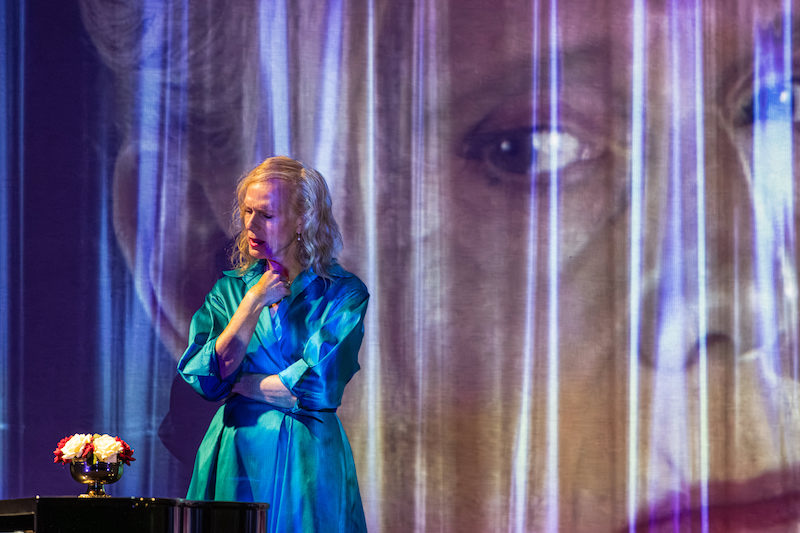
More generally, though, Green immerses herself in a faithful solo retelling of the work. The interiority of Clarissa’s thought processes suits Green’s monologuing skills perfectly, Woolf’s prose working well when delivered orally. Green wanders in front of and occasionally behind a translucent screen on which Monika Koeck’s beautiful video designs are projected.
Those same projections also help to portray some of the other characters in Woolf’s novel. Green plays them all, from Smith and his worrying Italian wife Lucrezia, to Clarissa’s former suitor Peter Walsh. It is the sequences with Smith, unsurprisingly, that provide some of the play’s deeper moments, flash frames of the trenches crashing in to haunt the soldier’s post-traumatic torment.
Green’s instinct for cabaret performance shines during a particularly haunting scene as Septimus is taunted by visions of a disconsolate clown (again played by Green). One is somewhat dismayed that this performance is captured on screen rather than played out live, but it’s acted and shot so well that it feels just as intimate as an onstage performance would.
We get some breaks from the story, with Green returning as herself to perform some original songs and even play party games with audience members. While there is an air of silliness about these story breaks, there is a further point to them: that Green, who has adapted the work with director Jen Heyes, finds the immersion into the author’s mind a scary process – she is, literally, afraid of Virginia Woolf, and the humour is as much a counterpart to that as to the novel’s themes and events. Such moments might work slightly better were Green less visibly uncomfortable about being a version of herself rather than any of the other characters, but some hesitancy in her crowd work lends an air of intimate camaraderie with the audience.
The second act revolves almost entirely around Clarissa’s party, at which attendees include Walsh, her husband Richard Dalloway, and her former love Sally Seton (now a peer’s wife with five sons). The projection screen fills with multiple characters, all played by Green. The interactions between them are shot and edited with care to imbue a sense of natural dialogue, even as the compositing against flat backgrounds deliberately underscores the work’s artifice.
There is a segment of the party where all the attendees give confessional monologues to camera, as if they were participants in an episode of Real Housewives of Belgravia, that doesn’t work anywhere near as well as the rest of the work. But that is largely beside the point. Far more important is how the news of Septimus Smith’s suicide ripples through the attendees, and how hearing of the death of a soldier she never knew impacts Clarissa.
Those elements are, importantly and correctly, handled by Green’s live performance. Indeed, throughout the video, projections feel like a complement to Green’s onstage presence, enhancing and magnifying it while avoiding the risk of distraction. This is an audacious version of Mrs Dalloway that dares to transform Woolf’s work into something far different to the original novel. In doing so, Green and Heyes point us to all the elements that, though published 100 years ago, cry out to us as all too contemporary.
Runs until 20 June 2026
