

Writer: Liam Holmes
Director: Michael Nero
“It was an act of God. I find that hard.”
Mr Jones movingly and engagingly lays bare the agonies of Aberfan after the town’s 1966 sliding coal tip disaster. There’s little concern around spoiler alerts here. Almost everyone’s heard of the notorious tragedy: 116 children at school assembly killed by the fast-moving debris, piled up for expediency by the National Coal Board on land riven with springs, swollen by autumn rain.
Many were made aware by The Crown, which devoted an entire episode to the incident and the crass treatment meted out to the bereaved. One of the Queen’s greatest regrets was delaying her visit to the shattered town by several weeks. Those unfamiliar with the story happening in Mr Jones are given the chance to read all about it in comprehensive programme notes.
So the challenge here for first-time playwright Liam Holmes is how to structure the story in a new and diverting way. He’s done this by presenting it through the prism of a close relationship between two optimistic, playful townspeople in their late teens.
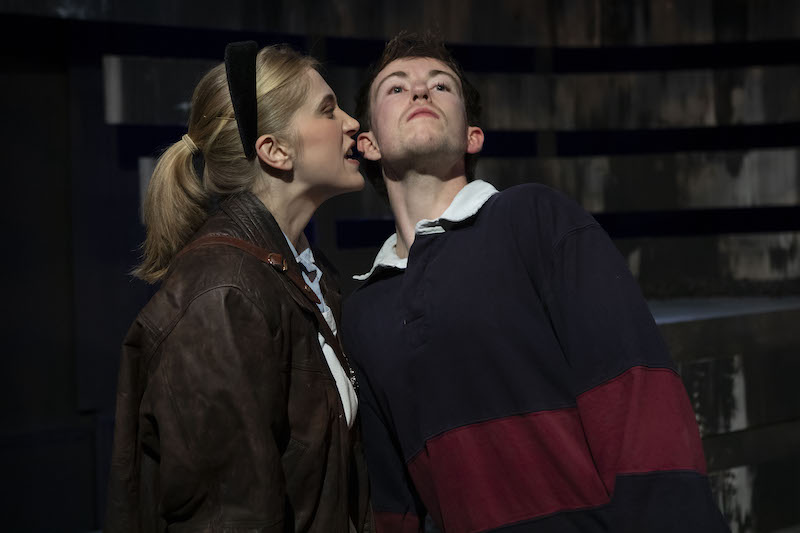
A local himself, Holmes grew up surrounded by echoes of the disaster, which propelled his conviction that it was well worth revisiting. He’s wisely cast himself as central character Steve Jones, just 17 and elated at his recent winning kick that’s propelled Aberfan into the regional rugby semifinals. Bright-eyed and overly confident, he’s looking forward to a promising future in the sport, and sets out to impress fetching nurse Angharad Price (Mabli Gwynne) by staging his triumphant penalty kick for her on the ominously sodden town rugby ground.
Beautiful, composed, and cleverly comedic, ‘Ang’ is out to bring Steve down a peg or two – “Alright macho, pipe down” – and it becomes clear that they’ve been affectionately sparring without actually committing to anything (beyond the odd smooch and cwtch: Welsh hug) for a long while, during which their family lives have become variously intertwined.
The trouble is, Ang has aspirations, and perceives that Steve has few beyond the next rugby match. He teases her about her attempts to anglicise her accent and deploy long, educated words like ‘hypothetically’. She’s threatening to leave for Australia, or at the very least, Cardiff. And he’d miss her, because he “loves her to bits”.
The action skips back and forth from happy-go-lucky pre-slip to agonised, chaotic mid- and post-slip, with Steve attempting to share his trauma with team mates, family and Ang. Given the static minimalism of the set (a stylish curve of evocatively grimy slats that allow for the infiltration of moody lighting), it’s tricky, occasionally, to figure out the temporal phase of any given scene. Perhaps more pub-based or outdoor background noise might help, but Holmes does a good job of making sense of his half-iterated conversations, and the audience rapidly cottons on.
It’s actually a relief that there isn’t a straightforward chronological arc from happiness to tragedy and mourning: that would have been far too predictable. As would an attempt to replicate the avalanche itself: a few ominous rumblings and the players’ shocked reactions are enough. The use of soundtracked local voices and views is also judicious: the pain-steeped lines, like “An entire generation wiped out”, are particularly poignant.
The action in the hospital, as Ang triages injured children, could perhaps be more anguished and hard-hitting, although in that situation, an actual nurse would probably be just as cool and level-headed. It’s Steve that’s left to crumble, and it’s the scenes in which he valiantly attempts to contain his grief and continue to socialise with his team mates that are the most affecting.
By contrast, the humour is at times reflexively laugh-out-loud funny, especially in the ‘will they / won’t they’ dialogue between Ang and Steve. Her put-downs are brilliant, as she wrestles with her attraction to what Steve might be, and what he seems satisfied to remain: an Aberfan lad working at the family bakery with the weekends enough to satisfy his passion for rugby. The play clearly exhibits how the tragedy warped the future trajectories of all Aberfan dwellers, leaving them too mired in shock to move on, or keen to completely remake themselves elsewhere as an antidote to trauma.
Conveying all these themes is a tall order in a mere 80 minutes, but Mr Jones covers sufficient ground to offer new perspectives on the situation without leaving the audience too wrung out. The dialogue is at times a little rushed – those not used to the Welsh accent might struggle to keep up – but there are regular pauses for much-needed contemplation.
Holmes has done well to couch the piece in appropriate 1960s vocabulary, although the American self-help phrase ‘living the dream’ sounds a little too modern. And there could perhaps be more references to other contemporaneous events, although maybe the lack of these helps to accentuate the over-familiar intensity of small-town life.
Most importantly, this is a genuinely heartwarming and heartfelt piece that helps to perpetuate the memory of what happened in Aberfan on that fateful October morning, as well as the terrible, enduring consequences for everyone involved.
Runs until 22 November 2025
