

Writer: Franz Xaver Kroetz, translated by Simon Stephens
Director: Ross Gaynor
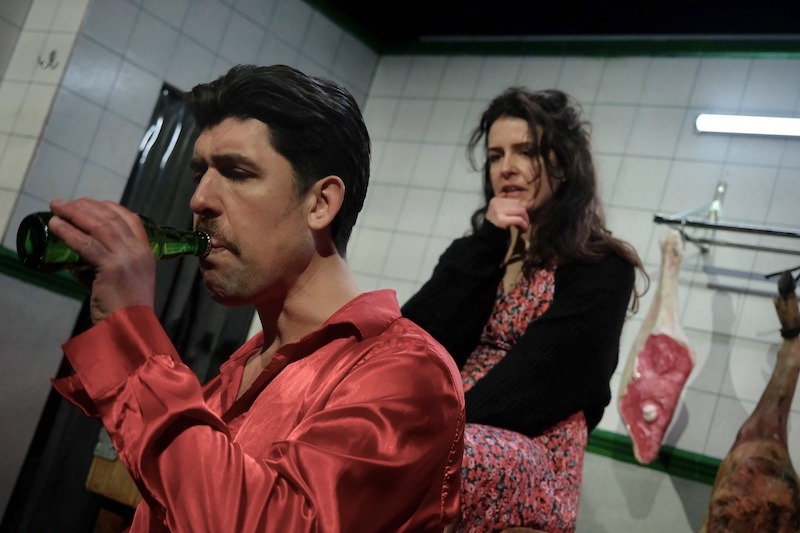
Franz Xaver Kroetz’s 1972 play, in a new translation by Britain’s Simon Stephens, is a nasty take on the battle of the sexes. A female butcher and a male welder embark on a loveless relationship, the action being moved from Germany to somewhere in Ireland. As Victor demands more of Charlie, the end of Men’s Business seems inevitable, especially with all the knives and cleavers hanging on the wall. In fact, the blades are red herrings, but blood will certainly be spilt.
Victor is an old-school man, unreconstructed in every way. He reads pornographic magazines shamelessly, but because they are expensive, he limits himself to a new one per week. Charlie seems only to like him because there’s no one else on the horizon. She’s inexperienced in the way of the world and defers to each of his requests, including stripping naked at the very start of the play after they have perused one of his girlie mags together.
Neither of them appears to enjoy the sex they have and when Charlie complains of pain, Victor bluntly informs her that she has had an orgasm. It’s unclear whether Charlie believes him, but this doesn’t stop her from trying to please Victor. She gives him caviar; promises him the finest veal steak. He continues to tell her that she’s unattractive and that every sexual encounter will be the last.
Both are jealous; he of her dog that he’s convinced licks her inappropriately, and she of the other women he may or may not be seeing. He whips the dog, locked in a room nearby, when it howls. She brings beers to her butcher’s shop in an attempt to get him to stay. Their jealousies, especially his, lead to a horrifying scene about two-thirds in. And after, it never gets any prettier.
It’s easy to see why Stephens was drawn to the play as its examination of toxic masculinity is something that he explored in Motortown, first staged at the Royal Court in 2006. Danny, the soldier who returns from Basra to find an England utterly changed, is a more complex character than Kroetz’s Victor, but both men enjoy the power they have, and think they deserve, over women. Both men are also competitive, with Danny revelling in his knowledge of capital cities and his ability to do one-armed press-ups. Victor’s competitiveness leads to the chillingly absurd final moments of Men’s Business suggesting that neither man nor woman is the winner.
Written in the middle of the wave of Second Wave Feminism, Kroetz’s play, of course, feels somewhat old-fashioned. There’s a sense here that for women to be liberated, they should play men at their own game, something that Germaine Greer, in her Second Wave Feminist work, The Female Eunuch, warns against. Women have to be free on their own terms, not looking to imitate men.
Men’s Business is a tough watch and particularly tough for the actors. Lauren Farrell plays on this discomfort with her Charlie being vulnerable at all times, her desperation to be less confused palpable in the way she looks at Victor as he or she undresses. Rex Ryan’s Victor is arrogant, challengingly staring out at the audience as he strips down to his Y-Fronts. However, behind this machismo is the sense that Victor is unsure of the male identity that the world has thrust upon him. At times, Ryan is almost robotic, like the women in the original Stepford Wives, another Second Wave Feminist text, although, rather meek and subservient like them, Victor struts and marches with Hard Man muscle memory.
The two actors are briefly joined on stage by Charlie’s dog (here played by Cooper, a 10-year-old German Shepherd). His fleeting presence forms the only chink of light in this darkest of plays. Andrew Clancy’s set is suitably dreary and Ross Gaynor’s direction is fierce.
Runs until 12 April 2025
