

Writer: Maureen Lennon
Director: Esther Richardson
The complicated, expansive, contradictory life of feminist forerunner Mary Wollstonecraft can be dramatised in many different ways. Her revolutionary philosophical writing, making a case for women’s rights in an eighteenth-century Britain that denied such rights existed, could be presented. The radical lifestyle choices that shocked her society could be teased out, and the consequences of those choices illustrated. Her contribution to the whirling philosophical adventures of the time that encompassed revolutions in France and in America could be discussed. All these things could be given space and context and nuance. Maureen Lennon and Pilot Theatre have chosen a different approach.
To the beat of a drum machine, the company shouts lyrics, strikes poses, and gives a broad-brush ‘Mary Wollstonecraft 101’ introduction to her thinking. There’s neither time nor space to unpick the ideas. None of the men with whom she comes in contact are anything but oppressive and dismissive unless they are sexual predators as well.
The dialogue is shouts and rants, there’s a lot of stamping, there are many poses struck that signify that women are warriors, and if the audience is pre-disposed to agree with the Wollstonecraft ideas, then that might be enough, but for anyone going to find out about her, the information is presented in big print and bold colours, and criticism or questioning are complications for another day.
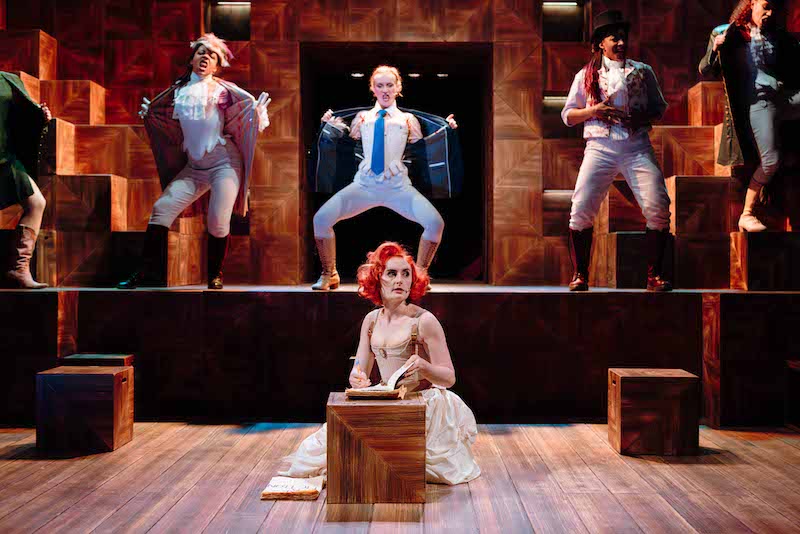
There is energy and drive in this approach. Laura Ellsworthy embodies Wollstonecraft with compelling force and flaming red hair, her five fellow cast members act out a world of stereotypes entertainingly, the action is non-stop. It’s all a bit breathless, though. Wollstonecraft’s seminal book, A Vindication of the Rights of Woman, is waved about as a totem, but never referenced or discussed. The production hasn’t got time to spare for reflection.
For a production where the writing and the acting are so full-on and simple, the design is very elaborate. Stacks of cubes that make walls and stairways fill the Wilton’s stage. Walls or stairs might be symbolic, or it might be a way of making multi-level stage pictures. The lighting is prominent and ever-changing, though more twitchy than mood-setting. The costumes hint at restrictive dress codes on top, with flouncy skirts and stripy stockings below, which again may be symbolic, but the coding is hard to interpret.
There is much to enjoy in this production. There are some good jokes. There’s a fleeting introduction to a number of personalities who informed the ideas of the time. What there isn’t is reflection or discussion, and for a production keen to introduce Mary Wollstonecraft to an audience that hasn’t heard of her, that feels like a disservice.
Runs until 29 March 2025
