

Choreographers: Jules Cunningham, Maud Le Pladec, and Michael Keegan-Dolan
If you want to force a post-interval audience into complete and utter silence before the house lights come down, position a man at the front of the stage, standing on a stool with a noose suggesting suicide.
It’s certainly an arresting image with which to start the third of a trilogy of new works choreographed to the music of American composer Nico Muhly. Before we even get to who the man is, though, we have two works to see.
Jules Cunningham’s SLANT uses Muhly’s Drones as its basis. The score, performed live by the Britten Sinfonia, relies on a note that plays constantly in the background, although responsibility for playing it shifts among the players. Over it, a series of string melodies emerges, pulling away from and then returning to the base note, alternately completing and clashing with it.
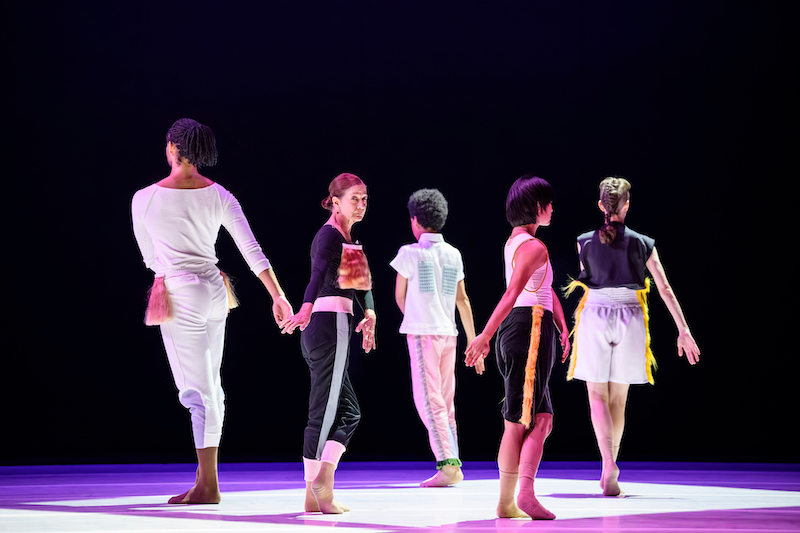
Cunningham is joined by five performers of varying ages (down to 9-year-old Archie McCourt), although Harry Alexander comes to dominate, helped by his being at least a head taller than his fellow dancers. The performers’ costumes are adorned with squares of fabric that, when paired with the short green capes donned by several dancers, make one feel as if the troupe are youngsters playing dress-up with a haberdasher’s offcuts.
Choreographically, the work resembles Muhly’s music in that individuals (particularly Cunningham) often seem to be drawn away from the rest of the group, before returning. It’s a work that feels interesting but ultimately does not feel like it has quite grasped what it wants to say – content, instead, to continue on like the drone at the foundation of Muhly’s score.
Maud Le Pladec’s Veins of Water, set to Muhly’s Drown, is a very different work altogether: precise, intricate moves from a trio of women, who wear shirts riven with streaks of blue sequin over flesh-coloured body suits. The dancers perform in fluid synchrony, evoking the ocean, the creatures who live there, and maybe those who swim in it for a short time.
Muhly’s piece moves between movements of fluid strangeness to silent stretches, punctuated by short staccato bursts. Le Pladec’s choreography finds a rhythm and pace throughout it all, making it feel as if the dancers are the ones in control of the music and not the other way around, a feat all too rare in modern choreography. The work sits alongside Cunningham’s to show how, despite the scores’ many similarities, interpretations could not be more different.
And then there is the third piece, the one that starts with a man seemingly about to hang himself on stage. The man is Sam Amidon, a folk singer whose rendition of a murder ballad was transformed by Muhly into The Only Tune, a three-part piece in which the folk song is deconstructed and reassembled piece by piece.
Choreographer Michael Keegan-Dolan takes the macabre folk tale and finds the comedy in it, with his eight dancers dressed in skeleton suits and faces painted into skulls. If played completely seriously, these could be people celebrating Mexico’s Día de Muertos, but everything they do is performed with Keegan-Dolan’s trademark twinkle.
The balance of the macabre folk song – about a girl who murders her younger sister – and the choreography’s initial humour is both unsettling and immensely charming. As the piece progresses, the dancers become infused with a more chaotic energy, a feeling that underneath the intrinsic silliness, there are roots of something more sinister.
It’s a mesmerising piece, even before the curtain behind Amidon and the eight dancers falls away to reveal the Britten Sinfonia, promoted from the orchestra pit where they reside for the first two pieces. Not only are they now on stage, but they, too, are dressed in the same skeleton get-up. Even though they remain static, the sense of a stage entirely inhabited by the undead lends even more weight to the work.
There is something so cinematic and disarmingly charming about The Only Tune that one wishes it were a longer standalone piece. As it is, it rightly dominates the triptych of works set to Muhly’s music. Three weeks too late to be a Halloween special, it nonetheless feels like a work that could become a seasonal treat.
Runs until 22 November 2025
