

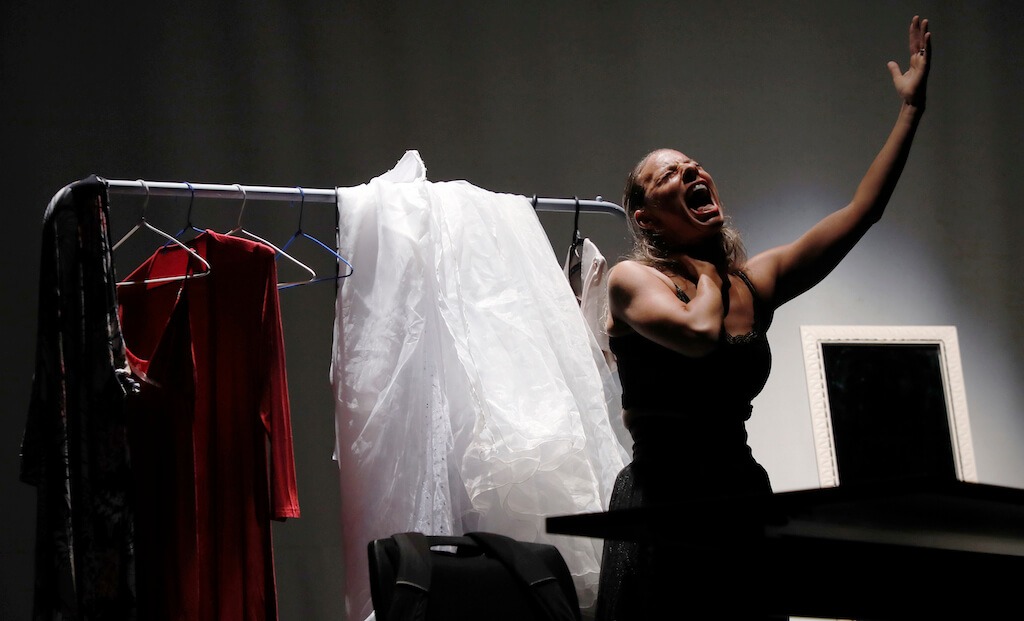
Choreographer and Concept: Maria Angelica Caruso
Choreographer and performer Maria Caruso brings Incarnation to life at Theatre Royal Drury Lane. It explores a woman’s journey through grief, identity, and self-discovery. The production’s intuitive dance movements, coupled with intense emotional themes, create a piece that is as impactful as it is perplexing. Drawing on the earlier work Metamorphosis, Incarnation weaves together fragmented narratives, offering an experience that, while reflective, occasionally leaves the audience searching for clarity.
The show’s structure, divided into distinct stages marked by costume changes and shifts in lighting, symbolises Caruso’s evolution. Yet, for those unfamiliar with Metamorphosis, some elements feel like missing puzzle pieces, leaving the audience unsure whether to view the narrative through the lens of personal trauma or lost love. The voiceovers, designed to provide context, vary in style—some are blunt and straightforward, while others curve into more poetic territory. This inconsistency makes the transitions feel uneven, adding to the sense of ambiguity.
Visually, Incarnation is a spectacle. Caruso’s mastery of dance and her physical storytelling are clear highlights. Her movements in dark clothing, embodying the struggle between light and darkness, captivate the audience. The use of props, such as the rope and the chair left on stage, powerfully conveys the character’s sense of entrapment and the need to shed her past. However, the logistics of some costume changes—particularly when buttoning up the white wedding-style dress—appear clumsy, breaking the otherwise fluid rhythm of the performance.
The production’s technical elements are superb. The lighting and projections are thoughtfully integrated, shifting to reflect the emotional tone of each stage. The use of large white cloths, which look like wings, creates a sense of freedom after she has been tied to the chair, symbolising a move from confinement to liberation. Such moments showcase Caruso’s brilliance in combining aesthetics with deeper themes, making the piece visually striking.
The most compelling aspect of Incarnation is its ability to provoke varied interpretations. Some audience members see the narrative as a dialogue between Caruso and her unborn child, while others view it as a confrontation with lost lovers, represented through letters that are never returned. This openness makes the piece poignant, as viewers are invited to project their own meanings onto the unfolding scenes.
The decision to retain a connection to Metamorphosis without fully contextualising it for newcomers creates a barrier to understanding. This is particularly evident in the initial voiceover, which feels more like a synopsis of a previous story than an introduction to the current one. It leaves the audience wondering if they are missing crucial insights, diminishing the emotional connection to the early scenes.
Incarnation is powerful, poignant, and, at times, petrifying. Caruso’s technical ability and emotional intensity secure the piece, ensuring it leaves a mark even as it drifts into abstraction. Its strength lies in its ability to provoke self-examination and emotional engagement.
Runs until 3 October 2024
