

Choreographer: Maria Caruso
Director: Matthew Titterton
Taking the opportunity to revisit a previous project, but continue to develop on its themes, is a fascinating proposal, and one that American dancer Maria Caruso approaches with a vigorous intelligence.
Filming her journey, Incarnation starts with footage of Caruso performing her dance piece Metamorphosis, first staged in 2018. An exploration of the contradictions of living with trauma, this clip, Caruso tells us in a voiceover, is from July 2022. The last date she would dance the piece. Caruso felt it was finished: she “didn’t need to say anything else”. But during this time, Caruso found herself writing frequent journal entries. These thoughts – on grief, loss and the desire to rise above the “weight of the past” – would become the inspiration for Incarnation.
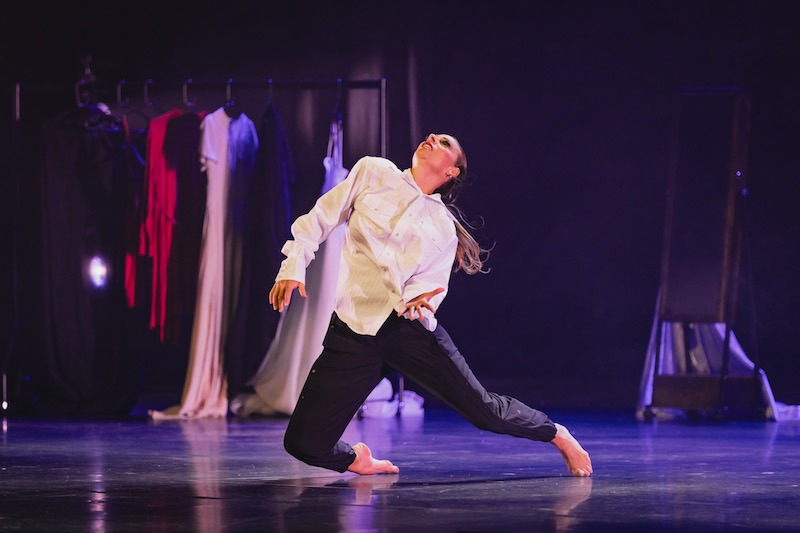
What carries across both performances is Caruso’s intense physical presence. Her background is in both classical ballet and contemporary dance, and Incarnation showcases her ability to move deftly from one language to another, blending them seamlessly. Caruso appears now on a stage with minimal props. A rail of costumes – dresses in red, white and black – hangs beside her, suggesting what lies ahead.
What is markedly different is Caruso’s use of voiceover throughout: Metamorphosis was non-verbal, and in a post-performance Q&A, Caruso talks about wanting to use her words – those journal entries – alongside the dance. Donning a white, frothy gown, Caruso gleefully delves into a sense of euphoria. Her open, sweeping movements are paired with diaphanous wings: Caruso is about to take flight.
During the performance, she writes letters to an unnamed recipient. Her next letter talks about feeling “buried in darkness”. The white is switched for a shroud-like black garment. The dance becomes more grounded, heavily so. She covers her ears to blot out the sound of the music (an excellent, perceptive score from Ryan Onestak). We witness Caruso’s emotional descent.
The depression begins to lift, and another change of wardrobe sees Caruso wearing red. But this is not basic fashion semantics: red for anger or passion. Red as confidence confounds expectations, and is an important point of difference: Caruso perceives the colour as her personal shot of energy. The mood pivots again in the final scene, as Caruso finally receives a letter in reply.
Dealing with deeply personal layers of trauma (Caruso talks openly about suffering a series of miscarriages), the dance does not operate in generalities. Caruso’s ability to emote is powerful and impressive, all the more for being linked so closely to her own history. We are not re-creating, we are remembering, and the quality of the performance reflects that. As a dancer, Caruso is hypnotic: her athletic and graceful notes reflect the sheer range of her experience.
Incarnation ends by quoting Ecclesiastes. For everything, there is a season. In how Caruso has reached this point, her philosophical attitude in taking life as it comes, is not mere confessional, but anchored in specific and meaningful biography. Incarnation merges insight with compassion. Perseverance supersedes perfection, and it’s a message more of us need to hear.
Available now
