

Writer: Nadia Jackson
Director: Spiky Saul
“Get your hands off my life” Dora Maar screams at Pablo Picasso during an entirely imagined scene in Nadia Jackson’s play Maar, Dora, which returns to the Old Red Lion Theatre, giving her a chance to say all the things she may have wanted to in life. A 50-minute biographical drama, Jackson’s piece tries to free Dora from Picasso’s shadow by making a case for her impact on the surrealist movement and insists she will not allow him to define her legacy – except Picasso is riven so tightly through Maar’s life that even Jackson cannot shake him off.
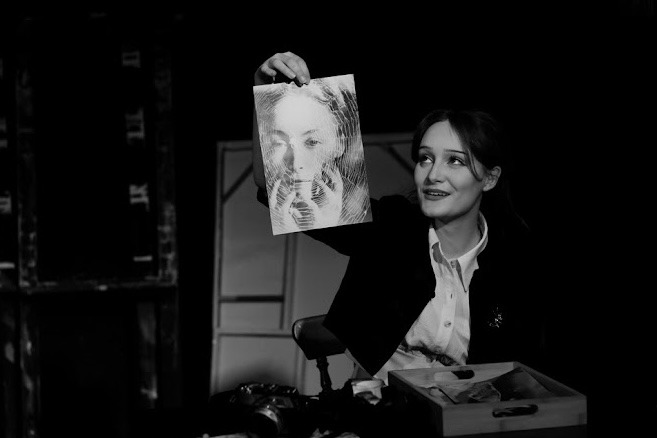
Dora Maar is reflecting on her achievements by re-examining her life story, beginning with glamour photography for commercial beauty firms before developing into surrealist photomontage. It is around this time that she meets the much older artist Pablo Picasso who begins to dominate her days and her personal life, trapping her in a faithless relationship and shutting Dora off from the world and even her own talent.
Throughout Maar’s story told by the character directly to the audience, Dora proclaims her frustration at being defined by others. First, her photography receives co-credits and later she becomes known first as the mistress of the famous artist rather than a creative in her own right. Disembodied voices are used several times to explain some of Dora’s history and the media commentary that shapes our impression of her today, and Jackson repeatedly makes the case for returning agency to Dora and tries to disentangle her personal life from her own artistic contribution.
But Maar, Dora gets a bit stuck when Picasso turns up fairly early in the show and then dominates the remainder of the dialogue even when he’s not on stage, at one point even pushing Dora aside to become the narrator. As scenes of his abusive behaviour and gaslighting follow, the play becomes a recreation of their relationship with Dora talking to or about him continually. There is perhaps a really interesting political angle in here about the impossibility of truly extricating wives and mistresses from their more famous lovers – Picasso, Hemingway, Fitzgerald to name a few – but Jackson never commits to the direction so it becomes an idea that surfaces for a moment and then drifts away, as does the thought that it is Dora who defines herself through Picasso, particularly when no other actors appear in the show.
Jackson’s character acknowledges some of these constrictions about needing Picasso’s presence as well as the famous The Weeping Woman series that has shaped her reputation, but arguably the framing device for the show isn’t the right one for the story that Jackson is trying to tell. To reclaim her story, Dora needs to exist within her own life not outside of it, so a multi-character piece that concentrates on her life before or after Picasso would flesh her out a bit, or a monologue in which the actor playing Dora (here Faye Ziegler) then recreates other characters and conversations within a narrative she is then controlling.
Picasso’s women remain tethered to him because he is continually written into their history. Even if she spent the rest of her life recasting her own traumatic time with him, for Dora to be more than a collaboration, she needs to also be written as an independent artist and a person who lived most of her life without the man who refuses to exit her story.
Runs until 16 March 2024
