

Writer: Ben SantaMaria
Director: Martha J. Baldwin
Lullabies exist to sing a frightened child past the things it cannot understand. Ben SantaMaria’s Lulla for Flaming Theatre borrows their melodies and inverts their purpose – Hush Little Baby is croaked in the dark, and understanding never comes. Marin, 16, queer, and in love with schoolfriend Dolores, flees her disapproving parents into a dream world of her own subconscious, guided by the gender-shifting Lady Nightshade and haunted by the nursery rhymes of her childhood. Martha J. Baldwin’s production is at its best in that dream world; the trouble is working out what the dream is for.
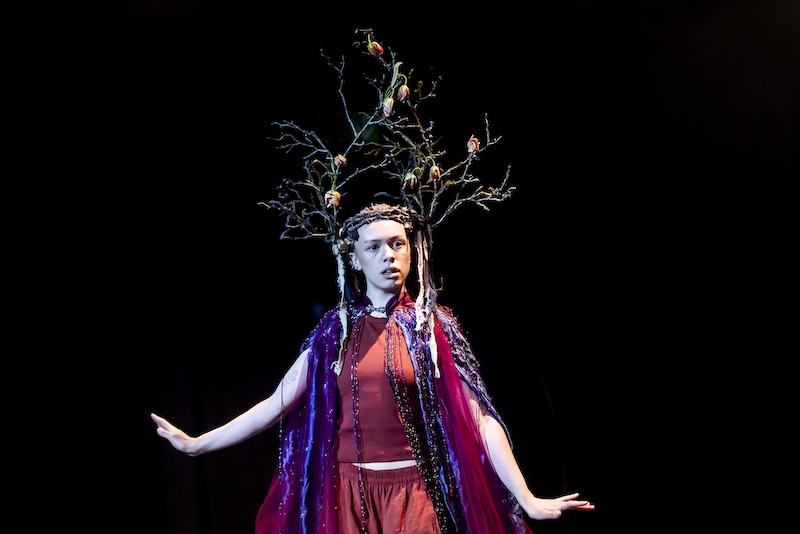
The surreal craft impresses. Foliage litters the stage, washed in bruised purple-blue light; Lady Nightshade arrives veiled, crowned in branches and fruit, passed between three actors who each lend the role a jolting fluidity. The shapeshifting seems poised to mean something; it settles for decoration. Robin Berry –underpowered as Marin’s father – transforms as the Dollmaker: a bald-capped apparition in a yellow gown, jerking under stuttering lights, bellowing his own name and croaking Itsy Bitsy Spider and Three Little Pigs.
Madeleine MacMahon gives the finest performance, doubling as Marin’s unaccepting mother and the most compelling of the Nightshades , ethereal and capable of detonating a well-timed profanity. Anna Marks Pryce’s Marin is weakest where the play most needs her. The ensemble over-enunciates its way through the domestic scenes, and only in the absurd does her performance relax into something believable.
But the surrealism thinks too highly of itself to explain anything. The question hanging over every striking image is the simplest one: why? And for all the production’s huffing and puffing, the house never quite comes down. When Marin wakes, her parents’ hostility has softened for no earned reason; if the dream was her passage through rejection, the play keeps that reading to itself. The needlessly graphic opening scene, meanwhile, spends shock the play doesn’t earn.
Weakest of all is the writing when Marin erupts against straight people – grievances listed, behaviours mocked, the chant of “they will never understand”. Had SantaMaria wanted to push boundaries in anything but surrealism – in the moral argument his play plainly aspires to – they’d have given this outburst some root in the drama around it. Again, one wonders, why?
The frustration is that the hardest part of theatre-making – conjuring a strange and vivid world – has been achieved, and yet the story it should serve is merely stapled to it – not glued or sewn but stapled. Hush little baby, don’t you cry, runs the show’s refrain – the lullaby never explains why. Alas, nor does Lulla.
Runs until 10 July 2026
