

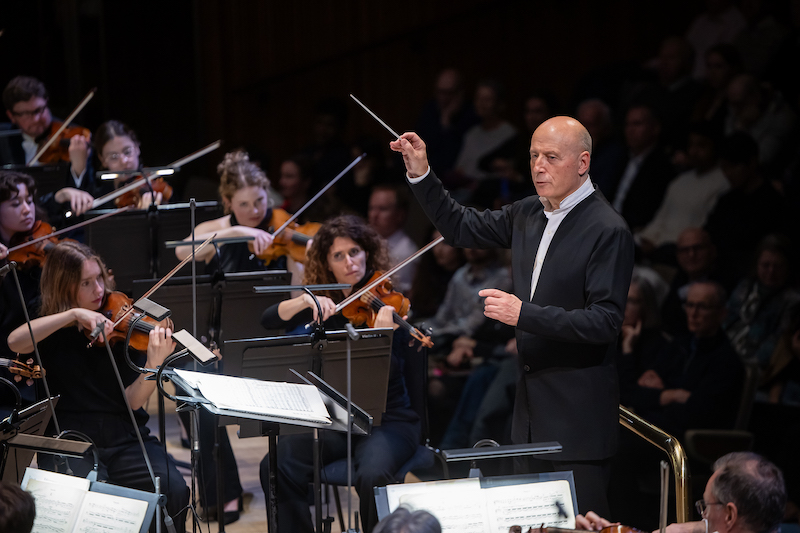
Conductor: Paavo Järvi
When multi-award-winning Estonian conductor Paavo Järvi leads the London Philharmonic Orchestra at the Royal Festival Hall, it’s a great event. Especially if the programme features Tchaikovsky and Sibelius with virtuosic piano-playing by French soloist Alexandre Kantorow, making his LPO debut. It’s just been announced that Järvi will follow Edward Gardner as the chief conductor and artistic advisor of the London Philharmonic Orchestra, starting with the 2028/29 season in the run-up to the orchestra’s 2032 centenary.
Järvi’s rapport with the orchestra is already clear as he conducts performances of the Finnish composer Jean Sibelius’s Second Symphony and Tchaikovsky’s sometimes-overlooked Piano Concerto No. 2. His style for the opening Tchaikovsky, from a podium behind the grand piano, is slightly more restrained, leaving the limelight to Kantorow’s impossible-seeming arpeggios. Globally-celebrated, Kantorow was the first French pianist to gain the International Tchaikovsky Competition’s Gold Medal and also won the Grand Prix, which has been awarded only a handful of times in the competition’s long history.
Tchaikovsky’s Piano Concerto No. 1 replaced the Russian national anthem at Olympic medal ceremonies after doping-related sanctions. The vivacious first movement of Tchaikovsky’s less-well-known Second Piano Concerto still has a slightly uncomfortable Russian imperialist air in the current climate, lightened by occasional haunting bars of flute. In the stately second movement, there are sweeter sections and some beautiful solos for strings, echoing the notes picked out on the piano. Here, orchestra leader Pieter Schoeman on violin and principal cellist Kristina Blaumane also have a chance to shine. The assembled violins produce a mesmeric swaying melody like seaweed waving underwater.
The orchestra is smaller than for Tchaikovsky’s popular first piano concerto, and the composer has done away with trombones and tuba altogether. In the fiery finale, contrasting images continue with dramatic and intimate moments interspersed. There are rousing blasts of whole-orchestral music, but also plenty of solos, where the pianist’s hands seem to fly over the keyboard in a frenzy of notes. After particularly complicated passages, Kantorow’s hands rise and fall as if propelled by some external force; elsewhere, they almost flutter, producing exceptionally delicate music. After rapturous applause, Kantorow plays an encore from The Nutcracker, in an arrangement for piano by Mikhail Pletnev, which allows the pianist to further showcase his exceptional skills.
In Sibelius’s Second Symphony, Järvi’s fluid and graceful conducting style comes to the fore. His movements are impassioned yet precise, with windmilling arms in the wild liberational sections and elegant, economical vibrations in the quieter moments. Sometimes he stills the noise of the orchestra with a swooping gesture like a cricketer catching a low ball, controlling the silence as skilfully as the sounds.
The symphony itself is glorious. It makes an interesting contrast with the Tchaikovsky. Written just a couple of decades later in 1902, Sibelius’s work channels the freshness of a new century. The composer called the symphony “a confession of the soul”, but many people have also heard in it a geo-political strain, representing Finland’s struggle for independence from Russia, and it’s sometimes called the “Symphony of Liberation”.
The brisk, but peaceful opening movement is full of purposeful strings and flowering wind instruments, building to brassy crescendo. This is spring-like music with a sense of sunrise and budding blossom. The slower second movement, originally written as a conversation between Don Juan and Death, has some rhythmic shifts. It starts with a thunder-rumble of timpani and unnerving pizzicato from the cellos and double basses like a low vibrating pulse.
The energy and brilliance of the third “vivacissimo” movement is fast and bright as racing sunlit streams and waterfalls. Slower oboe-led themes eventually merge with turbulent basses. The grand finale sweeps across the musicians like wind over barley fields. The music gives principal timpanist Simon Carrington plenty to do on the drums, and the tuba, horns and trumpets sound out in an incandescent paean to freedom. This is an orchestra packed with power and talent. Paavo Järvi and the LPO are a high-octane combo, giving London’s music-lovers a taste of things to come.
Reviewed on 4 March 2026
