

Writer: William Shakespeare
Director: Toby Gordon
“Promises, Promises,” Berowne sings in tribute to Dionne Warwick in Toby Gordon’s 1960s-set musical version of Love’s Labour’s Lost, performed on a chilly and rain-threatening summer evening in The Charterhouse courtyard. A less frequently performed play given some new life by the Royal Shakespeare Company in 2024, which has clearly influenced this Shakespeare in the Squares production, including a scene set on a golf course. Gordon’s approach offers a swift two hours, prioritising comedy over true love as characters race to the altar (at least that is the hope of the men).
It is a fun concept that uses music to give greater purpose to the period setting, offering worked -in renditions of Dancing in the Street, La Bamba, Twist and Shout and Hooked on a Feeling among other 60s tunes, as King Ferdinand and his friends instantly jettison their vow of abstinence and monk-like devotions to their studies in order to pursue the newly arrived Princess of France and her ladies. Colette Robinson-Collcutt also goes to town on the women’s outfits with brightly coloured shift dresses, loud prints and go-go boots, all of which give a taste of the era, even if Shakespeare’s verse never quite soars as well as the songs and visual choices.
With some of the clarity lost to the outside location in the first half – especially the role of comedy characters Armado, Jaquenetta and Costard – the second is much stronger as the lovers’ plot takes centre stage. The best sequence in this version of Love’s Labour’s Lost gives precedence to the “tongues of mocking wenches” who swap lovers’ trinkets and mask themselves to fool the men who are also in disguise – dressed like The Beatles post-India in a very funny and exuberantly played reveal. What follows as the men’s motives crumble has a motoring energy as Gordon’s show drives towards its sombre but appropriate conclusion.
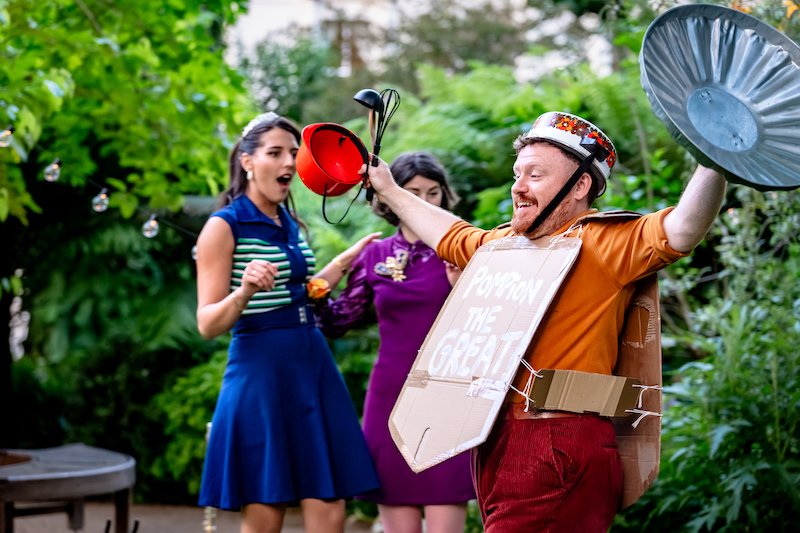
Gordon’s approach also works in some audience interaction throughout, including drawing out someone from the front row to appear in the very silly section on the Nine Worthies that celebrates some classical heroes in grand slapstick style. The balance tends to tip towards humour throughout as a way to keep the audience engaged, with John Holt-Roberts’ Costard leading the way as a jester-musician, mixing up the delivery of letters within the farce while Dexter Southern’s effusive Armado gets plenty of laughs.
Among the lovers, the women really have the best of it with Laura Andresen Guimarães as the Princess, Flo Lunnon as Katharine and Rhiannon Neads as Rosaline, convincing as good friends able to best and quite easily outwit their pursuers. With only 1 hour and 40 minutes of stage time, little chemistry develops with Niall Ransome’s Berowne, Nathan Musoki’s Ferdinand and Southern’s Dumain, but the women each feel distinct and certainly in charge of these relationships.
With Charterhouse as its backdrop, Gordon’s blend of 60s music and style with Shakespeare’s story is largely successful and an innovative approach to an ambiguous play.
Reviewed on 10 June 2026 and continues to tour
