

Writer: Maria Vigar
Director: Anastasia Revi
Set across two time periods, the present and the 1960s, and moving between England and Cyprus, Love in a Foreign Land unveils the decades-long struggle of a woman navigating life as an immigrant.
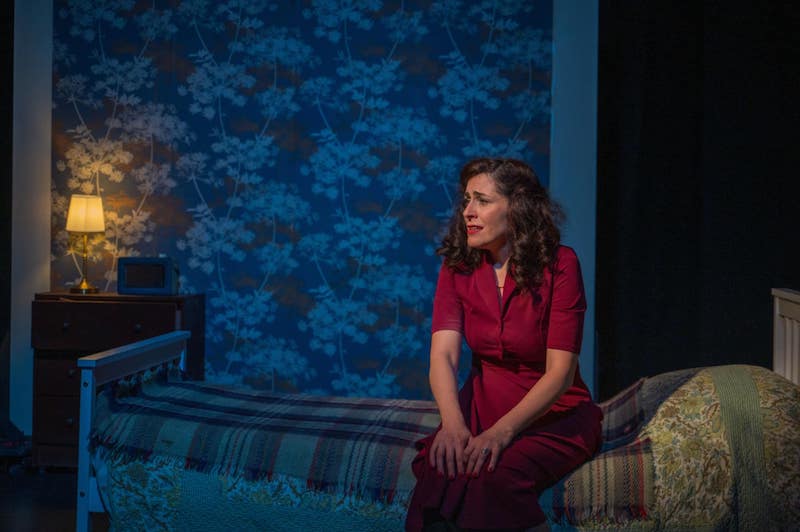
Written by Maria Vigar and directed by Anastasia Revi, the play centres on Theophana, a resilient woman who comes to England in search of her husband, Andy (Ilias Alexeas), only to discover that he is consumed by gambling and love affairs. Despite his betrayal, Theo brings her three children to London, attempting to build a life in a foreign land under the shadow of an irresponsible husband and father.
The play’s emotional weight is realised by the outstanding performances of Lucy Christofi Christy as the older Theo and Elena Hadjiafxendi as the younger Theo. Positioned on the two sides of the stage respectively, their interwoven narratives echo across time. While Young Theo indulges in the joy of reunion, the older Theo’s regret, underscored by the repetition of key lines, serves as a haunting reminder that love in a foreign land is not always a remedy but can also be a battleground. This dual portrayal not only deepens the emotional complexity but also highlights the lasting scars of betrayal.
The production employs Greek and pop music to present the cultural identity of immigrants. The songs, accompanied by scenes of singing and dancing, infuse the play with cultural richness and reinforce the theme of home in a foreign place. Although the Greek lyrics may not be understood by all audience members, they heighten the sense of intimacy within the immigrant family and add authenticity to the narrative.
However, certain aspects of this play could benefit from further refinement. The fact that actors portray multiple characters and assist with scene changes occasionally leads to confusion. For example, actors who portray Andy’s friends in a party scene later reappear as his children without clear transitions. Similarly, actors entering solely to adjust props disrupt the play’s immersive quality. Additionally, the volume of the background music at times overwhelms the actors’ voices, making dialogue difficult to hear.
Even so, the play’s storytelling remains compelling. It captures how a woman’s spirit can be slowly eroded by a toxic spouse. Yet, at its core, Love in a Foreign Land is a testament to resilience, as it presents the portrait of a courageous woman confronted with life’s harsh realities while refusing to be defeated. With more cohesive coordination between the performers, set, lighting and sound, the production could achieve even greater depth and clarity.
Ultimately, Love in a Foreign Land is a powerful exploration of love, loss and survival. It resonates not only as a story of immigrant experience but also as a universal portrayal of a woman’s fight to reclaim her dignity and independence against the conventions and her own fear.
Runs until 12 April 2025
