

Writer: Joe Orton
Directory: Bethany Pitts
When Joe Orton’s dark farce Loot premiered in 1965, it was not a success, opening on tour to largely negative reviews. In part, that was due to a script that had been heavily censored away from Orton’s original intent, issues that were remedied in later revivals as it became the success it deserved to be.
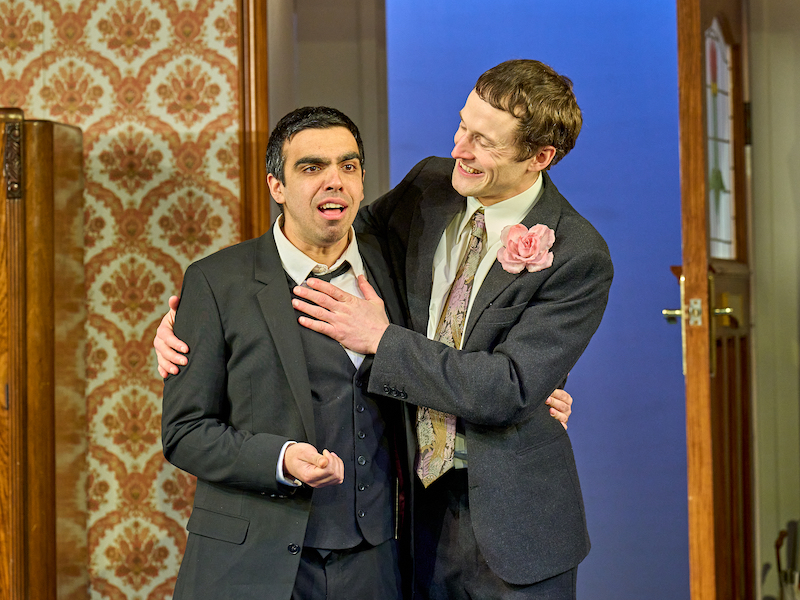
Orton’s play focuses on Hal McCreavy (Samuel Armfield), a petty criminal who has just robbed a bank with the help of his friend and occasional lover, Omar Bynon’s Dennis. Hal’s mother has recently died, and the coffin in which she is about to be buried is potentially a better hiding place for the money than the wardrobe Hal is currently using – or it would be if it weren’t occupied.
Alongside the physical slapstick required to navigate the general handling (and mishandling) of a corpse, Orton throws in some more salacious plots. Tanya-Loretta Dee’s Fay, Mrs McCreavy’s nurse, sets her sights on her patient’s husband (Simon Startin) before becoming embroiled in Hal and Dennis’s plot, while Dennis wants to marry Fay, much to Hal’s disappointment.
The satirisation of burial rites, the Catholic Church and the nature of morality is twisted by the queerness of Orton’s characters. The nature of Hal and Dennis’s relationship, along with both characters’ presumed bisexuality, is treated as quite the most normal element of the play. What must have seemed shocking in 1965 is still slightly out of place even today, if mollified by time. References to Hal’s use of brothels with underage sex workers offer glimpses into just how disturbed a 1960s audience may have been by the characters’ amoral attitudes.
What works about Bethany Pitts’s revival is its attempt to treat the farce not as a vehicle for outrage, but instead as one of a long line of English farces that just happens to be more overtly provocative than the seaside postcard sauciness of the Brian Rix/Ray Cooney style of Whitehall farce.
The production revels in the wit of Orton’s dialogue, which means that, especially in the first act, the pace of physical comedy abates as the characters stand still and deliver barbed quips, never quite deciding whether they should face the character they are supposed be talking to or project out into the auditorium. Still, Armfield in particular revels in his role, infusing his antihero with warmth and charm.
But the play rests upon the presence of the inevitable police inspector, who, in this case, receives an Ortonesque twist: as the police cannot enter the McCreavy household without a warrant, Nicholas Karimi’s Truscott insists he is actually from the Water Board. The script mercilessly lampoons police corruption and violence – topics still depressingly current 60 years later – and Pitts’s interpretation of Orton’s pacing definitely picks up when the character is on stage.
In places, though, Karimi’s manic energy obscures the nuance of Orton’s script. In the doomed 1965 run, Truscott was played by Kenneth Williams, and one can see elements of that actor’s style in Karimi here, with his wild swings between serious erudition and utter mania.
At times in Act II, Karimi’s delivery is so focused on being manic that clarity of diction suffers. It also tends to feel as though, because the character of Truscott is ramping up as the play reaches its climax, the rest of the production can coast behind him. This leaves an uneven impression, denying Orton’s comedy and satirical punches the full enjoyment they deserve.
Runs until 7 March 2026
