

Surely no part of the country is as prolific in summer festivals as North Yorkshire. The North York Moors Chamber Music Festival is one that is well established and can boast that it is one of the few music festivals to have gone ahead to live audiences in 2020 and 2021. A further oddity is artistic director Jamie Walton’s giving a theme to each festival and each concert.
This year the theme is Through the Looking Glass and each of the concerts bears reference to a different part of Lewis Carroll’s fantasy. The 14 concerts over a two-week period consist of 10 at home base, the marquee at Welburn Manor, and four at different churches in the national part. On Wednesday 16th the theme was Living Backwards in the beautiful setting of St Michael’s, Coxwold. There were at least two reasons for that title – the pieces moved backward in time from Kaija Saariaho who died two months ago to the 17th century Ignaz Biber and they formed a palindromic pattern of one soloist, two, three, two, one – but it provided a telling background to five pieces which could hardly be said to be well-known.

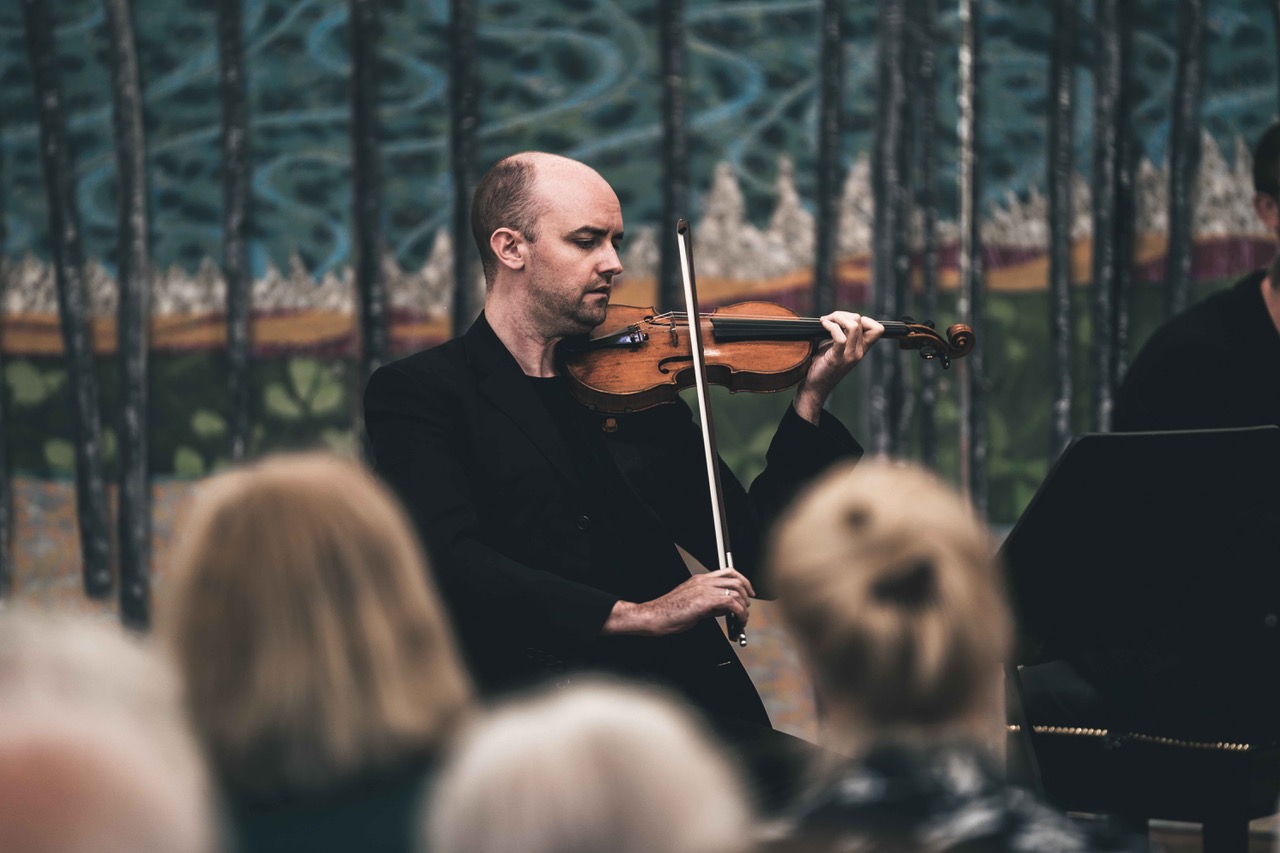
There were five soloists in all, with an imaginative grouping to begin with. Violinist Benjamin Baker took up position in front of violinist Alena Baeva and cellist Jamie Walton and began Saariaho’s Nocturne for solo violin, a melancholy work with a great sense of space composed in memory of Witold Lutoslawski. Beautifully played, but rather repetitive, its impact was only apparent when Baker exited down the aisle still playing and Baeva and Walton launched into Ravel’s Sonata for violin and cello. Dramatic from the start, it built its effects through intense pizzicato and wildly percussive playing. The third movement brought melancholy, almost introspective cello, before Baeva and Walton attacked the final movement with wild intensity.
Standing on its own centrally was Dvorak’s Terzetto, with Baker joined by violinist Charlotte Scott and Sascha Bota on viola. The warmth of the opening suggested the delightful story of its composition, planned as a piece for his young lodger Josef Kruis. In the end it proved too difficult for him, but the air of domestic charm remains, notably in the second theme to the Scherzo, almost reminiscent of a landler.
The planning of the programme astutely gave us Telemann’s Suite for two violins, Gulliver’s Travels, with Scott and Baker finding the humour in such pieces as Brobdingnagian Gigue before Baker left Scott on her own with Biber’s Passacaglia in G Minor, her violin weaving patterns, both delicate and inventive, over the recurrent four-note phrase.
Five outstanding soloists and an imaginatively planned concert made for a memorable 80 minutes.
Reviewed on 16th August 2023.
