

Writer: Alice Flynn
Director: Liam Rees
Billed as an Irish folk horror story, Little Sister is also an examination of grief and mental illness. And although there are some eerie elements in its story of the return of a missing schoolgirl 21 years after she went missing, Alice Flynn’s play suffers in the small Glitch Theatre, and there are a few too many final twists.
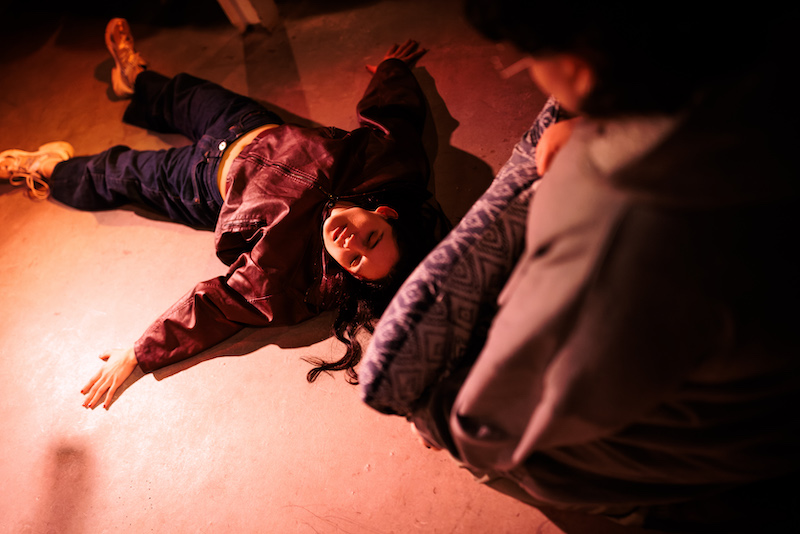
On the first anniversary of her mother’s death, Bridget (Beca Barton) decides to stay home while her wife goes off to the local pub quiz. She’s disturbed by a knock on the door. It’s a woman (Anna Coupe) with blood on her head, looking for her own mother. The woman believes she is 14 years old, the same age as Bridget’s sister Shona when she disappeared over two decades ago. Could this visitor be Bridget’s sister, or is she a true-crime fan, eager to enter the house at the centre of one of Ireland’s most famous missing persons cases?
So far, so creepy, especially when the radio news talks of changelings and when Bridget’s wife (Georgina Musgrave) relates the legend of Oisin, who returned to Ireland after spending 300 years in the ‘land of the young’. But the tension drops when Bridget, Shona and their other sister Sally, who arrives to help out, discuss their childhoods and their overbearing mother.
While the acting of the four actors is solid, especially that of Mimi Millmore, who plays the cool narcissist Sally, their performances aren’t helped by the odd placement of the stage in the middle of the Glitch. It would be fine if the actors were to use this space, but too often the stage is empty with actors sitting in the front rows of the audience, with the result that they can only be seen by half of the audience. And when, finally, the actors do decide to use the middle space, they sit down on the floor, with the second rows of the audience unable to see them at all. Admittedly, the Glitch is a challenging space, but other shows there have dealt with it.
There’s not enough intrigue in Little Sister to warrant its 75-minute run time, and director Liam Rees seems divided between leaning into its horror aspects or treating it as a comic family drama. Of course, the play can be both these things, but at the moment, it sits awkwardly between the two. Perhaps some Pinteresque pauses are needed to install more discomfit into the audience. The acts of violence otherwise just don’t work.
Runs until 1 March 2026
