

Writer: Sarah Ruhl, based on the book by Sarah Ruhl and Max Ritvo
Director: Blanche McIntyre
When playwright Sarah Ruhl was running a playwriting class at Yale University, she received an application from Max Ritvo, a poet who had never written a play before. That would typically have rendered him ineligible for her course, but she accepted him anyway. Eventually, they became friends, especially as Ritvo’s childhood cancer returned and he started receiving treatment.
In addition to face-to-face meetings, the pair communicated via letters, emails, and text messages, as Max initially moved to the West Coast to be with his mother and later to New York in the hope of pursuing a graduate degree program. After Ritvo’s death, Ruhl published their correspondence as a book, Letters From Max, later adapting that work into the play now receiving its UK premiere.
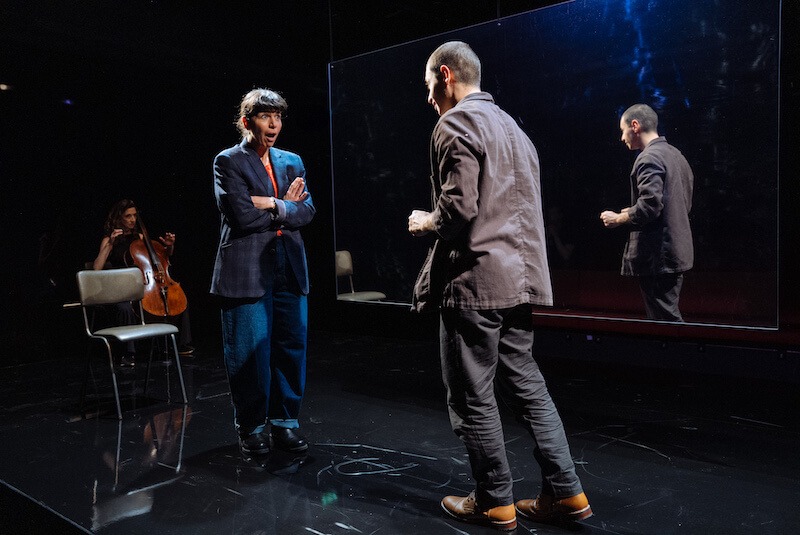
Ruhl’s work examines the pair’s relationship, in which she became as much his student as he had been hers. As Sarah, Sirine Saba is warm and maternal, allaying many concerns about the appropriate nature of a relationship between professor and student. As Max, Eric Sirakian combines both a mischievous twinkle and a deep sense of philosophical contemplation. “Funny poets are my favourite kind of human being,” Saba’s Sarah tells us, and Sirakian embodies those qualities admirably.
Dick Bird’s set design partially bisects the traverse staging with a half-mirrored glass pane, reflective but translucent. Scenes where Sarah and Max are communicating in text often occur with them on either side of the glass, symbolising how the written word is rarely as translucent as meeting face-to-face. “Resist opacity,” Sarah notes early on, and yet some of that opacity remains.
The half-mirrored surface also allows for a couple of moving scenes where, on either side of the barrier, Saba and Sirakian sit or stand, through the semi-opaque pane they appear to be next to, and interacting with, their scene partner’s reflected self. It’s a technique that is used sparingly, making it all the more effective. Just as effective is Laura Moody’s onstage cello work, an accompaniment that is similarly economical.
The moments in which Max and Sarah discuss each other’s poetry, praising each other’s work, tend towards navel-gazing. Indeed, the whole exercise of Ruhl adapting her own epistolary collection into a play in which she is the central character risks an element of self-regard that Blanche McIntyre’s production usually, but not always, manages to sidestep. The sickliest moments of two creatives congratulating each other’s brilliance are tempered by scenes of Max describing his cancer journey. Sirakian brings a depth to such moments, conveying a man who is determined to bring simultaneous layers of mischief and deep sadness.
The characters’ discussions about varying attitudes to the afterlife skim the spiritual without losing the audience in a philosophical morass. For those who have lost loved ones, especially to cancer, the pangs of grief and the need to hold on to the brilliance of life will be all too recognisable.
Continues until 28 June 2025
