

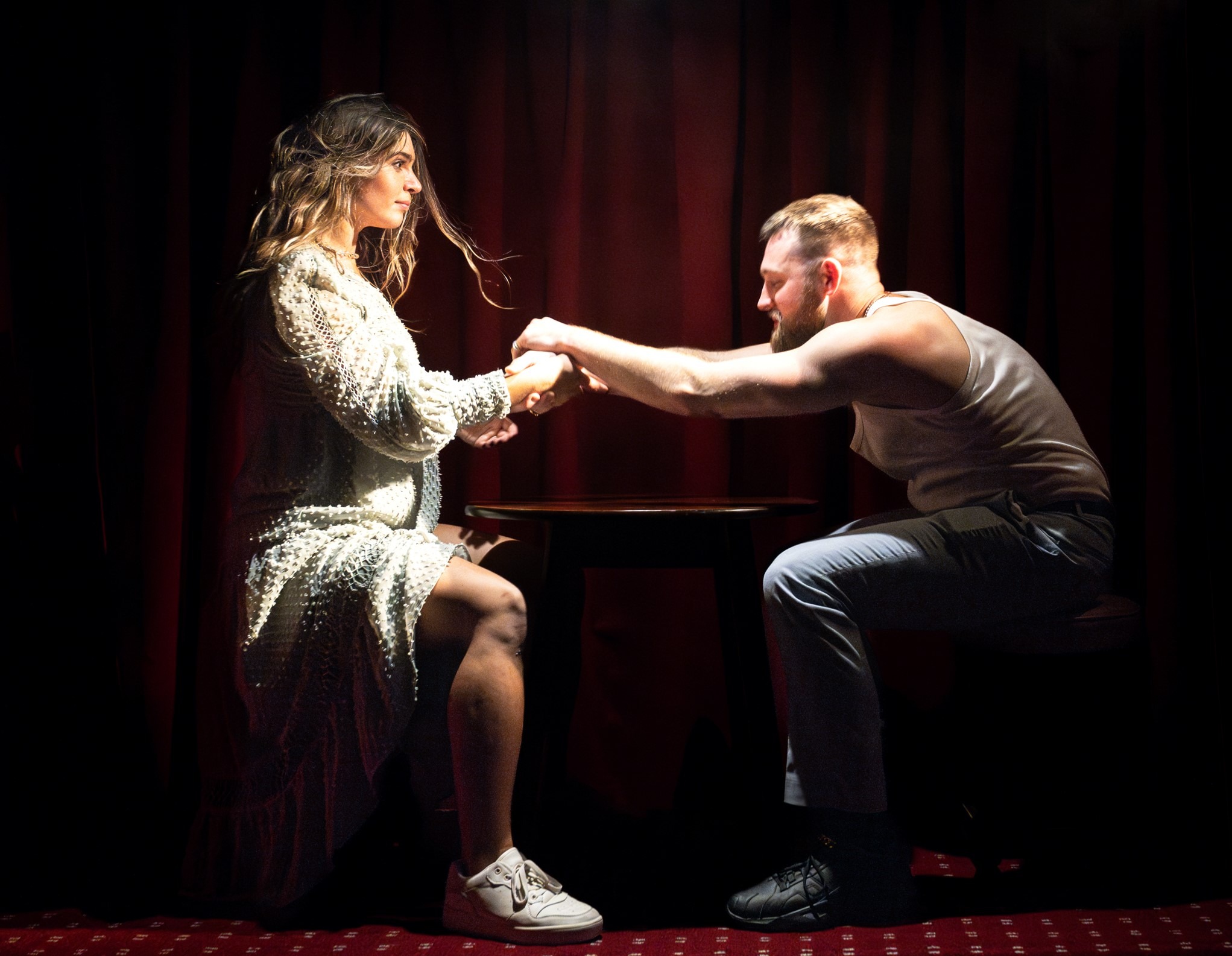
Director and Choreographer: Rhiannon Faith
Music: Anna Clock and India Merrett
The British Pub is more than a drinking establishment. It is a place of community, where it comes together to enjoy and, above all, support each other. It is this wider essence of the British pub that Rhiannon Faith has delved into for her latest production, Lay Down Your Burdens.
The Pit at the Barbican has been converted into a local pub. The audience sit on the fringes, but very much part of the pub space. As is often the case, the Landlady takes on a maternal role for her regulars. Sara (Sara Turner) is very much the maternal landlady in regard to her regulars. She is friendly, but not overly so, firm but not without empathy.
She is supported by her jack-of-all-trades, Dick (Dominic Coffey) a new father who spends more time at the pub than he does at home. The regulars arrive and, as you’d expect, the drinking and banter kicks off. As they fall into a seemingly regular dynamic an unknow traveller arrives. He’s American, homeless and has the ashes of his dead mother in a thermos flask.
The group dynamic shifts, slightly, and we start to see an unravelling of the various characters. Each, on the surface, is happy and engaging. But below the surface, each has their own troubles, their own burdens.
One by one we see these exposed, initially within themselves and then to the group of performers and audience. And as each is revealed they are addressed by the wider collective. Yes, there’s audience participation here. We, the viewers are critical in the healing process. We’re encouraged to participate in the pub games and sing along songs and then invited to offer up our list of things we love.
This is a show unlike any other. It is contemporary interpretive dance, dramatic play and group therapy all in one. As it starts, you’d be forgiven for thinking that you’d walked into a theatrical production of a Mike Leigh film. The boundaries of what’s staged and what’s not are blurred from the outset. The cast are mingling around and talking with the audience, just as you might in a pub.
Their spoken words present their ‘public’ demeanour – trouble-free and happy. However, we get snippets of their turmoil through their individual bursts of dance, showcasing something inside that’s not as it appears. It’s their personal burden. The balance of spoken word and dance shifts as more of the burdens are exposed and laid bare.
Lay Down Your Burdens is a bold and exciting production but falls short of brilliance. The first half of the show is mesmerising. The interplay between the cast and audience keeps you excitingly alert. The interplay between dance and spoken word has an eerie foreboding so reminiscent of David Lynch’s more esoteric work. As we resume in the second half, things take a somewhat different tone.
The excitement and frisson of exploring with the characters is replaced by a new-age, self-revelation therapy session, that seems to go on and on. This is heightened into a cult-like ceremony when, at the end, the cast and audience repetitively recite “I carry you. You carry me.” If this were the US, this would probably fly unquestioned, but in the UK, it feels like a bit of a gamble. On the one hand, there are those that will fully jump on the ride and see it though, chanting and all. But for many, where such activities are sneered at, this feels embarrassingly self-indulgent.
But maybe that’s the point. we need to be open and honest with our feelings if we want to be open to the support our community can give us. We need to express things in a way we’re probably not used to. And we need to acknowledge things that we probably don’t. In doing this we can receive and give support that makes us all better.
Lay Down Your Burdens is a powerful and deeply thought-provoking production. It asks a lot of its audience but doesn’t provide many answers. As such you’re left pondering it long after the lights come up. It is at once exciting and tedious, life affirming and laughable. The thrilling first act is a masterclass in dance as an abstract, and surreal expression that keeps you on the edge of your seat. The second act, by contrast, feels laboured and overly contrived. For the most part, it’s an affecting message, excitingly told.
Runs until 25 November 2023,
