

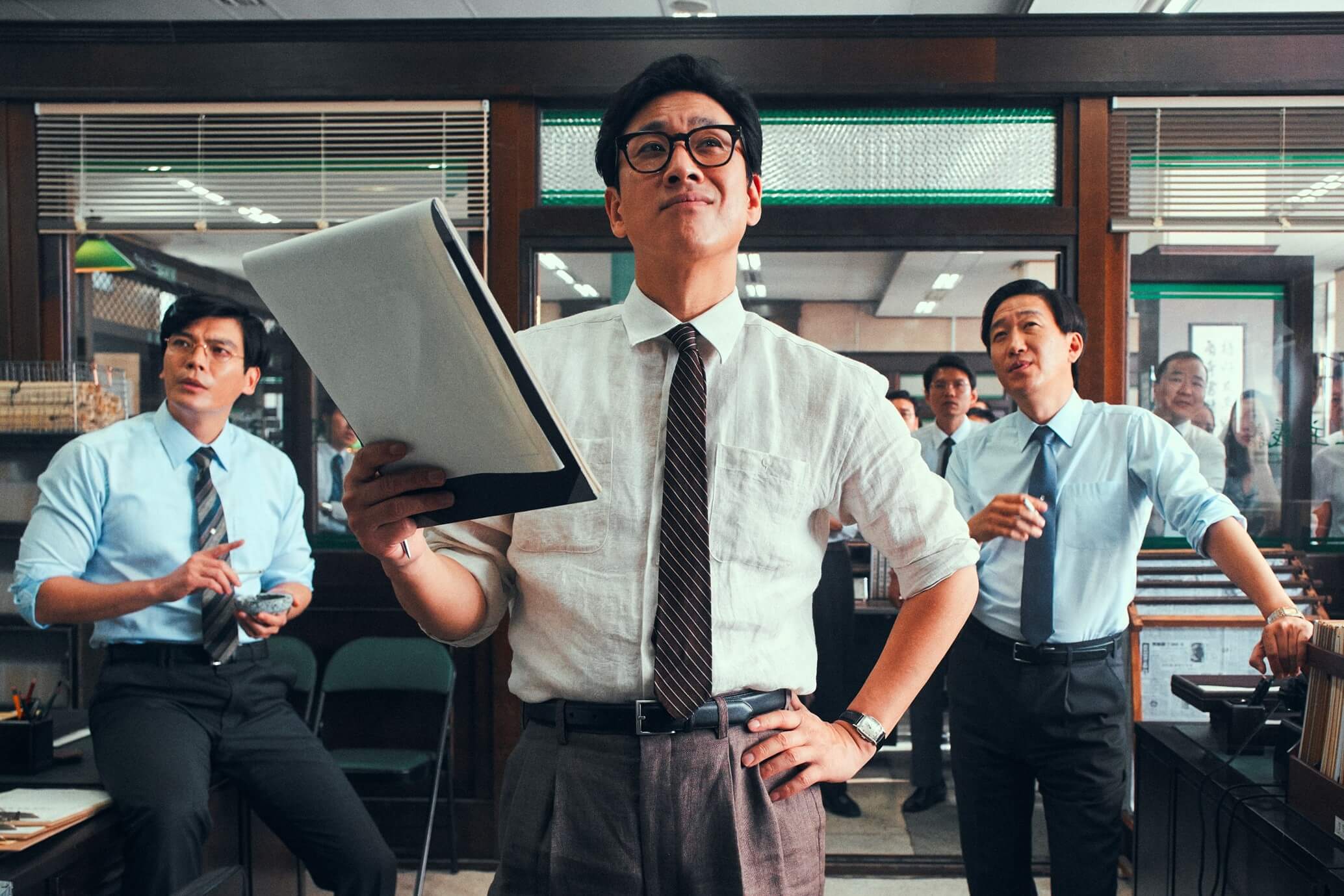
Writers: Byun Sung-hyun and Kim Min-soo
Director: Byun Sung-hyun
In the last eight years, perhaps since David Cameron’s Brexit referendum, British politics has never been so exciting and never so grubby. Elections aplenty, threats of Parliament being prorogued, illegal lockdown parties and some devious double-crossing have kept us all glued to the rolling news channels. So the world of South Korean politics as portrayed in Byun Sung-hyun’s stylish new film set in the 1960s and early 70s unexpectedly feels very familiar.
Although based on real events, Byun’s film uses a certain amount of poetic licence in the story about a rising politician finding success with the help of a spin-doctor who will stop at nothing to get his man elected. New Democrat candidate Kim Woon-bum is standing against a Republican in a local election. He’s got little chance of winning. His opposition supports the dictatorship that ruled South Korea right up to end of the 20th Century. The Republicans proclaim that Kim is a Communist, an accusation that is sure to lose him the popular vote. But when Seo Chang-dae offers his help Kim suddenly starts edging ahead. His sudden popularity is not down to his attractive left-wing politics, but because of the smear campaign that Seo has orchestrated against the Republican rival.
Seo’s dirty tricks – and there are plenty of them in the film’s first half where the Democrats even disguise themselves as Republican officials – see Kim slowly rise through the ranks to become leader of the Democrats, and outside of the film’s time period, president of the country. However, it’s hard to find Seo’s tactics repugnant as the Democrats have the right politics for our Western sentiments. Seo’s strategies may be Machiavellian but Kim is no cold-hearted Machiavelli.
It’s not entirely clear – thrillingly unclear, in fact – why Seo is so determined to get Kim in office and why Kim is so willing to risk his political career by accepting Seo’s help. In a way, it’s like a world where Mother Teresa’s chief aide is Dominic Cummings, although Seo has a lot more charisma than Bojo’s former chief adviser. Seo looks at Kim with an awe that is caught in the undertow of some failed erotic desire. When the two men hug, the camera zooms into one man’s hand patting the back of the other as if the hand is betraying a secret.
With excellent performances from Sol Kyung-gu as Kim and Parasite’s Lee Sun-kyun as Seo, Byun’s film is nothing short of riveting and, with scenes taking place at Mokpo’s docks and with others set in the smoky auditoriums of power, Byun’s film is handsomely shot too. Refreshingly, the focus is all on the politics and we learn next to nothing about the two men’s family lives. There’s no backstory to explain Seo’s actions, and the film is better for it.
Recently in his play The 47th, Mike Bartlett compared the arena of American politics to a Shakespeare plot, and here in Kingmaker there are allusions to Julius Caesar with the emphasis on demagoguery and behind-the-scenes machinations. In contrast, British politics is more fast-moving than a trashy soap opera. But perhaps Kingmaker is more akin to a play by Christopher Marlowe, of course not as homoerotic as the love between Edward and Gaveston, or even between Faustus and Mephistopheles, but there is something Marlovian in the way we see Kim and Seo take on the world.
The 17th London Korean Film Festival 2022 runs from 3 November – 17 November in cinemas across London. For more info: https://www.koreanfilm.
