

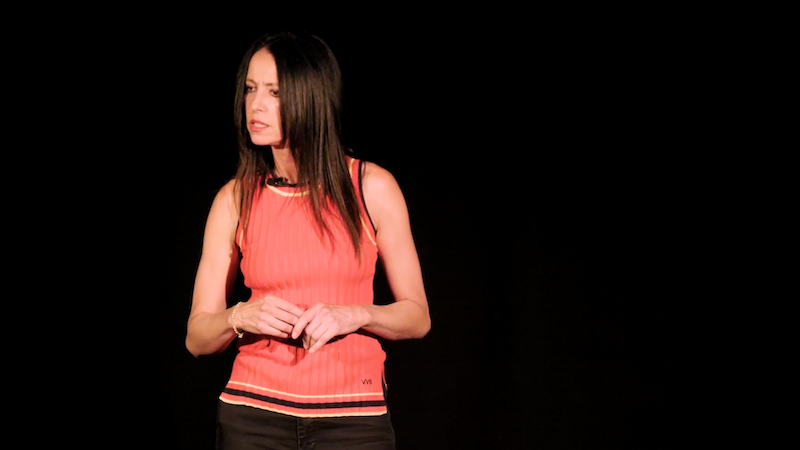
Writer: Samia Rida
Director: Gareth Edwards
It’s not uncommon for a comedian’s set to start by finding the level, using some provocative jokes to gauge the audience’s reaction. That technique is made explicit in Samia Rida’s Kidnap, as the hour of storytelling starts with an old-fashioned “Englishman, Scotsman and an Irishman” groaner, along with incendiary statements such as “multiculturalism has failed” – not her belief, but that of former Conservative Home Secretary Suella Braverman.
However tenuous her inclusion, there is a point to her bringing up Braverman, we are told. Rida’s family is genuinely multicultural. After the set’s shaky start, we hear about her Welsh mother and how she met Rida’s father, who is from Saudi Arabia. We also learn about her maternal grandmother, who suffered postpartum psychosis after the birth of Rida’s mother, and was institutionalised and lobotomised.
From there it’s an odd pivot to her father’s violence towards her mother, but that frames her descriptions of her three siblings. The youngest of four, Rida describes her two older sisters in less than glowing terms, but spends more time talking about her disabled brother, who is non-verbal and was born with cerebral palsy and epilepsy.
Rida’s stories about her family and how it was affected by her brother’s disability point to fertile areas that, when tapped, can provide moments of genuine insight as well as humour. But the cadence of her writing makes it seem as if each anecdote is building to a punch line that never arrives – at least, the story’s end is delivered as if it’s the killer line to a bit, but never has the impact required to make it work.
That carries through into the section of Rida’s work that gives the show its name. At the age of eight, Rida and two of her siblings were taken back to Saudi Arabia by their father. Rida makes light of the incident when describing the local newspaper coverage, but is more interested in describing her experience living with her father’s extended family. It’s a mixture of adult awareness – men dress in cooling whites while the women dress head-to-toe in heat-capturing black – with a child’s eye view of what, in young Samia’s eyes, was generally a pleasant experience.
That mix reveals that there’s not a huge amount of substance for a comedic monologue. Things pick up as Rida describes how the three children attempted to escape under their own steam and return to London. There is genuine tension and dramatic structure at work during this segment, which makes it all the more frustrating when it comes to an abrupt end, and Rida returns to her usual sardonic delivery.
That anticlimactic about-turn recalls earlier moments where the performer encourages the venue’s technical staff to change the lighting when she is making up a story, and her tales of scientific research that suggest when abused animals are faced with an open door they choose to stay with their abusers. But while the reintroduction of those elements at the end provides a structural payoff, it also undercuts Rida’s storytelling. There is a sense of an interesting family dynamic to be explored here, but focusing on her kidnapping by her father may not be the best way in to find the true nuggets of interest.
It feels like there are many tales of young Samia, her siblings and her dysfunctional parents that the writer-performer is yearning to tell. In this current structure, though, such stories feel frustratingly out of reach.
Runs until 1 August 2026
