

Writer: Ödön von Horváth, translated by Christopher Hampton
Director: Matilda Ziegler
Written in 1937, Ödön von Horváth’s Judgment Day is not explicitly about the rise of Nazism in the playwright’s native Germany. Its portrayal of a village that rises up against individuals based on the scantest of evidence, though, has both echoes of life under a cruel, fascist regime and resonance with a 2026 world in which online hate campaigns trigger mass protests based on suspicion, rumour and barely any fact.
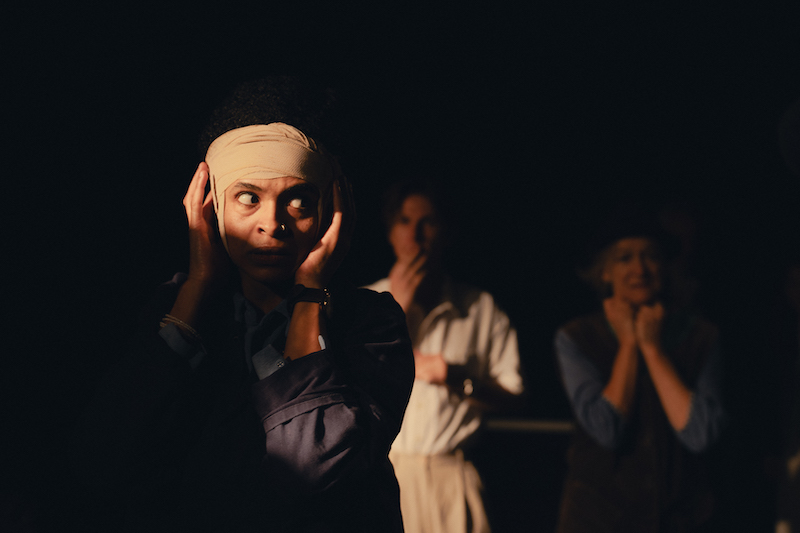
The play is set in a rural German town where a single man, Thomas Hudetz (Craig Hamilton), runs the small railway station as ticket salesman, platform guard, porter, and signalman. When his eye wanders in the direction of local girl Anna (Faye Ziegler), he fails to set the signal correctly, causing an express train to crash with substantial loss of life. In the subsequent investigation, Anna lies and claims Hudetz did everything correctly – testimony disputed by Hudetz’s wife, who was watching her husband kiss Anna when the tragedy occurred. As the village sides with Hudetz and Anna’s version of events, Agni Scott’s Frau Hudetz is ostracised, even though she is the one telling the truth.
Horváth’s work initially presents Hudetz as a pillar of society, respected by all and admired for his devotion to his job, only to expose him as ruthless and willing to lie to save his own skin. While Anna expresses guilt about her part in the deaths, and of her lies to save Hudetz, the stationmaster seems to double down. The sneering cruelty of Hamilton’s portrayal may not get to moustache-twirling heights of melodrama, but it comes close.
Director Matilda Ziegler (who played Anna in this translation’s 1989 debut, the role now taken by her daughter) leans into some of the play’s broader strokes, with many of the villagers coming across as arch stereotypes rather than rounded characters. Together with Christopher Hampton’s translation, which is often mannered and formalised, this creates a distancing effect. Horváth’s name may not be as well known as Bertolt Brecht or even Max Frisch (whose 1961 Andorra bears echoes of this work), but the style is undoubtedly familiar.
Yet the play feels most vivid when some of the characters feel slightly looser and more contemporary to us. Both Ziegler senior’s Frua Leimgruber, an archetypal old gossip, and Michael Higgs as Anna’s father are able to take Hampton’s mannered prose and give it a less stilted cadence. The rest of the cast struggles to emulate the same, bar perhaps Adrian Greensmith’s barmaid Leni, in a small but pivotal role.
Musician Evie Hilyer-Ziegler’s haunting live score adds to the atmospherics, especially in the second act as further tragedy triggers a manhunt and something of a supernatural reckoning for Hudetz. However, the score distracts from the climax of both acts; while the onstage performance comes to a suitably abrupt stop each time, the score lingers, robbing those moments of the impact they deserve.
It is always saddening, and not a little maddening, when a play written within (and partly about) the rise of fascism seems to also be so relevant. The eternal questions when a work is revived, especially one that is lesser known, are why this play and why now? Despite the deliberate distancing effect of Horváth’s style and Hampton’s mannered translation, Judgment Day feels like it has definitive answers for both. Judgment Day may be 90 years old, but it has a lot to say about contemporary times.
Runs until 10 October 2026
