

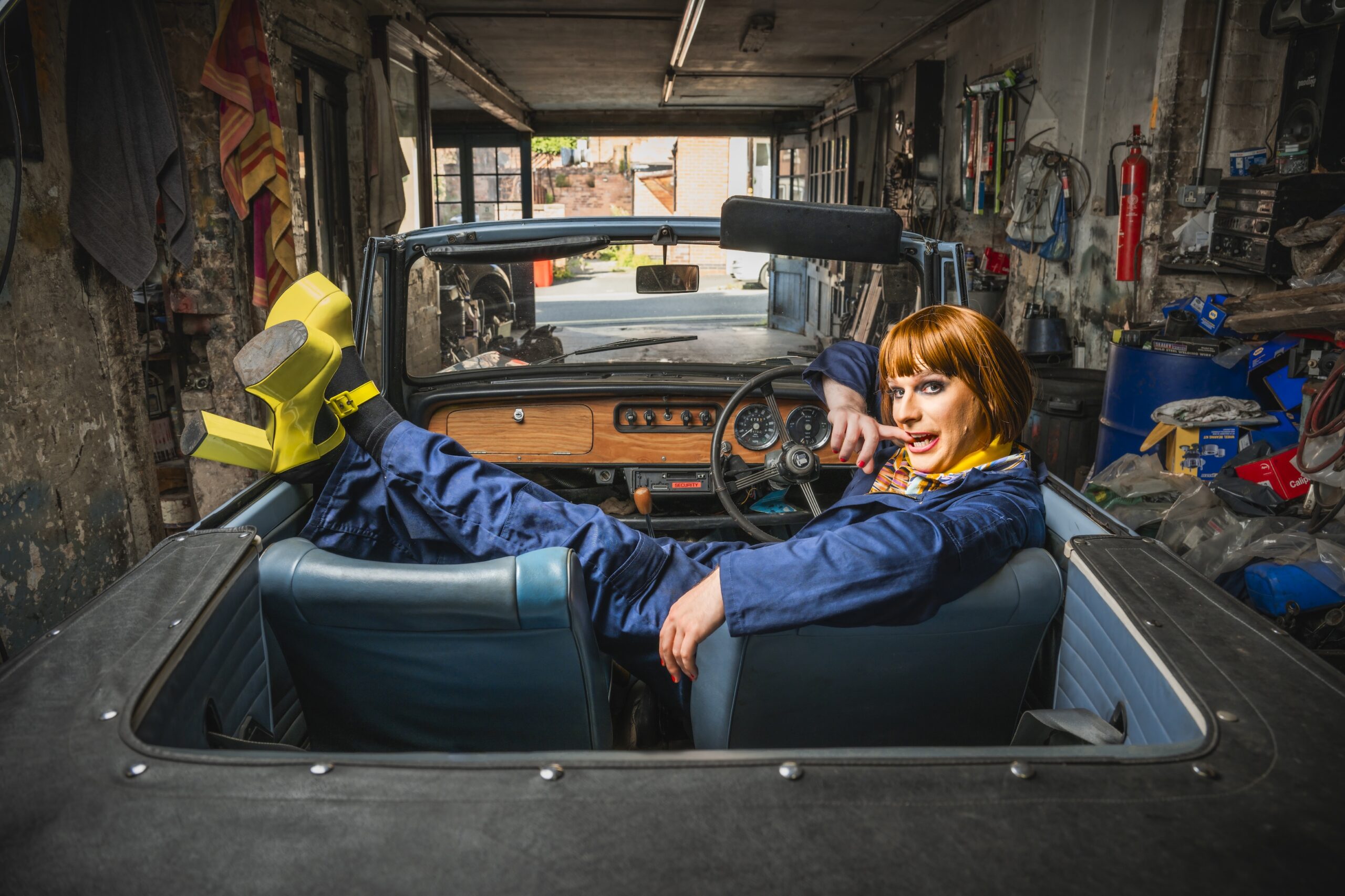
Co-created and performed by Matt Miller, Fixing is a hilarious, moving one-person show, which premiered in Newcastle last year and deals with family breakups and trying to make things better, learning car maintenance – with the help of Miller’s drag alter-ego Natalie Spanner – and choosing the right shade of lipstick to do it in. The show seeks to initiate conversations around care, nurture, rupture and recovery.
Ahead of the show touring to the Lawrence Batley Theatre in Huddersfield, Queen’s Hall Arts Centre in Hexham, The Garage in Norwich and the Tanya Moiseiwitsch Playhouse in Sheffield, we spoke to Miller about how they created the show and where their inspiration comes from.
What is Fixing about and where did the idea come from?
Tell us about your drag alter-ego Natalie Spanner and where the inspiration for her comes from.
Drag as an art form has rapidly grown in popularity over recent years – why do you think audiences enjoy it so much?
First and foremost, it’s fun, and I think audiences need that right now. That’s the easy answer, but also an important answer. We wanted this show to have a good amount of fun, and Natalie gives us that in spades. Digging deeper than that, genderplay has obviously been a really hot topic in recent years, with some pretty toxic responses. I think drag allows both a place that can fight back against that growing puritanism around gender, whilst also providing a place to engage with gender-twistery that can feel safe and manageable for both performers and audiences. It’s a bit of a paradox. That’s its strength. Drag is integrally political. The act of performing gender code-switches in itself throws spanners into the system and always has. But drag also has a bit of a superpower in that it can simultaneously fly under the radar. Cross-dressing has become a lot more difficult over the last ten years, but drag has become more popular. It is an arena where conversations around gender can be played out in a way that is fun, entertaining and, yes, always, still political, even if you don’t notice it. It can be easier to get complex, serious points across from a position of fun sometimes.
This is your third production with Peader Kirk. What have you learnt from your time working with Peader Kirk?
So much. It’s a cliche to say he’s taught me everything I know, but it’s not far off! I came into theatre through a bit of a wibbly wobbly route – I was a performance poet before I was a devised theatre maker. I didn’t train in theatre. In a way, working with Peader has been my training. His wealth of knowledge in theatre and live art is incredible, and his ability to throw the right things together in combination feels like a magic trick. He talks about it sometimes in terms of cooking – putting chilli and chocolate together for instance. It shouldn’t work, but it does. What does this story need to elevate it? So, our process started as me bringing autobiographical content and stories and Peader offering suggestions as to what we might put against that. Like the idea of performing magic tricks to flag up the feelings of visibility/invisibility around gender expression for instance. Every show, I’ve learned a new skill as well, or stepped into a new kind of performance. That’s a theme. Over the time we’ve worked together, our roles have merged in really interesting ways though. We both write now, we both structure. I think it was me who brought the idea of drag in this time, and we’ve both worked out what that means together. I think it was probably Peader who brought in the idea of Natalie being a self-help guru. It was certainly Peader who brought Dr Graham Music on board, and told me to get along to some garages to learn car maintenance hands on. But it’s increasingly a meld of ideas now, which feels right. The shows are truly co-created in every sense, I think.
What has been the highlight of your career so far, and what are your future creative or theatrical aspirations?
Theatre maker Chris Thorpe says something along the lines of ‘the only way to fail is to stop creating’. I often come back to that. Carrying on making work feels like it’s own end goal. It’s not always easy, and this show has been cooking for a few years. But the aspiration, really, is to keep making work that chimes with people, work that allows me to process a particular time or aspect of myself, but also allows other people to unlock something, feel something, shine a light on themselves. When we were touring our previous show, Fitting, someone brought their young gender non-conforming child along to the show ‘because it felt like they might enjoy it, and this might be useful for us both’. That was a highlight. With making art doesn’t always feel like you get to see tangible achievements. It’s not like building a building. But that felt tangible. It felt like what I’d done had been useful.
What do you hope audiences will take away with them after seeing Fixing?
We’ve had audience members saying after shows that they want to ring their dad now, which is great. So you might take away some renewed family connection. You genuinely might also learn something about how to maintain your car! I hope you’ll feel connected to other people. And uplifted. An hour with Natalie is a lot of fun.
