


Joe DiPietro hands over the final draft of a musical reluctantly, and only when perfected. “I honestly didn’t hand over the final copy to the cast and Kathleen until this past Thursday,” he tells me, four days before press night at the Aldwych. We are speaking by video call; DiPietro is at home, relaxed and warns me early that his partner might ring the doorbell. “I believe theatre is almost like having a living canvas that you’re painting on.” There is no apology for alterations that have been made in that. It is instead a statement of method: the show is not finished until it is right, and it was not right until Thursday.
That canvas has been three years in the making. Sinatra: The Musical began life at Birmingham Rep in 2023, crossed the Atlantic for a workshop reading, and now arrives in the West End with a new Sinatra in the form of Joel Harper-Jackson and a first act that DiPietro has trimmed from seventy-five minutes to sixty-five. “You’re always better off having a great two-hour show than a pretty good two-hour-and-fifteen-minute show,” he says.

For DiPietro – Tony Award winner, author of Memphis: The Musical, and the man who wrote Diana – the invitation to write about Frank Sinatra was less a commission than a homecoming. “My Italian American grandmother had two pictures cut out from Life magazine tacked on her kitchen wall,” he says. “One was the Pope and the other was Frank Sinatra.” He grew up in New Jersey, moved to Hoboken after college, Sinatra’s birthplace, and knew instinctively what Sinatra’s ascent had meant to that generation of Italian immigrants. “I knew what Sinatra meant to Italian Americans of that era,” he says.
“I told Tina (Sinatra, Frank’s youngest daughter): I won’t have to research what it’s like to be an Italian American of that time.” His grandmother, he adds, was still calling her refrigerator an ice box in the 1970s. That detail is in the show, owing, in a way a non-Italian couldn’t have taken for granted, to his own heritage: “I didn’t even consciously think about that. That’s, of course, how that woman would refer to her appliance.”
Tina Sinatra was DiPietro’s first port of call before he read a single biography. Every Monday during a punishing schedule at La Jolla Playhouse – where he was simultaneously working on the ill-fated Diana – he would drive three hours up the California coast to sit in Tina’s “den”, surrounded by family photographs, mementoes, and books about her father, and listen. “She gave me unprecedented access,” he says, something no archive could: specific, humanising details. One of such details is now among the most disarming moments in the show. When Frank left for Hollywood, Nancy Sinatra packed condoms in his luggage. “She said, ‘Don’t do anything stupid,'” DiPietro recounts. “She knew what was going to happen. It was a time when women were taught to look the other way.” He pauses. “That tells you so much about both of them.” He adds quietly that this detail is “nowhere else. No one else knows about that.”
Contradictions, he found, came not from Tina but from the written record. “The contradictions were in the books,” he says. Some accounts he trusted; others he dismissed as “scandal sheets.” What Tina gave him was balance and a mandate to pursue it. “No one wants to see a watered-down, milk-toast version of your dad,” he told her. “No one will believe it.” To her credit, he says, she agreed. There were very few things she pushed back on. She gave him, in his words, “carte blanche.”
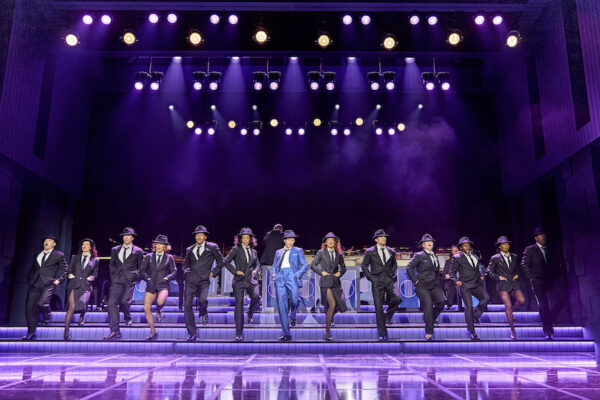
Joel Harper-Jackson and ensemble company. Photography by Birgit and Ralf Brinkhoff.
The result is a show DiPietro describes as an origin story: “How Frank got his superpowers.” The period it covers (roughly the mid-1940s to the early 1950s) is one of spectacular collapse and improbable resurrection. Sinatra left his wife, Nancy, for Ava Gardner, his records stopped selling, Columbia Records dropped him, his voice haemorrhaged. And then, almost impossibly, he campaigned his way into a small supporting role in From Here to Eternity, won the Oscar, met the arranger Nelson Riddle, and rebuilt himself into something greater than he had been before.
DiPietro was drawn to this period precisely because of that dramatic shape. “I thought it was the most dramatic and potentially most interesting point of his life,” he says. “He was complicated, but the times weren’t. I could put a complicated person in this really interesting story.” The Rat Pack years – Frank, Dean, Sammy – would have meant a different kind of show entirely, and one he wasn’t interested in making. “If you say Rat Pack, people will expect a Vegas show. Four guys in tuxedos.” He waves a hand. “Unpacking all that would be great, but I wouldn’t be interested in just [that].” The later years, he adds, only compound the complexity: “Then he married Mia Farrow, and she was 20, and he was 50. So, you just have to… it gets a little more complicated.”
What interested him more was the question of why Sinatra’s legacy endures when his contemporaries, such as Bing Crosby, Doris Day, have receded. DiPietro’s answer? Billie Holiday. “From the first time he saw her in this little Chicago supper club, he wanted to emulate her,” he says. “She put all of her emotions, all of her heartache into her music, and Frank heard her and said, ‘ That’s what I want to do.” Crosby, DiPietro argues, was sentimental: perfect for Christmas, useless in February. Sinatra was, like Holiday, viscerally emotional and true, and truth doesn’t date. “You listen to One for My Baby, and you’re like, the guy singing this was in a bar in the middle of the night because he’s depressed. You don’t have to do research for that.”
That same appeal shaped song selection. With a catalogue as vast as Sinatra’s, DiPietro found the story could always lead, and a song would follow, the reverse of the usual jukebox problem. “I let the story dictate,” he says. “Frank so embodies all of these songs that I could always find one that expressed what he was going through.” He describes the process as writing backwards – working toward songs already known to audiences rather than creating songs the scene requires – but stresses that the story’s demands came first: Sinatra had enough classics that the narrative never had to bend for the music. Even so, the choices cost him. Summer Wind, a song he loves, couldn’t be made to fit the story. Cycles, an early-seventies recording most audiences won’t know, still haunts him. High Hopes, which he had earmarked for a scene between Frank and young Nancy, was replaced at Tina’s suggestion by The Way You Look Tonight. “That’s maybe a better song,” he concedes.
The problem of chronology – how to include My Way, written in 1969, in a show set in the 1940s – is one DiPietro faced head on. A purist solution was available: restrict the show to songs from the period depicted. He dismissed it. “I’ll Never Smile Again is a great song,” he says, laughing, “but the crowds are not going to be happy if he just sings ‘I’ll Never Smile Again.” The answer instead was dramatic logic. “Frank so embodies these songs that they were always within him,” DiPietro says. “They’re always inside him, and in our narrative, they’re just coming out earlier. We’re not writing this show in 1953. We’re writing it in 2026, with modern ears looking back at his life.”

Joel Harper-Jackson and Phoebe Panaretos. Photography by Birgit and Ralf Brinkhoff.
The casting of Joel Harper-Jackson came late. DiPietro knew him by reputation as a dramatic actor, knew he had replaced the lead in Cock in the West End, but wasn’t certain about his voice. “Joel walked into the audition room and sort of swaggered up to the table,” DiPietro recalls. “Masculine confidence, not arrogant, just like: I’m here to do this job.” He sang. DiPietro was convinced. Then Harper-Jackson began the scenes, and Tina Sinatra, seated beside DiPietro, reached over and grabbed his hand. “She started getting emotional,” he says. “And I’m like: this is the guy.”
It is, DiPietro is at pains to emphasise, a massive role. “There’s an old writing thing: take your protagonist and throw as much as you can at him, then let him figure it out. We throw it all at Frank.” He grins. “And Joel knows how to embody that.”

Watch the whole interview here (to be added soon)
Sinatra The Musical is playing at the Aldwych Theatre and is booking until 10 April 2027. Tickets here.
