

Writer: Robert Khan & Tom Salinsky
Director: Josh Roche
Robert Khan and Tom Salinsky have carved out something of a niche with their contemporary historical thrillers that explore how grubby machinations, rivalries, and backroom deals among small groups of often ego-driven people change the course of British history. Coalition, Kingmaker and Brexit looked at the Cameron and Johnson years. Last year’s sell-out, The Gang of Three, focused on the factional splintering of the Labour Party in the 1970s. Set a decade later, their fascinating, timely, and impeccably put together piece, In The Print, explores the splintering of an entire industrial class: the final, decisive confrontation between Margaret Thatcher’s industrial reforms and the trade unions’ traditional power.
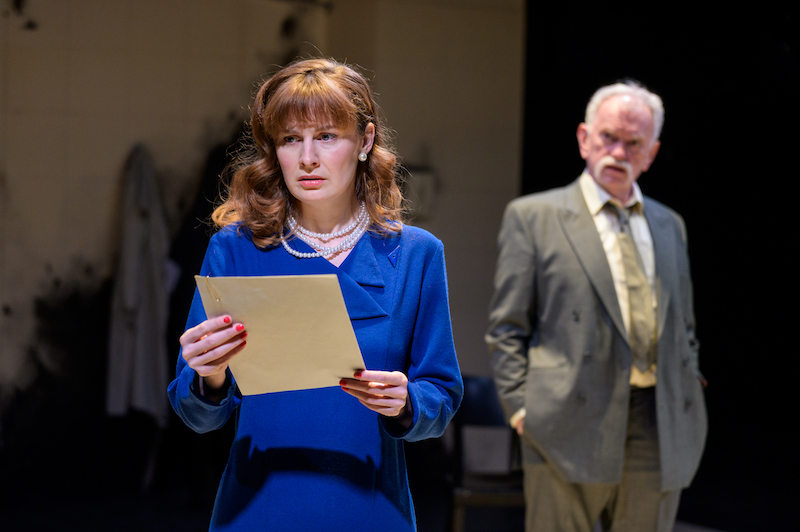
It is 1985, and Brenda Dean (Claudia Jolly) becomes the first woman to lead a major British trade union, elected mainly by poorly paid female clerical workers outside London. Meanwhile, Rupert Murdoch is secretly constructing a high-tech printing plant in East London, equipped with computerised technology that will render the jobs of Dean’s highly paid, militant, male Fleet Street printers obsolete.
Determined to draw power away from the unions and back into the hands of proprietors, Murdoch (Alan Cox) entices the union into a trap, triggers a strike, summarily dismisses 6,000 workers, and moves production behind the razor wire of “Fortress Wapping”. What follows is a bitter, sometimes violent year-long clash of wills between Dean’s tough-as-nails printworkers and Murdoch, backed by compliant police and the legal might of Thatcher’s law reforms. Will Dean overcome plotting by competing unions (whose names we hear resemble a random “set of Scrabble tiles”) and leverage the printers’ might to bring the heavily indebted Murdoch down?
“It’s easy to get attached to an old idea”, Murdoch tells Dean shortly before she is elected to her job. Technology-led change is coming, and as he schemes to rewrite the rules of the paper business, what he wants to know from her is, “Are you going to help me, or fuck everything up?” Dean, who grew up checking her dad’s pay slips to make sure his employers were not cheating him, sees the need for modernisation but must take her members, embodied by the old-school “Father of the Chapel,” Bill Sargent (Jonathan Jaynes), with her.
The serpentine, foul-mouthed editor of The Sun, Kelvin Mackenzie (Russell Bentley) and the louche, self-regarding Sunday Times editor Andrew Neil (Alasdair Harvey finds the evening’s best comic moments) add spice to the Machiavellian treachery and plotting. Georgia Landers completes the ensemble as Joan Harrison, the lawyer tasked with helping Dean navigate the legal challenges involved in standing up to Murdoch.
Director Josh Roche brings a claustrophobic air to events as Jolly’s spiky, hard-nosed Dean (the actor’s extraordinary similarity to Angela Rayner may or may not be casting happenstance) faces up to the “malevolent cane toad” that is Murdoch. Jaynes finds pathos in Sargent’s “machine-room Robespierre” shop steward, who is fatally blind to events unfolding around him. Cox, tremendous in last year’s The Gang of Three, is on top form, too, as the devious, calculating proprietor with a God complex (“let there be light”, he says as the first Wapping print run emerges) who decides to fire the Sunday Times’ investigative journalism team for not finding out in advance what he is up to.
Sarah Spencer’s slow, insistent drumbeat sound design adds tension, even though we know from the off where events are heading. As they often do, Khan and Salinsky find most of the drama by focusing on the losers. There is Greek tragedy in Dean’s inability to understand that she is being outplayed at every turn by a man who believes in “total victory and utter defeat”, or indeed to recognise that the union’s dodgy working practices are a factor in the demise of so many jobs. Peiyao Wang’s set hints at the grim reality of the old-style Fleet Street print room: smudges of ink splashed against the floor and rear wall, with coat hooks where the workers’ scruffy, stained jackets are destined to end, hung up, for good.
The parallel between the events shown in In The Print and the current wholesale dislocation of the world of work resulting from the AI revolution is hard to miss. “Ink and paper are lost causes”, bemoans one of the union characters late on. If it was true then, it feels truer now.
Runs until 3 May 2026
