

Writers: William Shakespeare and John Fletcher (in collaboration with Hannah Khalil)
Director: Amy Hodge
Breaking away from previous incarnations of the play, Shakespeare’s Globe brings a fresh perspective to a classic staging of Henry VIII, delivering a new context through the reframing of the female characters and their roles within the story. Entertaining and empowering, this modern staging brings feminism to the heart of the drama, and flips the hierarchy of gender on its head.
Henry VIII is a theatrical adaptation of the sequence of historical events that broke England away from Catholicism, addressing his divorce from Katharine of Aragon and his subsequent marriage to Anne Bullen(Boleyn) with whom he fathered a daughter, the future Queen Elizabeth I. This new adaptation tells the story from the perspective of the female characters who are often overlooked in the original text. Taking center stage as the main character through whom we observe the events, is Mary, the young daughter to Henry and Katharine.
In this contemporary reimagining, writer Hannah Khalil enriches the parts of Katharine, Mary, Anne, and the female ensemble characters by using text and dialogue from many of Shakespeare’s plays and sonnets, enabling depth and development to be seeded in each character, and providing a new context for the events of the story. However, while these additions create a rich and rounded atmosphere for their supplementary narrative, they also seem to cause some issues in pacing, where certain scenes are either too long to hold adequate attention from the audience, or too short to convey the drama and emotion they are deserving of.
The upheaval of the classical patriarchal approach in the production provides an interesting contrast between the attitudes of the different genders. Blurring the lines of traditional masculinity and femininity often found in classical literature, Henry VIII reverses the characteristics of the characters, with the women being proactive and dynamic in their pursuit of power and respect, whereas the men become the pitied, powerless, and helpless, which is well-demonstrated through the emotional monologues of Buckingham and Wolsey.
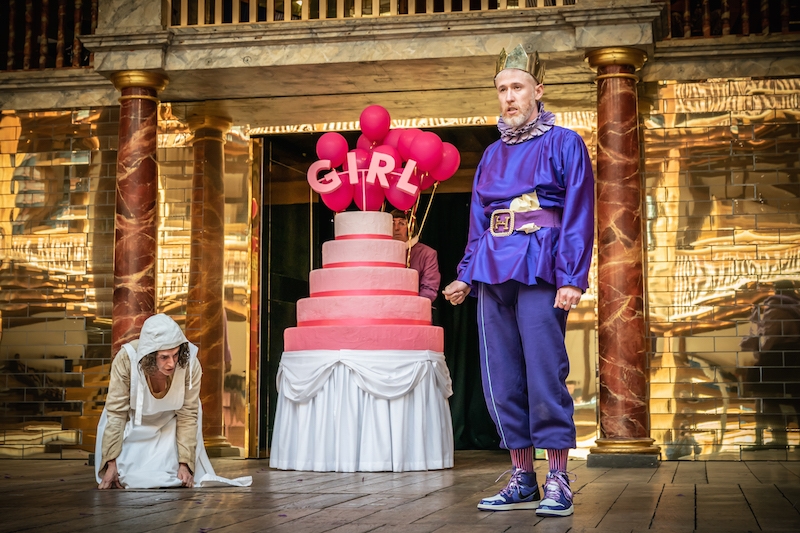
The visual design of the performance is a vital element of its artistry. Costumes and set, designed by Georgia Lowe, allow the story to thrive in its metaphors and surreal unreality of semi-fiction. With an almost child-like design to the apparel and scenery, the style seems to reflect the events as seen through Mary’s eyes, bringing her closer to the role of an observational narrator.
Adam Gillen triumphs in the titular role of King Henry, with a mesmerisingly commanding presence that demands attention from his audience. Gillen does justice to the cruel nature of the tyrannical Tudor, while also committing to the hierarchical switch that reflects a sense of weakness and moral inferiority in comparison to his wives and daughters. Similarly, Jamie Ballard’s Wolsey and Jonah Russell’s Buckingham deliver equally compelling performances of helpless distress.
Although still ultimately the victims of the story, Bea Segura’s Katharine, and Natasha Cottriall’s Mary dictate a dynamic authority of femininity, and take charge of their own stories, expertly demonstrating the importance of recognising women and womanhood within a historically male-dominated world, both in reality and in literature.
This contemporary reimagining of Shakespeare’s classic play is a creative and bold new approach to historical literature and drama, and pushes itself to new depths with its feminist perspective.
Runs until 21 October 2022
