

Writer: William Shakespeare
Director: Ricky Dukes
Lazarus Theatre Company has set itself the challenge of performing Hamlet without the ‘adult’ characters, a feat which should in practice rule out the entire cast but ‘adult’ seems to be defined here as the older characters in clear positions of power – mainly Claudius, Gertrude, Polonius and, although not a court functionary, the Gravedigger. This 100-minute production at Southwark Playhouse also features several actors making their professional debut in what is an imaginative if inconsistent reworking of Shakespeare’s great tragedy.
Directed by Ricky Dukes, it soon becomes clear that it is all but impossible to stage this play without the adults, a classification that does not extent to the Ghost of Hamlet Senior whose pivotal appearance is played in full, though voiced collectively by the extended cast. Nor can necessary exposition or decision-making speeches be cut in their entirety, so Claudius, Gertrude and Polonius instead exist as a disembodied speaker, a kind of social control mechanism who speaks to the characters as needed. While the audience never sees the embodied King take fright at the play-within-a-play or give instructions to Rosencrantz and Guildenstern to ferry Hamlet to England, these necessary plot points are included as a monotone voice that could be calmly announcing the next tube stop rather than pronouncing exile on Elsinore’s heir apparent.
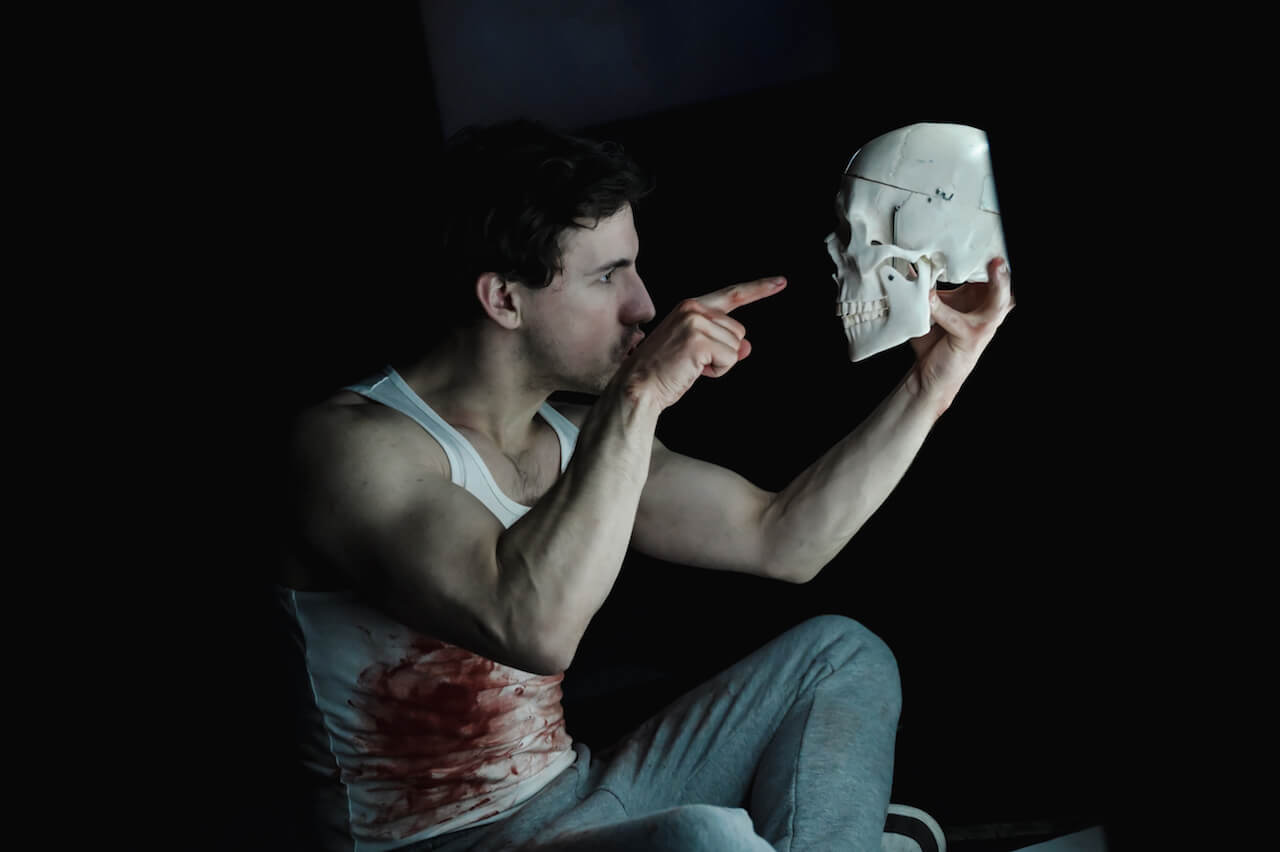
What it means for Hamlet is then quite complex, taking a great deal of empathy and purpose from a character the audience has no reason to trust or believe without antagonists to fight against. And it is never clear if creating a less likeable protagonist is the point. It is rare to see actors of about the right age as Hamlet and Michael Hawkey plays him as a petulant boy, sneering and snarling at his friends who struggle to understand his change of heart towards them.
This production also plays down the soliloquies so there is little attempt to get underneath Hamlet’s skin and to understand the depths of his emotions. Hawkey’s delivery is often fast with little chance to get inside the grief and betrayal his character feels or to unpack the lyrical meanings of these speeches, while ‘To be or not to be’ has an almost bombastic, declamatory feel as though Hamlet is excited by the possibility of the adventure beyond death. The performance though grows as the play unfolds as Hawkey settles into his bad Hamlet persona.
There are some really interesting choices here; the rehearsal room circle of chairs that evolves into a semi-full staging, the rapid cuts later in the play that excise almost everything from the graveyard to the fencing match and the staging of The Mousetrap that finds a rare comedy in the grotesque presentation of the villain – with suitably exaggerated costume touches by Sorcha Corcoran. There are some promising performance interpretations, too, from Lexine Lee as an angry Ophelia who refuses to be cowed by Hamlet and is instead broken by Polonius’ death, and, particularly, from Kalifa Taylor who delivers an affecting performance of the First Player’s speech that is unafraid to pause or allow the silence to settle – what a Hamlet she might make.
There are thought-provoking ideas but a Hamlet without the adults doesn’t quite work because the play loses some of its best material and its lead character’s core purpose while retaining the longer sequences that usually slow down a full production. If the starting point had been Hamlet in 100-minutes then that creates a quite different set of choices and possibilities. But it is an experiment worth trying and one that gives this young cast their first professional experience of rethinking a classic.
Runs until 4 February 2023
