

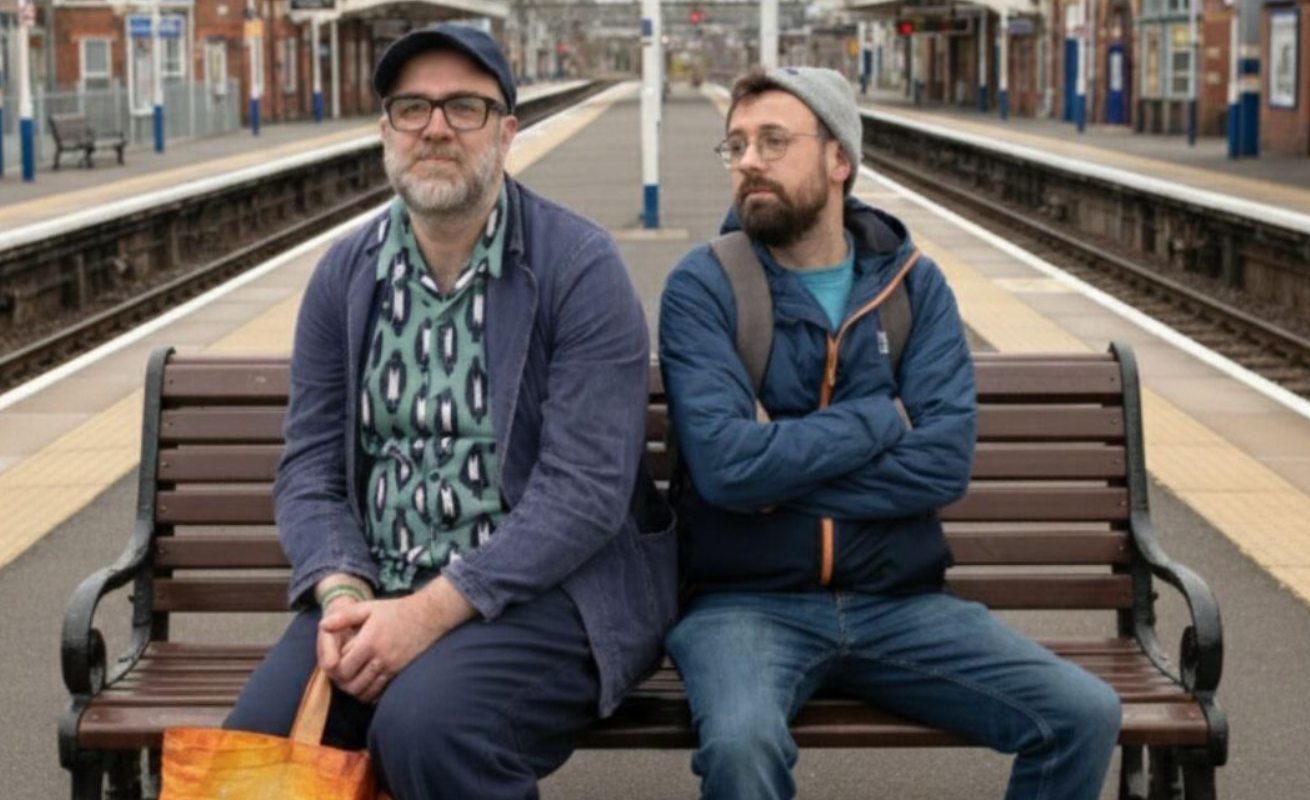
Gricers, a brand-new spontaneous play at the Unity Theatre, provided a masterful conclusion to the opening night of the Liverpool Improvisation Festival. It is a exceptional example of “theatre of nothing.” On the surface, the premise is as stagnant as a rusted rail: two men waiting for trains. Yet, beneath that stillness, the performance excavates the full gamut of life, love, and the human condition within a brisk, 50-minute runtime.
Much like the DNA of Waiting for Godot, the two characters, Mark and Mike, exist in a state of perpetual anticipation. They never see a train, but they fill the void with a chemistry that feels lived-in and dangerously honest. Whether spiralling into a hilariously surreal routine about speed dating or the logistics of male intimate waxing, the duo ensures the void is never empty.
The brilliance of the show lies in its distinct archetypes. Mark Smith plays the grizzly curmudgeon to Mike Burton’s eternal optimist, a man perpetually looking to Mark for a wisdom that doesn’t actually exist. They are joined by the Station Master (Fergus Wynne), who serves as the perfect yin to the duo’s yang. Wynne injects a burst of normality that acts as a structural anchor, rooting both the play and the audience in a recognisable reality.
This is fresh, funny, and inherently “dangerous” improvised theatre. Rather than relying on frantic plot twists or cheap gags, the trio demonstrates a rare aptitude for slow-burn improvisation. Phrases and motifs are recycled throughout the set, gaining new layers of meaning each time they resurface notably a recurring theme involving Mark’s questionable, cut-price purchases from TEMU.
There is a visible craft in how the performers utilise silence. By withholding or delaying dialogue, they allow the audience to find their own meaning in the gaps, perfectly echoing the frustrations of a cancelled train or life’s broader woes. Their bond defies easy labels, not quite father and son, nor brothers, but something akin to a long-term marriage where every look or muttered breath is a challenge or an olive branch.
The production value further elevates the work above typical improv. While the simple brick wall and rail signage provide a physical location, it is Xenia Bayer’s lighting that truly enhances the piece, delicately shifting to reflect the changing seasons. Such a thoughtful aesthetic is a rarity in improvised performance, which too often settles for a bare stage and a single lighting state.
The closing moments functioned as the emotional engine of the play, moving beyond “nothing” into something deeply substantial. Smith’s final monologue bridged the gap between the hobby of train-spotting and the universal desire for purpose. As Mark lamented Mike’s impending relocation to Birmingham, the previous 50 minutes of circular dialogue felt like a necessary prelude to this sudden, raw vulnerability. It clarified the relationships between Mark, Mike, and Fergus (station master), leaving the audience with the sense of a world that continues to exist long after the house lights come up.
Gricers proves that even when the train never arrives, the journey of the people left on the platform is more than enough to fill the stage. By focusing on the minutiae of the relationship, Burton and Smith found the extraordinary within the mundane.
Reviewed on the 7 May 2026
