

Writer: David Hare
Director: Jeremy Herrin
What is theatre for? A question Dave Hare might well have asked of himself when penning this slightly scattered depiction of the careers of Ellen Terry and Henry Irving, the darling partnership of the late Victorian stage, focusing on their time at Lyceum Theatre, along with parallel tracks for her illegitimate adult children. Grace Pervades arrives at the Theatre Royal Haymarket following its initial run at the Theatre Royal Bath, but struggles to find a purpose for this performance amidst its heavily expositional debates.
Inviting her to join his new company at the Lyceum Theatre in 1878, Ellen Terry and Henry Irving become the great actors of their day in a magical partnership in which she is able to direct him with a rare honesty. But as scenes from their lives and those of Ellen’s children Teddy and Edith play out into the 1960s, the cost of a theatrical life and never finding the perfect role take their toll.
Hare’s play cuts through time, looking at the importance and influence of theatre from lots of different perspectives as Ellen and Henry bicker happily through 20 years of a stage marriage that – in the words Hare gives to Irving – established acting as a serious profession for the first time since the Elizabethan age. Meanwhile, Ellen’s son Edward Gordon Craig, known as ‘Teddy’ (Jordan Metcalfe), pushes against the kind of theatre his mother’s generation represented in a failed search for modernism, his entire plot line merely serving a single reference to a young Peter Brook late in Act Two. Edith (Ruby Ashbourne-Serkis) moves from wardrobe assistant at the Lyceum to building a community theatre in her back garden, living in a bland but happy menage with two other women, although its integrated role in this story is less certain.
Yet Hare never lets the audience beneath the surface of these characters. Yes, the grand and glorious theatre is their life – “I am my work”, Henry proclaims – but we learn little more than the clunky biographies inserted into most scenes, much of which is repeated in the programme, and the characters seem to end where they started, developing little in their 2.5 hours on stage.
Ellen Terry is a woman of wild appetites and impetuous romances on the page, happy to live beyond the boundaries society creates for her, raising her illegitimate children and becoming a beloved stage star in spite of it all. Yet this clipped, stilted and always restrained version of her, played by Miranda Raison, holds back, offering little colour or spark to accord with the facts that Hare shoehorns into the play or the engrossing performances for which she is remembered.
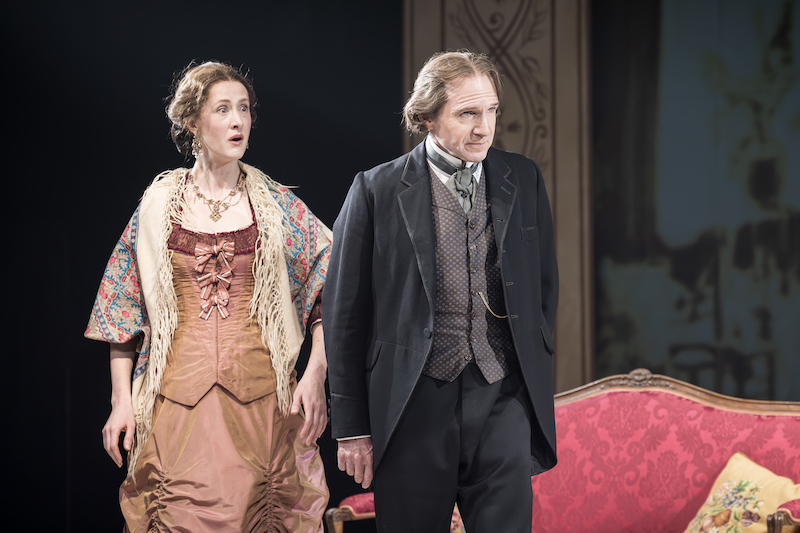
Irving is a little more successful in Ralph Fiennes performance as an awkward and unsociable man brought out of himself through acting and his relationship with Ellen, but beyond explanations about his repertory choices and Hare’s time jump structure, this feels like a tick list of the Irving-Terry highlights. Part narrated separately by Ellen’s children, their existence is a strange digression that suffers from her absence in their scenes, giving the audience no opportunity to see how her fame, her devotion to theatre and to Irving, along with her disastrous personal choices, actually shaped them.
There are some good lines, a smattering of comedy moments and the nub of some interesting discussions about the life of an actor as a servant to the play and to the company, as well as the extent to which a life onstage is more real for an actor, and certainly more meaningful than the one off it. But Grace Pervades feels incomplete. Even Jeremy Herrin’s direction is unusually flat in a play that ultimately is too invested in the revered reputations of Ellen Terry and Henry Irving rather than their complex flesh and blood reality.
Runs until 11 July 2026
