

Writer: Elvin Köse
Director: Marcello Crisci
A story of a fascist regime cracking down on civilian protestors is an all too relevant one. Barbar Theatre Collective’s Gallows and Children is inspired by 1970s Turkey, but similar stories reverberate around the world. That said, it is unlikely that any current regime is led by a raw meat-eating drunkard who has angry sex with their closest aides.
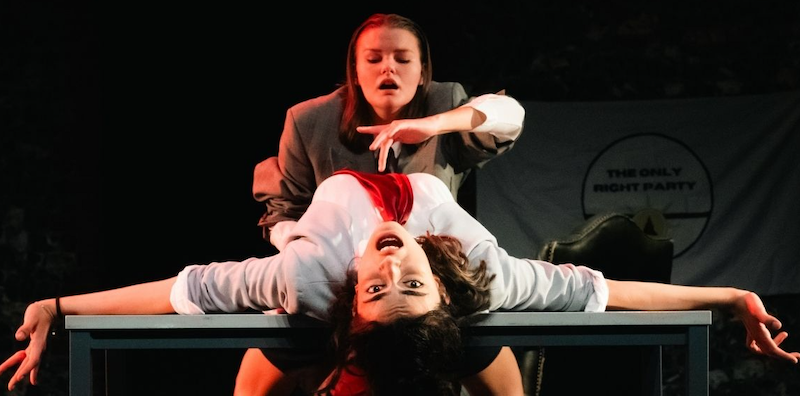
The trio of performers plays both the ruling regime and a group of protestors. The most interesting potential comes from the political leadership, where Ulla Lohi’s punnily-titled “Prime Sinister” is serviced by Elvin Köse’s sexualised assistant (who practices her “Good morning, Prime Sinister,” in the manner of Marilyn Monroe singing Happy Birthday) and a more practical Luka Nešović. Unfortunately, there is little practicality or believability in the portrayal. Instead, the troupe seems more interested in being quirky than in exploring the true nature of people in power.
There is also a framing device of a noose, hanging over the audience and whose shadow is occasionally cast onto the stage. It appears that this talking gallows is the real power, cajoling the Prime Minister into pursuing the regime’s worst excesses. It’s unclear what the company is trying to achieve with the device – if it’s suggesting that the figureheads of corrupt governments are often controlled by unseen forces the public is unfamiliar with, that would be one thing. Here, though, it lessens the impact of any anti-fascist intent, suggesting that the rulers involved have little to no responsibility for their actions.
Scenes of the ruling elite alternate with the same three players as students spurred on to protest and then take direct action. Again, there are germs of interest here, with Lohi playing a poet whose words progress from technical commentary to words of inspiration – although that ascendance comes more from the performance than from the words themselves.
There are moments of physical theatre that hint at something palpable, most notably as the students face police assault and torture. And as the regime grapples with how to quell the uprising, the fact that the students’ young age would seem to rule out their execution suggests a potential to grapple with how far a corrupt political class is willing to go in order to hold onto power.
Unfortunately, the whole piece is delivered in a manner that substitutes shouting for character study. Individuals’ motives and even personalities shift so often that it is hard to understand, much less care about, any of the characters involved. That leaves Gallows and Children as a piece which has identified a topic worth exploring, but does so in a manner that feels self-indulgent and opaque.
Runs until 13 March 2026
