

Writer: Patrick Nash
Director: Jesse R Tendler
Opening with an address to the audience that could either be a wellness-bunking critique of 21st century obsessions or a take-down of insincere bandwagon-jumping for profit capitalism, Funny Guy is a play that has a message but also wants to leave you guessing what it could be.
The address is delivered by Dan, played by Jud Myers, one half of one of two New York couples that the play revolves around. He has his own business and seems to be both happy and wealthy. His friend Bill, played by Jesse R Tendler who also directs the play, is still working for the man, lacking ambition and possibly earning less than his wife. We learn this in a conversation between Bill’s wife, Margie (Clara Francesca) who is complaining about him to Dan’s less than sympathetic wife Emma (Karen Genaro Dosanjh).
The two couple set-up could have come straight of many American sitcoms of the 90s or stage plays of the 80s, with the usual power plays all in place. Dan defends his friend because he doesn’t like Margie getting Emma to do her bidding rather than because he really thinks that Bill has his life sorted and some things are more important than money. Emma’s own annoyance at her friend’s complaints may also be more to do with feeling that the grass isn’t necessarily greener on her side of the street.
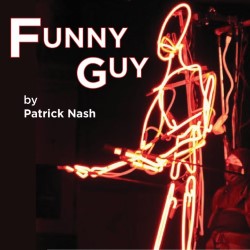
What takes the play out of the familiar and into the philosophical is the marionette that Dan creates and gives to Bill, leading to him finally discovering his true calling as a stand-up comic. His rise becomes meteoric and corresponds with Dan’s fall from grace as his financial worth and the life he has built around are revealed to be pillars of sand. The neon-glass version of the marionette, voiced and moved by Tommy Vance, looms large in Dan’s subconscious and on the stage as this happens. The message becomes as clear and illuminated as the marionette itself when this happens.
There are strong performances from all of the actors, and the neon marionette created by writer Patrick Nash is very impressive in its construction and the way it is integrated into the story rather than shoe-horned into it. However, the short, quick-fire, episodic nature of most of the scenes mean that the characters never really develop beyond the stereotypes and themes they’re there to illustrate. This also means that the script gets dangerously close to sounding like a message with a story attached to it, rather than the other way round. The marionette and the message are clear, but the characters and the story would benefit from more depth.
Runs until 24 August 2024 (not 18th) | Image: Contributed
