

Writer: April Hope Miller
Director: Merle Wheldon
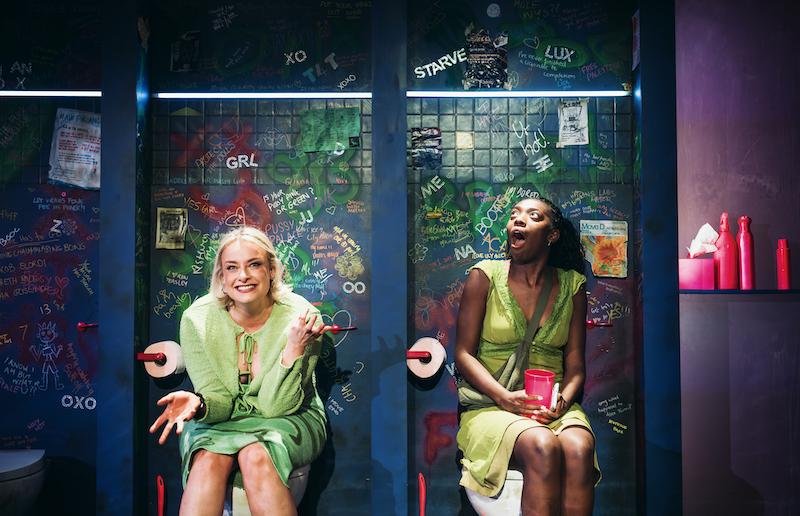
When looking for a play location that supports multiple people crossing paths, opportunities for conversations between friends and strangers, and conversations from the inane to the intimate, you can’t do much better than the ladies’ toilet in a nightclub.
The particular facilities in question in April Hope Miller’s Flush belong to an establishment in Dalston – one imagines not too far from the Arcola itself. Elle Wintour’s artfully designed set, walls between cubicles left to the imagination, and fluorescent graffiti that does the opposite, plays host to teenage girls stressing about their fake IDs, bridesmaids on a raucous hen night, a work outing, and much more.
Initially, Miller’s script uses the venue as a basis for some quick-fire sketches and character studies, with most of the five performers assuming various roles. Each performance seems as authentic as it is different, from capturing the swagger of teenage girls revelling in getting into the club in the first place, to a woman hiding in the loo to escape an encounter with someone with whom she shares an embarrassing school past.
Most notable of all these is American Billie (Jazz Jenkins), who has moved to London for a job in TV but is struggling to mix with her colleagues. Jenkins, the only actor to play a single role throughout the play, returns to show us how Billie’s evening is progressing. Like all the other scenes, this starts off humorously, with a re-recording of supposedly spontaneous voice notes, and laboriously over-explaining the fancy dress outfit she has chosen.
As the evening progresses (and for some clubgoers, the drink and drugs flow), all the characters’ stories introduce more serious aspects alongside the comedy. Miller’s Liv, a raucous maid of honour organising the aforementioned hen night, offers hints that her wild behaviour may be an escape from a highly stressful job. Miya Ocego, Ayesha Griffiths and Joanna Stratford’s multiple characters cover issues from eating disorders, a first tentative lesbian kiss and women who have been conditioned to reject trans women’s use of ladies’ toilets. In each case, the juggling act between humour and a message is deftly handled in both writing and performance.
It is in that deepening narrative that Billie’s story begins to emerge, from when Jenkins returns to the ladies’ with a wound on her knee and a sense that the formerly bubbly woman is emotionally shutting down. In the whirlwind of other storylines that intersect with each other, Billie seems increasingly isolated – until Liv, until now the maid of honour from hell, is able to shift back into work mode and use her listening and empathy skills to help a woman she has only just met in the toilets of a dingy club.
It is a progression like Liv’s that makes Miller’s piece such a strong example of writing and acting. It feels like neither a character nor a line is wasted in its portrayal of the variety of life that is witnessed in the ladies’. That it is also inclusive in its quiet, but adamant, refutation of transphobic rhetoric is a plus — but it is the strength and sympathy for Billie, and for the women up and down the country who, every week, blame themselves for the situation men put them in, that is Flush’s unmissable crowning glory.
Runs until 6 June 2026
