

Writer: Shimmy Braun
Director: Hannah Chissick
Shimmy Braun’s bleak drama, Faygele – the word means ‘faggot’ in Yiddish – covers familiar territory: teenage suicide in the face of homophobic bullying, internalised shame, and family rejection. The dramatic lineage goes back to Wedekind’s masterpiece Spring Awakening. “Words seem a little less evil in Yiddish”, says one of the characters. We certainly hear a lot of bigoted slurs during an evening of polemic that can be painful to sit through and light on optimism.
Research suggests LGBTQ+ teens are up to twice as likely to attempt suicide as their heterosexual peers. The problem is particularly acute in ultra-conservative faith communities, where the pressure to conform and the lack of easily accessible support are most apparent. Joel Edgerton’s 2018 movie Boy Erased, a tremendous film, explores the issue within a conservative Christian community. Braun sets his piece in an ultra-Orthodox Jewish community in New York.
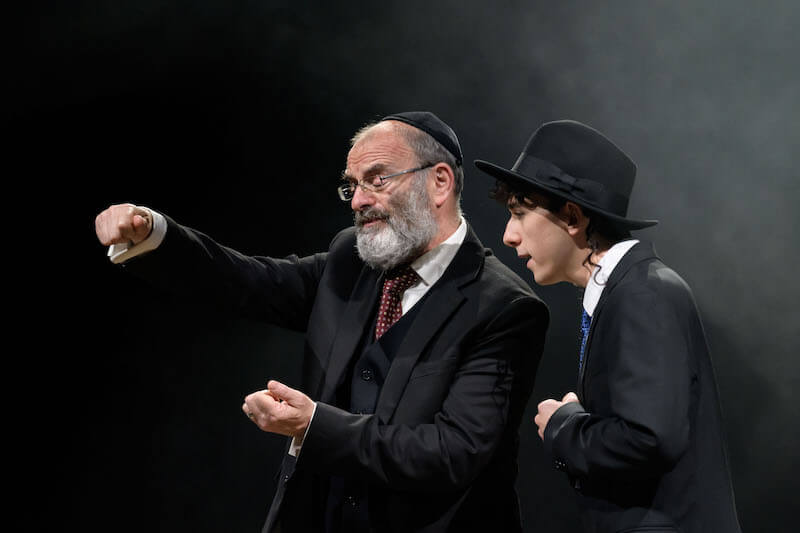
There are three iterations of the teenager Ari onstage much of the time in Faygele. The first is a black-edged photograph of a cherubic-looking 13-year-old at his Bar Mitzvah (“we should have called it a Butt Mitzvah” snarls the lad’s vile Dad). The second is a coffin containing his 18-year-old body. The third is the fourth-wall-breaking ghost of the dead Ari (Ilan Galkoff), who paces the stage listening in to the prayers and inner thoughts of the living, offering a kind of judgmental lens on the sins and hypocrisies of those who failed him in life. And failed he most certainly is.
Braun’s bulky narrative time shifts between the funeral, Ari’s childhood, and events leading up to his suicide. There is a late-act fancy dress dream sequence in which the characters act out a traditional Hasidic parable. It sits a little oddly with the tone of the piece, but at least offers a glimmer of light amidst all the darkness.
Ben Caplan plays Ari’s abusive, porn-addicted father, Dr Freed, an ironic name for someone so imprisoned by a wretched, condemnatory form of faith. Freed’s parenting style veers between violence and barely concealed loathing for his eldest son. “You’re a curse to the family”, he yells at the 15-year-old Ari. The boy’s crime? Sitting with his legs crossed the wrong way and suffering sexual abuse at the hands of an elder student at his Rabbinical seminary school. Braun offers up little credibility by way of backstory to explain why Dr Freed is such a monster, which leaves the character more of a cypher than a rounded personality.
Equally thinly drawn is Ari’s mother, Mrs Freed (Clara Francis), whose love for her child takes second place to shopping, her ten other kids, her duty to the patriarchal order, and her determination that Ari should “pray the gay away”. Francis does her best with what she is given, but the character barely moves beyond the stock ‘submissive wife’ trope. Braun rightly foregrounds Ari’s story. But one yearns for more complexity in these parental characterisations. Opinions will vary as to whether they remotely deserve the redemption Braun seems determined to give them.
What Galkoff’s nervous, capricious, contradictory Ari mostly wants in life is to be listened to and heard: “the ache of hiding, the thrill of being seen” is how he puts it. He finds solace in highly transactional sexual trysts with elderly members of the religious community, leaving open the question as to who the abuser is and who is abused. Some gay men will feel a twinge of recognition at the character’s teenage sexual precociousness.
Add to the mix family friend Rabbi Lev (Andrew Paul), whose struggles with reconciling his anti-gay religious certainties with affection for Ari add some welcome complexity to the piece. Yiftach Mizrahi plays Sammy, a kind of generalised role model for gay Orthodox youth (one suspects the voice of the writer lies here), but one who, in his way, also fails the boy.
David Shields’ stark set, featuring unembellished wooden planking, is beautifully lit by Nic Farman and cleverly evokes the austerity of absolutist faith. Revolving cubby holes reveal books and breakfast items. Simple chairs and tables, constantly rearranged during scene transitions, provide the only stage furniture.
Flawed as the work is, Faygele serves as a valuable reminder of the issues at stake for vulnerable LGBTQ+ teenagers. One cannot help but think that the ultra-Orthodox community that would most benefit from watching the play is unlikely to see it. The metropolitan Marylebone Theatre audience tends to take these themes in its stride, leaving the piece feeling a tad anachronistic.
Runs until 31 May 2025
