

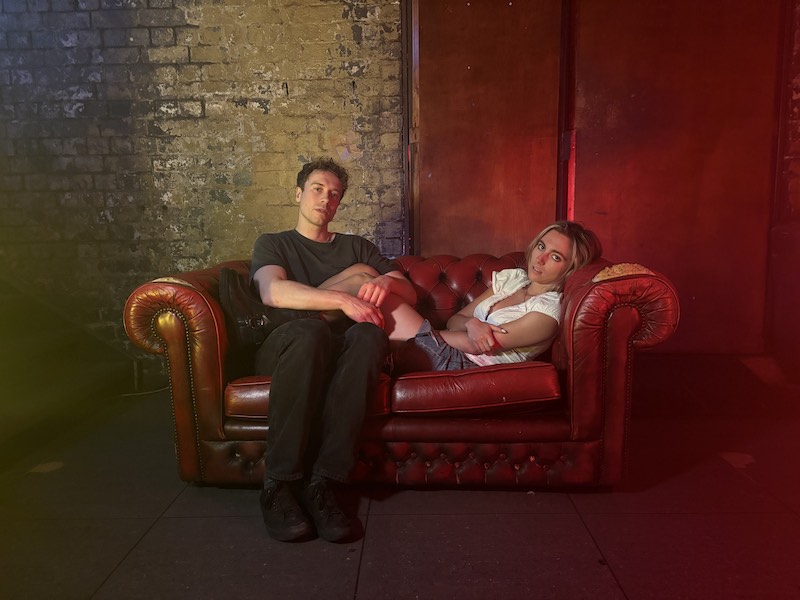
Writer and Director: Barnaby Tobias
Plato’s ancient Greek myth of Er is a reflection on how to live our best life. It’s a serious contemplation, so in Barnaby Tobias’s contemporary Er, a romantic twist is added. A fun proposition, though ultimately, this humorous exploration into the consequences of two people destined to be together leaves us without much to consider. The hour-long duologue is entertaining, but a thin plot finds two characters stuck in purgatory, and two watchable actors in search of a play.
With faint echoes of the dead Rosencrantz and Guildenstern, we meet Tess and Jay in an underworld, having died some time ago. Here, in some sort of waiting room, they are about to be released back into the world with another chance at life. On the verge of freedom, they must choose their next future, while, at the same time, trying to remember their past.
References to the river Styx or Lethe, and a neat metaphor for a city cab, hint at the play’s opening world. However, the question of who these characters were in their past life is the thrust of the story, and this is where things are muddled. There isn’t an immediate sense of when or where they were living, or how long they’ve been dead. Do they know they are destined to be together? We have to figure this out along with them.
As the play’s action jumps out of the anteroom, we learn only of one past life. These young university students met when Tess was a creative writing student who had just moved to the city. She finds herself at Jay’s house party, where their lives are cut short by a tragic accident. As events of their inevitable demise are revealed, these two are forever entangled.
Other than some barstools and a few props meaningful to Tess and Jay (the significance of which remains unclear), the stage is sparse. There are multiple references to a gold and fashionable dress that Tess wore when she died (“I’m too overdressed for the party”). Jay’s character, when alive, was a painter. The choice of black base for costumes leaves us only to imagine, and it would be nice to see a little more of who they were, perhaps with the addition of a coloured scarf or remnants of the golden material.
Tobias introduces a handful of other characters to Jay’s party, which allows Drew Sheridan-Wheeler and Emily Cosaitis’ playful interactions with the audience. Charming and funny, Sheridan-Wheeler’s Jay has a captivating physicality. In contrast, Cosaitis finds a stillness and grace in her young Tess, revealing an endearing awkwardness.
Oddly, for two destined lovers, Tobias at first keeps a distance between his characters, so without any chemistry between them, their initial relationship is elusive. The writing also focuses too much on showcasing literary references and clever dialogue, rather than character development. The actors bounce off each other beautifully and relish the words they are given, but there is little drama.
It’s a play that comes close to exploring the question of what we would choose if we had the chance of a redo on our lives. A thoughtful question worth asking, and one that might have been answered if Tess and Jay were old souls about to be thrown together again throughout eternity. But these young and sheltered characters have not lived much life, and perhaps this is why they have little insight into what has been lost.
The moment when Jay and Tess find each other at the party, a connection between these two characters sparks. Their meet-cute is funny, moving and genuine. Their excitement and newness, of finding someone who really gets you, incredibly sweet and believable. However, by this point, there is little else happening. The play’s synopsis is keen to guide us towards notable Irish playwrights whose work we will recognise as establishing this premise, but we are left waiting for more.
Runs until 26 August 2025
