

Conductor: Baldur Brönnimann
Director: Kip Williams
Composer: Du Yun
Librettist: Royce Vavrek
Angel’s Bones, a new work by composer Du Yun and librettist Royce Vavrek, opens at the London Coliseum after its UK premiere at the Aviva Studios in Manchester. We are warned that it’s a very dark work: ‘as morality dissolves,’ the programme notes, ‘uncomfortable truths begin to surface – not least our own willingness to look away.’
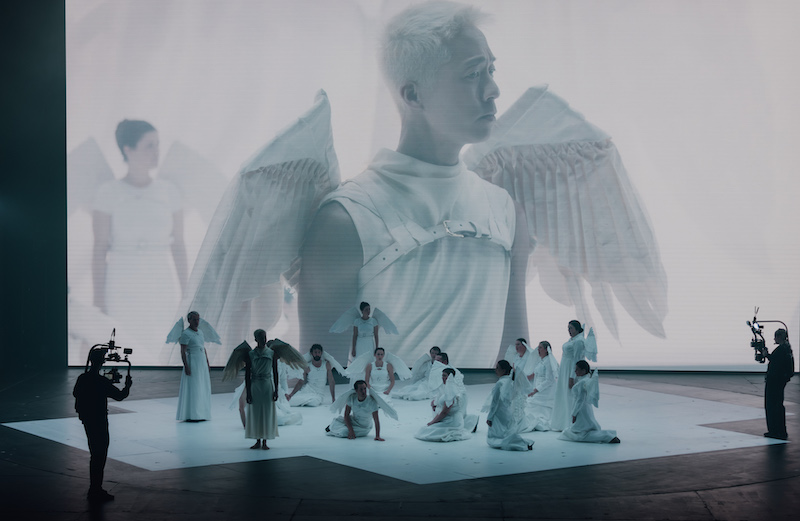
For the first half of this 80-minute work, Angel’s Bones is compelling. The performances, the surreal concept, the staging (by Marg Howell) and, in particular, the innovative use of on-stage cameras (video design by Ash J Woodward) all create something breathtaking. It’s true – you really cannot look away. As the cameras peer into domestic interiors of the ever-revolving set, they project onto a huge back screen scenes which would otherwise be small-scale and intimate. What we see is both grotesque and fascinating.
The central characters are a jaded middle-aged couple, Mrs X.E and Mr X.E, strongly performed by Allison Cook and Rodney Earl Clarke. Superficially sophisticated, they are privately in financial trouble, which is tearing them apart. ‘This is not the dream you promised me,’ sings Mrs X.E over and over, as she drags furiously on her cigarette.
But at the start we have seen a mysterious host of white-feathered angels looking down on this world, with a young couple, Boy Angel and Girl Angel, doomed for undisclosed reasons to land on earth, falling into brambles in the garden of the Macbeth-like couple.
The story moves quickly at first. Mr X.E discovers the shaken and damaged pair and brings them into the house to tend. The human couple, as we’d expect, see this as a mysterious blessing, the angels’ feathers in particular seeming some sort of precious celestial currency. There is some talk of whether God is indeed blessing the human couple or deceiving them. But this suggestion of providential belief goes nowhere and is soon dropped. Indeed, it takes no time for the couple to reveal their innate greed.
It’s Mrs X.E who decides on the next shocking step. The angels must have their wings severed to ensure they remain on earth. The scene which follows, as she wields a pair of secateurs, is fascinatingly horrible. Mr X.E joins in without compunction. There are none of Macbeth’s pangs of conscience here. We are shown the bloodied, torn flesh of their scapulars, as the wings are hacked off, the angels finally left with just their bony superstructure.
Du Yun’s score tracks the descent into human depravity. Having opened with a melodic chant of the angels, a whole range of clashing instrumentation creates a suitably unnerving evocation of this descent.
The couple are determined to monetise their captives, inviting friends to a party where each white feather is sold as a magical talisman. The symbolism now begins to feel strained. What exactly is it that the feathers will endow them with? Perhaps like the tale of the Goose that Laid the Golden Egg, the moral lies in the emptiness of the promise when greed spoils a magical gift? All we know is that the party quickly descends into a no-holds-barred orgy of drug-taking and sex.
The camera work is designed to leave little to the imagination, showing increasingly violent scenes of sexual abuse. But it’s around this point that the opera begins to flag. There’s only so much an audience can take of an onstage orgy, one might imagine. But the production, under the direction of Kip Williams, is determined to force us to watch almost beyond the point of endurance. The programme has much to say about modern slavery and sexual trafficking. But we’re in no danger of missing the point. And did we really need fallen angels to reveal the dark side of humanity?
The two innocent angels, the touching youthful Marian Wallentin and Matthew McKinney, are shown bruised and battered and now forced into degrading sexual acts with their captors. Shockingly, Mrs X.E will later declare that the Boy Angel has made her pregnant. Royce Vavrek’s attempt to turn this into a sordid reversal of the Annunciation seems just that – sordid and vulgar. By repetition, the words of the libretto now seem vacuous, with the return to early lines about Heaven being a ‘prism’ and a ‘flurry’ having little to add. As the damaged angels curl up for comfort in the couple’s bath, a line about a ‘clawfoot Eden’ sounds more smart than profound.
The climax of the work is the scenes of the violent rapes of the two angels, and the music is suitably powerful. Here, we feel Angel’s Bones could end – on a terrifying note of apocalyptic horror.
Given that the work began as a 35-minute chamber piece, Yun and Vavrek now go for a needlessly protracted ending. We watch the pregnant Mrs X.E, having shed her husband, reinventing herself by telling her story to the press. There are plentiful TikTok-style images of her, now in a new flattering wig, as she poses for the camera. But influencer culture is an absurdly easy target, and it’s at this stage that what at first promised to be profound in Angel’s Bones now reveals itself to be shallow and overblown. Even the much-vaunted generic variety of Du Yun’s music now feels sheer gimmickry.
Runs until 31 October 2026
The Reviews Hub Star Rating
-
6
