

Choreographers: George Balanchine, Martha Graham, William Forsythe and David Dawson
Music: Pyotr Ilyich Tchaikovsky, Gian Carlo Menotti, Thom Williams and Richard Strauss
The English National Ballet’s latest programme, R:Evolution, attempts to take a slice through the last 80 years of dance, showcasing four very different choreographers who helped shape the world of ballet.
While not quite a chronological journey through the evolution of dance, starting off with George Balanchine can make it feel that way. His 1947 Theme and Variations uses the final movement of Tchaikovsky’s Orchestral Suite No. 3 for a series of set pieces in costumes that epitomise Blanche’s classical style: all the women in stiff tutus, all the men in regal tunics and white tights. It’s what many people think of in terms of how classical ballet looks.
Whether the substance matches the style is another matter. All the choreographer’s trademark requirements are in there, from intricate en pointe work to full use of the expansive stage. But with no narrative to fall back on, the moments where the dancers do not live up to the precision that the choreographer would have demanded. While Balanchine himself did a great deal to move ballet beyond the classical mode, Theme and Variations harks back a little too fondly to the era being left behind.
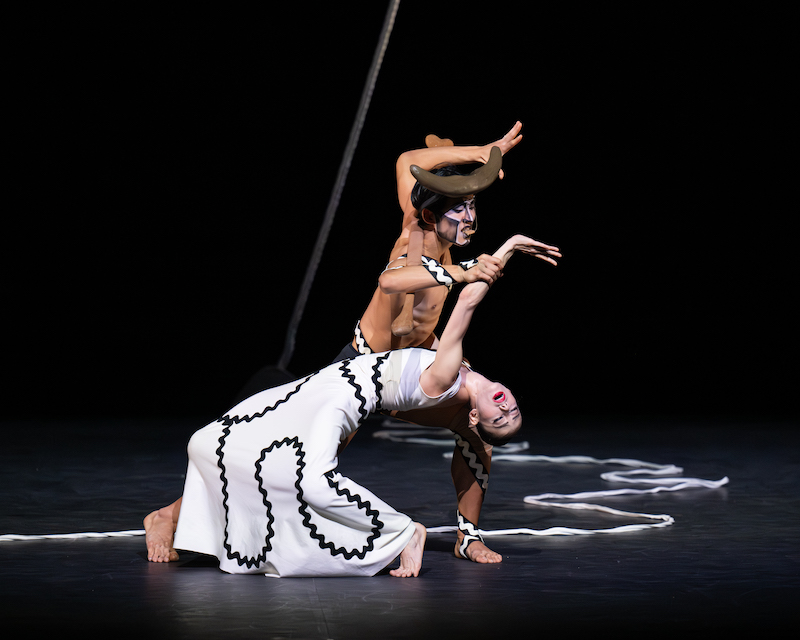
It is a complete volte-face for the company’s next piece. Martha Graham’s Errand into the Maze is a two-person psychological exploration, inspired by the legend of Theseus and the Minotaur. Emily Suzuki plays The Woman, a character infused with both qualities of Theseus and Ariadne, the Cretan princess who helps her love defeat the Minotaur.
Suzuki is initially alone on a dark stage, a twisting piece of rope guiding her way, towards a wooden structure that could be a gate, but also resembles a woman’s pelvis. In this version, the Minotaur is replaced by a “Creature of Fear”, Rantaro Nakaaki’s powerful frame topped by both a bull-like pair of horns and a yoke across his shoulder that thrusts his forearms upwards like a further set of antlers.
The choreography, which Graham first performed herself, is angular yet organic, a great deal more emotionally charged than the Balanchine. The Woman’s three confrontations with the Creature burst with raw intensity; the Creature’s eventual downfall, and the Woman’s ability to step through the gate, feel incredibly cathartic.
The whole piece feels decades beyond the Balanchine, and yet it originally premiered the same year as Theme and Variations, even preceding it by some months. Placed side by side, they epitomise how post-war ballet was breaking free of the classical repertoire even while retaining its elements.
There is less chronological ambiguity around Herman Schmerman (Quintet), a 1992 piece by William Forsythe that also featured in ENB’s Forsythe programme at Sadler’s Wells earlier this year. With original electronic music by Thom Willems, the evening’s programme returns to a narrative-free, abstract form. Here, though, there is a much greater strength of joyful emotion and playfulness, which, coupled with the five dancers’ precision, provides a thrilling sequence. On press night, one dancer ended up landing on the wrong beat, throwing off her own choreography in relation to the others. Still, the ease and subtlety with which she rejoined the formation without disrupting her own movement further emphasised the skill on display throughout.
The fourth and final work, David Dawson’s Four Last Songs, is at the other end of the emotional spectrum. Premiered by ENB in 2023, the work features 12 dancers, all in nude-coloured dance wear and body paint that further obscures the line between flesh and costume, who dance plaintively to Richard Strauss’s song cycle as Soprano Madeleine Pierard performs Herman Hesse’s libretto.
With songs that contemplate the nature of life, death, and the afterlife, the minimal costuming enables the dancers to assume roles of humans expressing profound love, sorrow, and joy, of angels shepherding them to a new, eternal life, or of the holy statuary adorning great cathedrals. In a sense, it brings the evening full circle, with a large ensemble performing largely abstract works – but it also demonstrates the progression of the ballet world between 1997 and the 2020s. Every move of Dawson’s work carries with it a heaviness, not of physical form but of emotional heft. It is a dance that one could not imagine sharing an era with Balanchine.
And yet it is Graham’s Errand into the Maze, the oldest work in the evening, that feels the most contemporary of them all. Perhaps that is the key here: the great choreographers will remain timeless, even as audience tastes ebb and flow around them.
Runs until 11 October 2025
