

Writer: Lieve de Putter
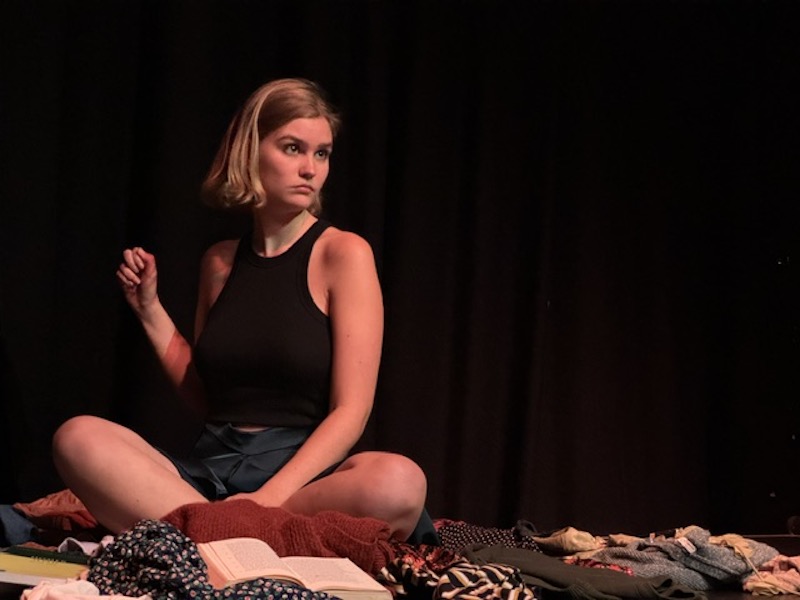
‘My echo, my shadow and me,’ The Ink Spots sang in 1946 (a song later covered by Brenda Lee), a sentiment that echoes in a new one-woman show exploring the recurring repression of women and the silencing of their voices. Performed at the Hen & Chickens Theatre, Echoes blends a modern woman navigating work and various patriarchal relationships with excerpts from Greek Tragedy and the many female characters whose stories have been shaped by men. Running at just 45 minutes, the piece makes impassioned connections between the ancient world and now, echoing the thoughts of every woman in the room who has certainly experienced them.
A nervous actor stands before the audience, afraid of her voice and all the characters she will assume; an office worker in high heels notices men eyeing her but cannot get them to listen; a girl on a date endures a man monologuing at her with no interest in her thoughts. Meanwhile, in Ancient myth, verbose women are punished: Philomela loses her tongue, Cassandra is deemed mad, Echo loses her autonomy, and Helen is stuck with a reputation attributed to her by men.
Echoes takes an interesting and innovative approach to explore many of the gender assumptions and biases that have shaped women’s lives throughout history, weaving together contemporary scenes with their ancient equivalents to demonstrate quite forcefully how little has changed. Across 10 mini-scenes, the writer-performer places these experiences side by side, emphasising the commonalities in how women have been treated and the consuming insistence of the male voice through time. So, as the office worker tries to draw attention to a report on harassment in the workplace during a male-dominated meeting, the scene fades into Cassandra angrily extolling the frustrations of being overlooked and ignored thousands of years earlier – offering a really smart and pointed commentary.
As these comparative scenes unfold through the single day-in-the-life of the unnamed modern character, Echoes also notes some of the wider behaviours and micro-aggressions that continue to afflict women in everyday life, a series of insightful observations about their objectification as men ogle her in the high heels that make her hips swing, along with the dismissive, patronising and thoughtless communication that both the central character and the classical women endure from the men who write them. The note about male translators deliberately styling Helen as a seductress while a very recent female translator recast the interpretation of her words entirely is particularly sharp.
This is a short piece, so there is relatively little time to delve into these scenarios in more detail, and much more time should be given to the classical women or women in the present. Some of the situations, from the laddy office meeting to the one-sided date and the conversation with her misguided father accelerate too quickly, eager to make their sexist points at the expense of more natural conversation, so building this out into a 60-minute piece could lengthen some of these interactions and show how jaded the central character becomes from just one day of living with this exhausting assault on her agency.
Echoing Jermyn Street Theatre’s 15 Heroines from 2020, this recasting of women in Greek mythology is a valuable extension of the notion that whoever wins the war writes its history. The question that Echoes poses is who gets to write the history of now when we’re all living, like The Ink Spots, with the echoes of our gendered past?
Reviewed on 11 May 2026
