

Writer and Director: Nick Lane
Based on the novel by Bram Stoker
You can’t keep a good corpse down, and no one proves this more than Count Dracula who, since his first appearance in Bram Stoker’s novel in 1897, has become one of the most famous literary characters of all time. This is surely thanks to his proliferation in pop culture, and the Count is now an instantly recognisable figure. This then makes the property attractive to creatives who, understandably, gravitate toward more commercially viable source material, and following previous productions featuring similarly familiar (and public domain) faces such as Frankenstein, Jekyll and Hyde, and Sherlock Holmes, Blackeyed Theatre’s latest whisks its audience to Transylvania for what is mostly a faithful adaptation of the book.
Retaining the structure of Stoker’s novel, the story is presented at least in part as journal entries, newspaper articles and letters. Jonathan Harker (Pelé Kelland-Beau) is sent to Dracula’s castle to make arrangements for the mysterious count to move to England. While Harker remains trapped in the labyrinthine structure, Dracula travels to Whitby where he targets Harker’s fiancé Mina (Maya-Nika Bewley) and her friend Lucy (Marie Osman), as Lucy’s fiancé/husband Arthur (Harry Rundle), nervous Dr Seward (Richard Keightley), and vampire expert Abraham Van Helsing (David Chafer) investigate.

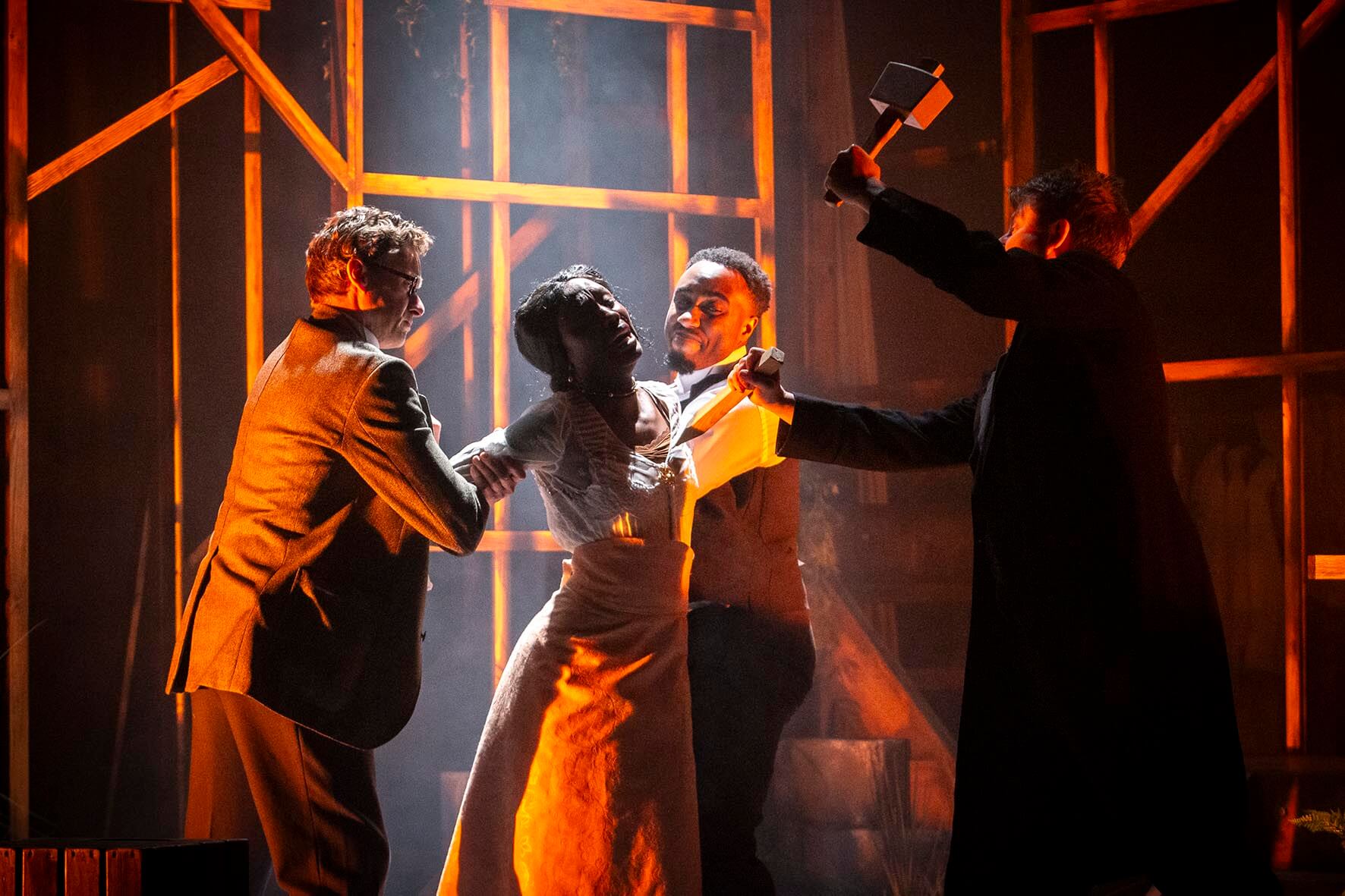
Like their excellent production of Jekyll and Hyde from a few years ago, Blackeyed presents Dracula with a simple fixed set and a limited cast playing multiple roles. However, while Jekyll and Hyde is more of a chamber piece with limited locations, Dracula is a sprawling story, bouncing between Transylvania and various English locales, before becoming a literal chase across Europe. It’s here that the simplicity of the staging starts to come at odds with Nick Lane’s ambitious adaptation. While Lane’s writing and direction always impressively makes clear where the action is and (in the case of the cast playing multiple parts) who is who, the production is bogged down by too much expository narration and dialogue. Furthermore, while Victoria Spearing’s set (all stone steps and timber frames) and Oliver Welsh’s lighting design are both good, they are not enough to conjure the atmosphere that is so vital to the piece. The staging of the fateful journey of the ship The Demeter gives a taste of the creepiness that the audience expects, but otherwise too much action is either described, mimed or intimated.
What doesn’t help is the self-seriousness of the production. There are a couple of humorous one liners, but otherwise Lane seems to be fixated with avoiding the usual clichés that come with the character but in doing so, has produced something that offers no thrills, chills, or scares. A few rubber bats, a set of fangs, or even a single drop of blood would be most welcome in creating some gothic ambience. As it is, the production is a little anaemic. It should be said though that Tristan Parkes’ sound design does effectively contribute: the stereo speakers making it sound like bats are flapping overhead or rats are skittering around the stage.
The cast are all good in their roles, and the title character is played in turn by Chafer, Keightley, and Rundle which quite nicely illustrates how Dracula becomes more youthful as he feasts on his victims. Lane is clearly a talented writer and director, but this adaptation is too packed with incident and locations, as well as newly inserted references to things like the atrocities done in the name of the British Empire, women’s rights at the time, and the vague notion of a type of reincarnation through memories within the blood, to allow anything to truly make an impact.
Dracula remains a box-office draw, but this production doesn’t do him justice. Ironically, it simply lacks bite.
Runs until 12th April 2025

1 Comment
Compared to other performances ive seen, this Dracula way far too simplified. Very simple and not very versatile set design. Over narrated. Underwhelming costumes, major shortage of atmosphere and required eeriness within effects and sound. And the distinct lack of the Dracula we all know and love, no elaborate makeup, no fangs, no dramatisation, not even the merest hint of blood or representation of it. Overall a lot missing. I don’t want to see a play where I have to use this much imagination, I want the stunning visuals, of which there were none. Very disappointed.