

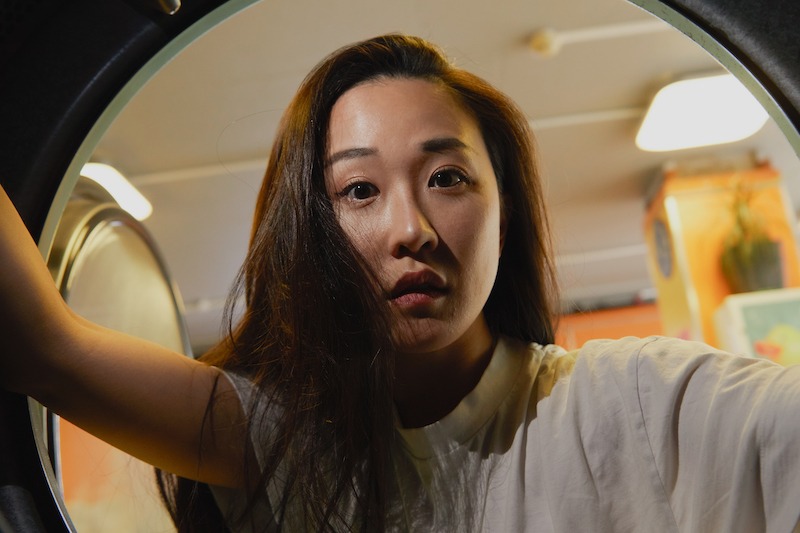
Writer: Diana Feng
Director: Francesca Hsieh
Anna May Wong was the first true Hollywood star of East Asian origin. But despite her skill and beauty, she was often relegated to stereotypical roles in a studio system all too eager to equate the “exotic” character of non-white people to the role of villain. She also suffered from America’s anti-miscegenation laws, which meant that if given the leading lady role she was more than capable of handling, she would have been prevented from kissing her leading (white) male co-star.
In Diana Feng’s Don’t Call Me China Doll, Feng plays CD, a modern-day actress whose self-tape audition to play Wong causes her to consider the similarities between two actors a century apart, but still facing similar racist attitudes.
Feng portrays a character who came to America as a young girl, and who attempted to assimilate by suppressing her own culture, spurning anyone who spoke Cantonese or Mandarin, and not backing up her high school best friend when his accent is mocked by two stereotypical classmates (girls whose self-absorption and meanness are depicted better in Mean Girls or Heathers).
As CD, Feng is both hesitant and rushing, tripping over her words and repeating lines as if struggling to keep on track with her own script. This may be an affectation, though, for when playing other characters, especially her languidly world-weary boss at the laundry where she works part-time, her delivery is precise and knowing.
As CD dreams of Wong and starts to relive some elements of the older actor’s life – from playing Fu Manchu’s daughter in Daughter of the Dragon to providing the inspiration for English lyricist Eric Maschwitz’s These Foolish Things – Feng plays with the concept of what it is like to be an East Asian person living in a society which is always keen to see them as “other”.
Wong’s roles often played into, and perpetuated, such stereotypes. While the play steers us towards wondering whether her success in the roles she was permitted to play helped to reinforce stereotypes rather than break down walls, it is the way in which CD comes to acceptance in her own skin that is the most intriguing part of the piece.
Even then, there are some choices in the play’s construction that get in the way. Feng brings two audience members on stage to help with a self-tape in a move that, stylistically, feels out of place with the rest of the piece. It feels more of an addition for the sake of it, a lack of self-confidence in the play that, while consistent with CD’s own insecurities, does not quite work.
Frequently throughout, we are reminded of the philosopher Zhuangzi, who dreamed that he was a butterfly and, upon waking, did not know if he was a butterfly now dreaming of a man. Don’t Call Me China Doll never quite lives up to the poetry of that Daoist philosophical thought as it attempts to overlap its two timelines. Those times when it succeeds may be fewer than Feng or her director, Francesca Hsieh, may have hoped. As a way into discovering Anna May Wong, and the complexities of a woman whose onscreen roles only tell a small part of a much larger story, it offers occasional glimpses of what could be.
Reviewed on 22 July 2024 and plays at the Edinburgh Fringe 2024
