

Writer: Ivan Menchell, based on the original manga series by Tsugumi Ohba and Takeshi Obata
Composer: Frank Wildhorn
Lyricist: Jack Murphy
Director: Stephen Whitson
There is a phrase doing heavy lifting throughout the marketing for Death Note as it makes its international debut: “reimagined for the London stage.” That word, “reimagined,” is working rather hard.
For the uninitiated, Death Note is one of the most popular manga series in the world. It has sold over 30 million copies, spawned a 37-episode anime, and been adapted for both Japanese and Hollywood cinema. The musical first opened in Japan in 2015 and has played consistently there and across Asia ever since. An English-language concert staging premiered in London in 2023, and now the full English-language production arrives here too.
The story follows Light Yagami (Xander Pang), an idealistic high-schooler troubled by a world he sees growing ever more dangerous, propped up by a legal system that fails its victims and indulges its criminals. He comes into possession of a Death Note, a book that kills anyone whose name is written in it. These books belong to the Shinigami, mystical death spirits in the mould of the Grim Reaper, who use them to decide when a given human life ends. Realising the thing actually works, Light begins striking dangerous criminals from the world, egged on with sardonic relish by Ryuk (Telly Leung), the Shinigami whose Death Note he has found.
It does not take long for his handiwork to be noticed. Sensing something is badly wrong, the police assemble a special task force and call on L (Colin Ryan), a preternaturally gifted young detective with a knack for cracking the uncrackable. What follows is a cat-and-mouse pursuit as Light and L each try to outwit the other. The knot is pulled tighter by Misa (Stephanie Zaharis), a pop star besotted with Light after he kills the criminals responsible for her parents’ murder, and by the awkward fact that Light’s own father, Soichiro (Paolo Montalban), is leading the hunt.
It is a fantastical premise, but a compelling one, tracing Light’s descent from idealistic student to megalomaniacal demi-god across a world where the human and the spirit intermingle. It is easy to see how the manga and its screen adaptations captured the hearts of millions, and just as easy to see the high bar any new version has to clear.
Here Light’s story becomes a two-and-a-half-hour musical, and getting it there has meant some radical surgery. Characters and plotlines have been removed outright; others are heavily compressed. The focus now falls squarely on the tussle between Light, coercively aided by Misa, and L.
It is a defensible choice, but there is still something like 16 hours of story to squeeze down, and while Ivan Menchell’s book gives us a serviceable arc, it feels a touch too truncated. Much of the build towards Light’s god-delusion has gone, as has the tension of a father unknowingly pursuing his son. For a fan, the pared-back story feels frustratingly cool where it should be devastating; for a newcomer, it may feel a little disjointed.
Happily, that is where the complaints end. Narrative niggles aside, what the Barbican serves up is a production of real visual and musical exuberance. Frank Wildhorn’s score is anchored firmly in rock-inflected pop, its tunes immediately engaging and, in several cases, genuinely memorable. Sitting atop them are Jack Murphy’s lyrics, which do more than colour a scene; they quietly patch the gaps the book leaves behind and keep the story moving forward.
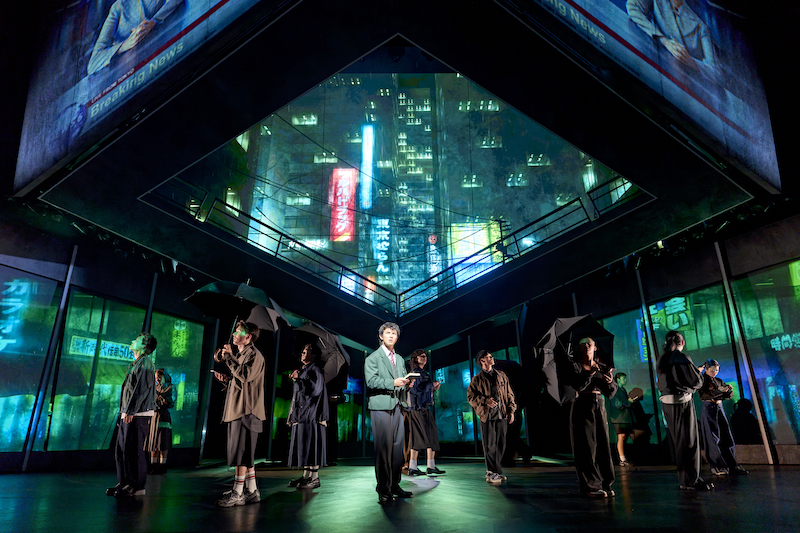
The evening’s crowning glory is the design. John Balzor’s set and Jen Shriver’s lighting conspire to make the Barbican feel as though it has been dropped into an anime rendering of a Tokyo street, the sightlines stretching away until the skyline seems never to end. It is a remarkable trick, conjuring both intimacy and urban sprawl in a single space, and the lighting is exceptional throughout, summoning tension, mystery and adrenaline by turns.
The cast is uniformly excellent. Pang gives us a Light of easy, sunlit charm, which makes the darkening all the more unsettling. Ryan is a joy as the introverted, caffeine-fuelled, socially graceless L, and Leung all but steals the show as a gloriously gothic, camp Ryuk, wringing the biggest laughs of the night.
Stephen Whitson’s direction is bold and frenetic, beautifully served by Fabienne Aloise’s choreography, the two sliding between dance and straight playing so smoothly that the join disappears. Together they give us a modern metropolis with a shimmer of the fantastical, and tie the whole thing up in a genuine visual triumph.
And so the frustration of it lingers. This is a dazzling piece of stagecraft, punchy in its score, a wonder in its design, a delight in its cast, and yet it is built on a saga simply too vast to survive the squeeze. The ruthless compression leaves the emotional heart of Light’s descent oddly muted, holding you at arm’s length at the very moment it ought to be pulling you in, and what is missing is the ache that should sit beneath all that spectacle. There is a great deal here to admire, and only that one thing to mourn. Reimagined, certainly. Reborn, not quite.
Runs until 12 September 2026
