

Writer: Fyodor Dostoevsky
Adaptor/Director: Laurie Sansom
This production of Crime and Punishment is configured to the size of a Studio Theatre. First staged at the Cast’s Second Space, it moves on a short tour of similarly sized venues. The number of actors is reduced to three: despite references to Northern Broadsides’ typical style. It is far distant from Barrie Rutter’s sweeping Shakespeare productions or Laurie Sansom’s debut production of Quality Street which added extra characters.
The original novel runs to 500-plus pages – some task to cut down to a bare two hours of stage time. The central character, Raskolnikov, a student living in extreme poverty, decides to kill an old money-lender and help himself to her money. He does the deed, but instead of enjoying the loot is wracked by guilt and becomes embroiled in family problems, both his and Marmeladov’s, a drunk whom he befriends. To simplify, his sister Dunya is planning marriage to a middle-aged man Luzhin who is taking advantage of her unfortunate experiences as a governess, while Marmeladov is killed by a carriage when drunk, leaving his widow penniless and his daughter Sonya with whom Raskolnikov falls in love working as a prostitute.
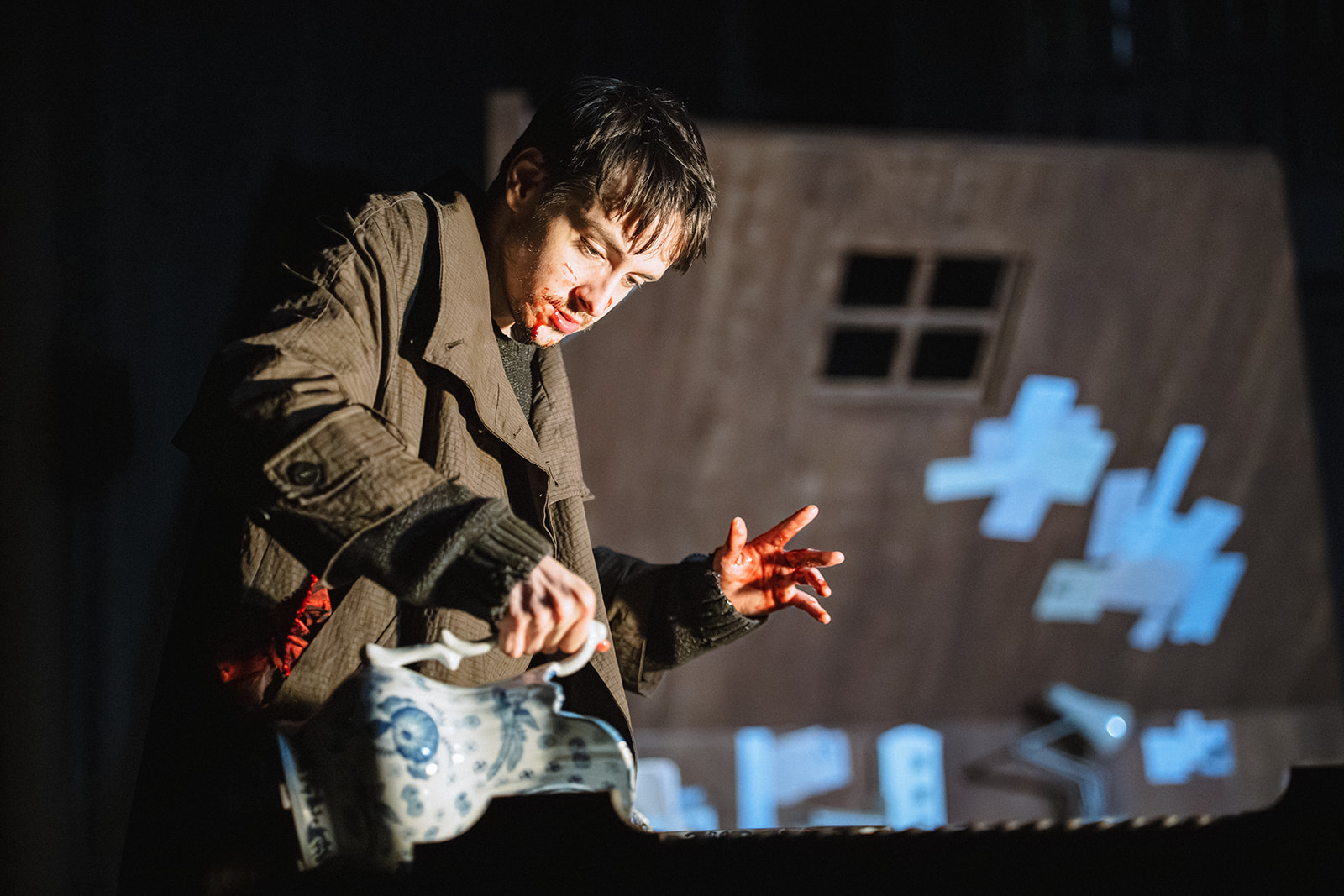
Sansom concentrates at the outset on Raskolnikov’s mental state. Much of the first half operates on an unhinged level where it’s not always possible to determine what events are real and what the products of Raskolnikov’s imagination. His room, a lopsided shape with a skylight, models of houses and walls papered with writings (set designed by Rose Revitt) is cloaked in darkness as often as not, with lamps being moved or turned on and off by members of the cast – very effective, though the movement of furniture is a bit much.
Chris Davey’s lighting throws up eerie shadows and the windows of the houses periodically fill with light, then to complete a formidable stage design team team Philip Pinsky’s music and sound never let the audience rest – a constant thrum of menace with dramatic bursts of sound from time to time.
The problem lies with the text. Events outside Raskolnikov’s imagination play out, we become involved in Dunya’s and Sonya’s problems without fully understanding them and, as actors change character at the drop of a hat, we gradually lose track of who is who – Lara Booth’s costumes do their best to differentiate, but there are too many and the changes too rapid.
Niall Costigan manages to differentiate at least six different characters reasonably well: he has a nice drunk scene as Marmeladov early on, but his Porfiry, the investigator, never convinces. The real victim of this confusing multiplication of characters is Trudy Akobeng, with a series of female and male/young and old folk and little distinction of voice or accent, though she summons up reserves of passion for Dunya and, especially, Sonya.
Connor Curren is outstanding as Raskolnikov. Some of the scenes do not grip, but he always projects a haunted character, torn between concealment and confession, with radical views coupled with misogyny, and a fine fury that arises when his sense of self is threatened.
Laurie Sansom describes the production as “a work in progress”. One cannot but agree: the scenes of Raskolnikov tormented are very good, some others decidedly less so.
Reviewed on 7th March 2026. On tour in the North of England and Scotland.
The Reviews Hub Star Rating
-
6
